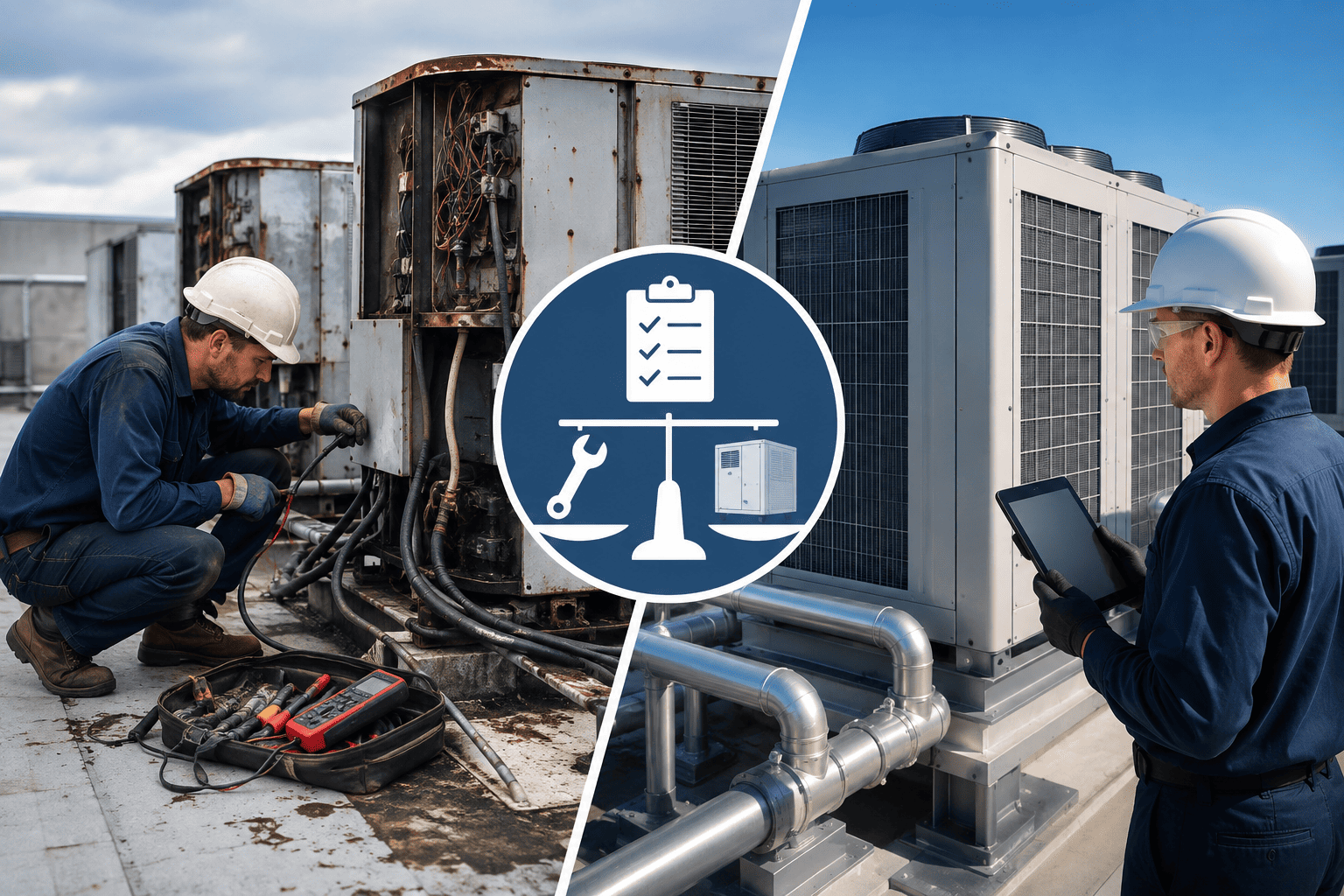
Commercial HVAC and refrigeration equipment represents a significant investment for any Houston business. When a rooftop unit, chiller, walk-in cooler, freezer, air handler, or industrial refrigeration system begins experiencing recurring problems, facility managers face an important question: Is another repair financially justified, or is it time to replace the equipment?
Choosing between repair and replacement is not simply a matter of equipment age. Operating costs, repair frequency, energy efficiency, system reliability, refrigerant considerations, facility requirements, and the consequences of unexpected downtime should all be evaluated.
ACF Mechanical provides Commercial HVAC & Industrial Refrigeration Services in Houston TX, helping businesses assess equipment condition and determine the most practical solution for their facilities. A professional evaluation can identify whether targeted repairs can restore reliable operation or whether replacement would provide better long-term value.
For Houston businesses operating in demanding Texas heat and humidity, making this decision before a major system failure can also reduce operational risk and unexpected expenses.
Why the Repair-or-Replace Decision Matters for Houston Businesses
Commercial cooling equipment often supports much more than indoor comfort.
HVAC systems maintain working conditions for employees and customers, control indoor temperatures, support ventilation, and can help protect temperature-sensitive equipment. Refrigeration systems may directly protect thousands of dollars in inventory.
A failure can affect:
- Employee and customer comfort
- Food and product safety
- Production schedules
- Inventory
- Building operations
- Energy consumption
- Equipment performance
- Business continuity
A restaurant with an unreliable walk-in cooler has different risks than an office building with an aging rooftop HVAC unit. Likewise, a warehouse refrigeration system supporting temperature-sensitive inventory requires a different replacement strategy than a small commercial AC system.
The right decision therefore requires evaluating the equipment within the context of the business it serves.
How Long Does Commercial HVAC Equipment Typically Last?
There is no universal commercial HVAC system lifespan.
Actual service life depends on equipment design, operating hours, maintenance history, installation quality, environmental conditions, system loading, and how quickly developing problems are addressed.
Commercial systems in Houston can experience particularly demanding operating conditions because cooling equipment may run for extended periods during hot weather.
Equipment commonly evaluated includes:
- Rooftop packaged units
- Commercial split systems
- Chillers
- Air handlers
- Condensing units
- Commercial AC systems
- Ventilation equipment
- Controls and associated components
Age should therefore be treated as one factor rather than an automatic reason for replacement.
An older unit that has been consistently maintained and remains efficient may still have useful service life. A newer system with repeated compressor failures, airflow problems, poor installation, or chronic control issues may require more extensive corrective action.
How Long Do Industrial Refrigeration Systems Last?
Determining an industrial refrigeration system lifespan can be even more complex.
Commercial and industrial refrigeration systems contain multiple components that may age at different rates, including:
- Compressors
- Condensers
- Evaporators
- Fans
- Valves
- Controls
- Electrical components
- Refrigerant piping
A refrigeration system may therefore require component-level upgrades long before complete system replacement becomes necessary.
Restaurants, food-service facilities, cold storage operations, warehouses, and other Texas businesses should evaluate both individual components and overall system performance.
For example, a compressor failure does not automatically mean that an entire refrigeration system needs replacement. However, repeated compressor problems combined with deteriorating efficiency and other aging components may indicate that continued repairs are becoming less economical.
7 Signs Commercial HVAC Equipment May Need Replacement
Repair is often the most cost-effective response to an isolated problem. However, several warning signs can indicate that an aging commercial HVAC system in Houston deserves a broader evaluation.
1. Repair Frequency Keeps Increasing
An occasional repair is normal during the service life of commercial HVAC equipment.
Repeated failures are different.
If a business is repeatedly paying for:
- Electrical repairs
- Fan motor replacement
- Compressor-related work
- Control failures
- Refrigerant-related service
- Airflow corrections
- Emergency service calls
the cumulative cost should be compared with the cost and benefits of replacement.
Repair history provides valuable information. Looking at the total amount spent over the previous several years can reveal whether an older unit is becoming a continuing financial liability.
2. Energy Consumption Has Increased
Declining HVAC efficiency can gradually increase operating expenses without causing an obvious equipment failure.
Possible contributors include:
- Dirty or damaged coils
- Deteriorating compressors
- Restricted airflow
- Fan problems
- Control issues
- Incorrect refrigerant conditions
- Aging components
- Poor system performance under load
Maintenance or repair may correct many of these problems.
However, when an older system remains inefficient despite proper service, an energy efficient commercial HVAC system in Houston, TX may provide better long-term value.
For commercial buildings in Houston, where cooling demand can remain high for extended periods, efficiency differences can have a meaningful effect on operating costs.
3. The System Cannot Maintain Required Temperatures
A commercial HVAC system that runs continuously but struggles to maintain temperature requires professional diagnosis.
The problem might involve repairable issues such as airflow restrictions, sensors, controls, coils, fans, or refrigerant conditions.
But declining capacity can also indicate more extensive equipment deterioration.
Businesses should avoid assuming that replacement is necessary until the underlying cause has been properly diagnosed.
4. Major Components Are Failing
Some repairs have much greater financial implications than others.
A commercial HVAC compressor replacement Houston businesses are considering, for example, should be evaluated against:
- Equipment age
- Overall unit condition
- Repair history
- Other components likely to require replacement
- Current operating efficiency
- Expected remaining service life
Replacing an expensive component in an otherwise reliable system can make sense.
Installing a major new component in severely deteriorated equipment may simply postpone replacement while adding another significant expense.
5. Downtime Is Affecting Business Operations
Repair cost alone does not represent the full cost of unreliable HVAC equipment.
Businesses should also consider operational losses caused by failures.
A system that repeatedly stops operating during peak Houston temperatures can disrupt employees, customers, tenants, production environments, or facility operations.
When downtime becomes frequent, reliability itself becomes an important financial factor in the replacement decision.
6. Comfort Problems Continue After Repairs
Persistent hot spots, humidity issues, airflow problems, or inconsistent temperatures can indicate that the problem extends beyond a single failed component.
The cause may include:
- Improper system sizing
- Ductwork problems
- Air distribution issues
- Inadequate controls
- Equipment deterioration
- Changing building loads
Before recommending a rooftop HVAC unit replacement Houston businesses should have the entire system evaluated rather than simply replacing individual parts without addressing the underlying problem.
7. The Equipment No Longer Meets Facility Needs
Commercial buildings change over time.
A facility may add employees, equipment, production areas, refrigerated storage, new tenant spaces, or different operating schedules.
Equipment originally designed for previous conditions may no longer match the building’s requirements.
In these situations, a commercial HVAC upgrade in Houston, TX may solve performance problems that repeated repairs cannot.
Signs Industrial Refrigeration Equipment May Need Replacement
The repair-versus-replacement decision is especially important for refrigeration because equipment failure can directly threaten inventory.
Temperature Problems Are Becoming Frequent
Walk-in coolers, freezers, and larger refrigeration systems should maintain temperatures appropriate for their application.
Recurring temperature problems may be related to:
- Compressor performance
- Evaporator problems
- Condenser problems
- Controls or sensors
- Defrost issues
- Refrigerant conditions
- Airflow
- Door or enclosure problems
A single issue may be repairable. Multiple recurring problems across an aging system require a more comprehensive assessment.
Compressor Problems Keep Returning
Compressors are critical and expensive components.
Before proceeding with refrigeration compressor replacement in Houston, TX, technicians should evaluate why the compressor failed.
Simply replacing the compressor without correcting the underlying cause can result in another failure.
The complete refrigeration circuit, electrical conditions, controls, heat rejection, refrigerant conditions, and operating environment may need inspection.
Refrigeration Energy Costs Continue to Rise
Industrial refrigeration equipment can represent a substantial portion of a facility’s energy consumption.
Declining industrial refrigeration efficiency in Houston, TX can result from aging components, poor heat transfer, controls, improper operation, maintenance deficiencies, or system design limitations.
When maintenance and targeted repairs can restore efficiency, replacement may not be necessary.
When deterioration is widespread, an industrial refrigeration system upgrade may provide a more sustainable solution.
Product Risk Is Becoming Too High
Reliability has greater value when equipment protects perishable or temperature-sensitive inventory.
For restaurants, food operations, warehouses, and cold-storage facilities, the financial impact of refrigeration downtime may exceed the immediate repair cost.
Management should consider:
- Value of refrigerated inventory
- Acceptable downtime
- Availability of backup refrigeration
- Repair frequency
- Emergency repair history
- Operational consequences of temperature excursions
A system that technically remains repairable may still represent unacceptable operational risk.
Walk-In Cooler: Repair or Replace?
A walk-in cooler problem does not automatically require complete replacement.
Professional walk-in cooler repair in Houston, TX may address problems involving controls, fans, coils, electrical components, refrigeration equipment, or other serviceable parts.
Replacement becomes more relevant when problems involve multiple parts of an aging system or when the existing equipment consistently fails to meet operational requirements.
The enclosure itself should also be evaluated separately from the refrigeration equipment. Door seals, insulation, panels, and other structural factors can affect performance and energy consumption.
For this reason, a walk-in cooler replacement decision should consider the entire installation rather than one failed component.
Walk-In Freezer: Repair or Replace?
Walk-in freezers operate under demanding conditions and require dependable low-temperature performance.
Repair may be appropriate when the issue is isolated and the remaining equipment is in good condition.
A walk-in freezer replacement becomes more reasonable when:
- Major failures are recurring
- Multiple components are deteriorating
- Temperature stability is unreliable
- Energy costs remain excessive
- Equipment is poorly matched to current demand
- Business operations are repeatedly disrupted
Professional walk-in freezer repair in Houston, TX should begin with diagnosis rather than assumptions about replacement.
Rooftop HVAC Units: When Does Replacement Make Sense?
Rooftop units are common in commercial buildings in Houston and can operate for long periods during Texas cooling seasons.
A rooftop unit should be evaluated for replacement when several factors occur together: advanced age, recurring failures, deteriorating efficiency, major component problems, and difficulty maintaining required indoor conditions.
For relatively healthy equipment, repairs and preventive maintenance may extend useful service life.
When replacement becomes appropriate, businesses can also evaluate updated equipment efficiency, capacity, controls, and building requirements rather than simply installing a direct equivalent of the old system.
What About Commercial Chillers and Air Handlers?
Large commercial systems require an even more detailed approach.
A commercial chiller replacement in Houston, TX can represent a substantial capital investment. Decisions should therefore consider system performance, compressor condition, heat exchanger condition, controls, operating costs, maintenance history, and facility demand.
Air handler replacement should likewise be based on actual equipment condition.
Airflow problems may originate from filters, coils, fans, belts, motors, controls, ductwork, dampers, or other components. Replacing an entire air handler without diagnosing the airflow system can leave the original problem unresolved.
Repair vs. Replacement: Key Factors to Compare
| Factor | Repair May Make Sense When | Replacement May Make Sense When |
|---|---|---|
| Equipment condition | Overall system is healthy | Multiple components are deteriorating |
| Repair history | Failure is isolated | Failures occur repeatedly |
| Energy efficiency | Performance can be restored | Efficiency remains poor after service |
| Major components | Remaining equipment is sound | Several major components are aging |
| Downtime | Failures are uncommon | Downtime regularly disrupts operations |
| Capacity | System meets current demand | Building requirements have changed |
| Temperature control | Problem has a repairable cause | Performance remains unreliable |
| Long-term cost | Repair extends useful life economically | Continuing repairs provide poor value |
No single factor should determine the decision. A professional evaluation should consider the overall condition of the system, operating requirements, and long-term cost.
Calculate More Than the Immediate Repair Cost
One of the biggest mistakes businesses can make is comparing only today’s repair estimate with today’s replacement price.
The real comparison is between the total expected costs and risks of both options.
For continued repair, consider:
- Current repair cost
- Likely future repairs
- Emergency service expenses
- Energy consumption
- Maintenance requirements
- Potential downtime
- Lost productivity
- Product or inventory risk
For replacement, consider:
- Equipment and installation cost
- Expected efficiency
- Maintenance requirements
- Reliability
- Expected service life
- Potential reduction in emergency repairs
- Ability to meet current facility needs
This provides a much more useful financial picture for facility managers and business owners.
Houston Climate Makes Equipment Condition More Important
Houston’s climate creates demanding operating conditions for commercial cooling systems.
High outdoor temperatures can increase cooling loads and cause equipment to operate for extended periods. Humidity adds another challenge because HVAC systems must manage both temperature and moisture.
Outdoor equipment must also operate while exposed to environmental conditions that can affect coils, electrical components, cabinets, and other parts.
Industrial refrigeration equipment faces similar heat-rejection challenges. When outdoor conditions are severe, condensers and associated components must still reject heat effectively.
This does not mean Houston equipment automatically needs earlier replacement. It means inspection and preventive maintenance become especially important for identifying deterioration before it produces a major failure.
Why Preventive Maintenance Changes the Repair-or-Replace Equation
Commercial HVAC maintenance in Houston can extend equipment life and provide businesses with better information for capital planning.
Regular service allows technicians to monitor changes rather than discovering problems only after failure.
Preventive maintenance can help identify:
- Deteriorating electrical components
- Coil condition
- Airflow problems
- Abnormal operating conditions
- Fan and motor issues
- Control problems
- Refrigeration system concerns
- Developing compressor problems
Industrial refrigeration maintenance provides similar benefits.
More importantly, maintenance records create a performance history. Facility managers can use that information to determine whether repairs are becoming more frequent and plan equipment replacement before an emergency occurs.
Why Waiting for Complete Failure Can Cost More
Running equipment until it completely fails may appear to maximize its service life, but it can create additional business risk.
Emergency failure can result in:
- Unplanned downtime
- Expedited repair costs
- Lost inventory
- Interrupted business operations
- Employee or customer discomfort
- Limited time to evaluate replacement options
- Emergency equipment decisions
Planned replacement gives businesses more control.
It allows facility managers to evaluate equipment requirements, schedule installation, coordinate operational downtime, and budget for capital expenses.
This is especially valuable for restaurants, warehouses, commercial properties, and industrial facilities where cooling or refrigeration is essential to daily operations.
When Repair Is Usually the Better Option
Repair can remain the best choice when:
- The equipment is otherwise in good condition
- The failure is isolated
- Repair frequency is low
- The system still meets facility requirements
- Energy performance remains reasonable
- Parts and service are practical
- The repair is expected to provide meaningful additional service life
The objective should not be to replace equipment simply because it is older.
A well-maintained system can remain valuable if it continues to operate reliably and economically.
When Replacement Deserves Serious Consideration
Commercial HVAC equipment replacement in Houston deserves consideration when several warning signs occur together:
- Major repairs are becoming frequent
- Reliability is declining
- Energy costs are increasing
- Multiple major components are aging
- Equipment cannot maintain required conditions
- The system no longer matches facility demand
- Downtime creates significant business losses
- Repair spending is becoming difficult to justify
The same principle applies to commercial refrigeration equipment replacement in Houston.
The decision should be based on long-term business value rather than equipment age alone.
A Practical Checklist for Houston Facility Managers
Before approving another major repair, ask:
- How old is the equipment?
- How often has it required repair during the last two years?
- How much has the business spent on repairs?
- Are failures becoming more frequent?
- Has energy consumption increased?
- Can the system reliably maintain required temperatures?
- Does it still meet current building or refrigeration loads?
- Are major components approaching the end of useful life?
- What would an unexpected failure cost the business?
- Can replacement be scheduled before peak operating periods?
- Would newer equipment provide meaningful efficiency or reliability improvements?
If several answers indicate increasing cost or operational risk, it may be time for a professional repair-versus-replacement assessment.
Why Houston Businesses Choose ACF Mechanical
Making the right equipment decision requires more than replacing the component that failed.
ACF Mechanical works with commercial HVAC and refrigeration equipment used by businesses throughout the Houston area. Our approach focuses on diagnosing the actual cause of performance problems and helping customers understand practical options for their facilities.
Houston businesses choose ACF Mechanical for:
- Experienced technicians
- Commercial HVAC expertise
- Industrial and commercial refrigeration knowledge
- Preventive maintenance support
- Professional troubleshooting
- Fast response when equipment problems occur
- Reliable service focused on business operations
Whether a facility needs commercial HVAC repair in Houston, industrial refrigeration repair, preventive maintenance, or evaluation of aging equipment, the goal is to identify a solution that supports reliable operation and long-term value.
Plan Repairs and Replacements Before They Become Emergencies
The best time to decide whether to repair or replace commercial HVAC or refrigeration equipment is usually before a complete failure forces the decision.
An isolated failure in otherwise healthy equipment may justify repair. Repeated failures, increasing operating costs, deteriorating efficiency, major component problems, and growing downtime can make replacement a better long-term investment.
For Houston businesses, these decisions are particularly important because HVAC and refrigeration equipment must perform reliably under demanding Texas conditions.
ACF Mechanical provides Commercial HVAC & Industrial Refrigeration Services in Houston TX for commercial facilities that need professional diagnostics, repairs, maintenance, and equipment evaluations.
If your rooftop unit, chiller, air handler, walk-in cooler, freezer, commercial AC system, or industrial refrigeration equipment is becoming unreliable, contact ACF Mechanical to schedule an evaluation and discuss the best option for your facility.