
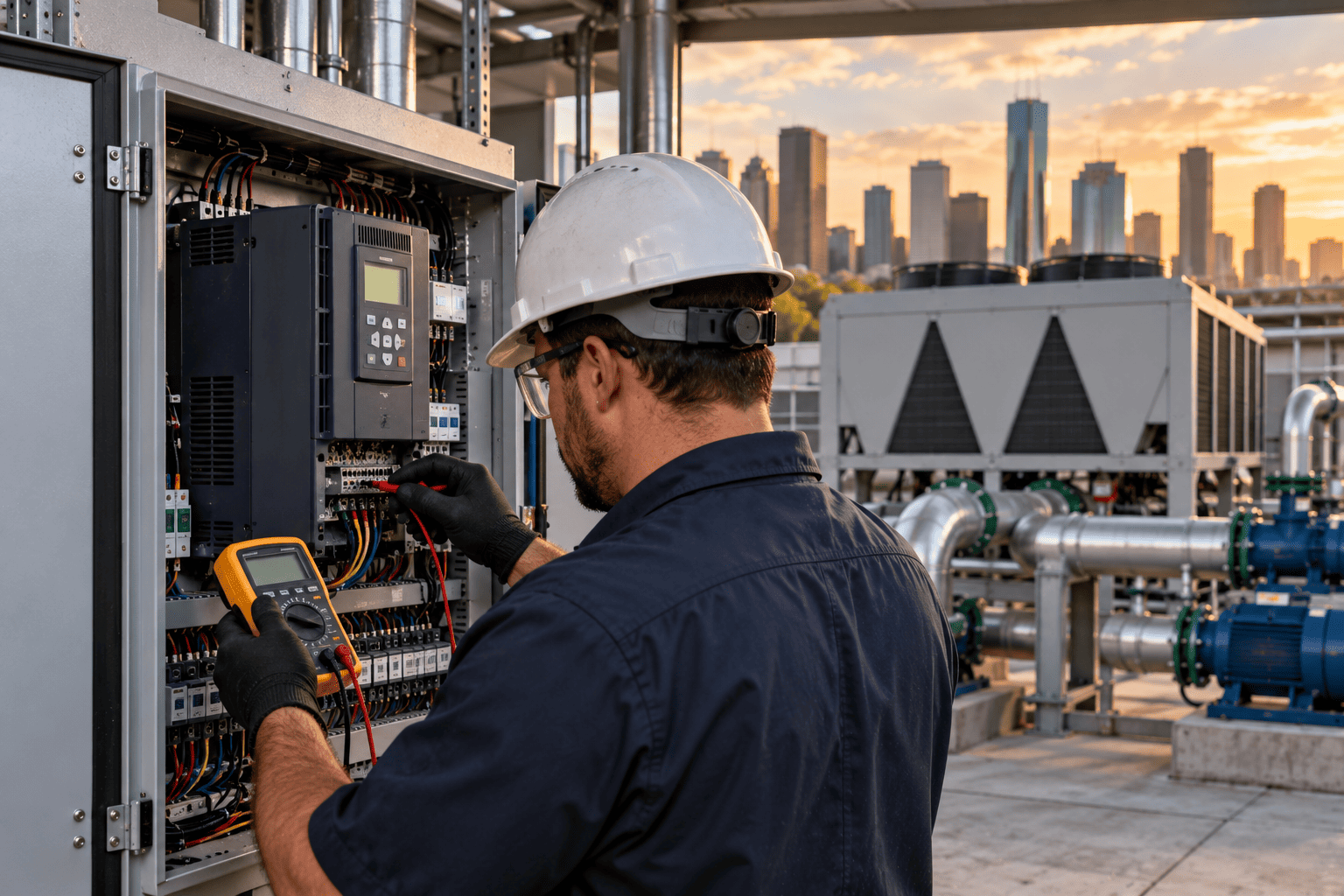
Variable frequency drives play an important role in many modern commercial HVAC and industrial refrigeration systems, controlling the speed of compatible fans, pumps, compressors, and other motors to match changing system demand. When a drive develops an electrical, control, communication, cooling, or programming problem, the result may be poor airflow, unstable pressure, incorrect motor speed, equipment trips, loss of cooling, or complete shutdown. Businesses that depend on Commercial HVAC & Industrial Refrigeration Services in Houston TX need accurate VFD diagnostics because a drive fault does not always mean the VFD itself has failed. ACF Mechanical helps Houston businesses identify VFD-related problems and determine whether the cause is the drive, motor, controls, sensors, wiring, or another part of the HVAC or refrigeration system.
What Is a Variable Frequency Drive in Commercial HVAC and Refrigeration?
A variable frequency drive, commonly called a VFD, is an electronic device used to control the speed and torque of a compatible AC motor by adjusting the electrical frequency and voltage supplied to it.
Instead of forcing a motor to operate continuously at full speed, a properly designed VFD application can allow equipment output to change as system demand changes.
Depending on system design, VFDs may control:
- Air-handler supply fans
- Return and exhaust fans
- Commercial HVAC blowers
- Chilled-water pumps
- Condenser-water pumps
- Cooling-tower fans
- Condenser fans
- Evaporator fans
- Refrigeration pumps
- Selected compressors
- Other compatible motors
Not every commercial HVAC or refrigeration motor uses a VFD. Equipment design, motor type, control strategy, and manufacturer specifications determine where variable-speed operation is appropriate.
Why VFD Problems Matter to Houston Businesses
A failed motor is usually obvious because the equipment stops operating. VFD problems can be more complicated.
A drive may continue operating while delivering the wrong motor speed, receiving an incorrect command, repeatedly resetting, overheating, or generating intermittent faults.
These conditions can affect commercial buildings in Houston in several ways. An air-handler VFD problem may reduce supply airflow. A pump drive problem may interfere with chilled-water circulation. A refrigeration condenser fan VFD issue may affect heat rejection.
The result may include:
- Poor cooling
- Unstable temperatures
- Reduced airflow
- Pressure-control problems
- Excessive equipment cycling
- Higher operating costs
- Unexpected shutdowns
- Lost refrigeration capacity
- Business disruption
Professional commercial HVAC VFD diagnostics Houston TX should therefore consider the complete equipment sequence rather than treating every displayed VFD alarm as proof of drive failure.
Common Signs of Commercial HVAC VFD Problems
Variable frequency drive problems can produce different symptoms depending on the equipment and control strategy.
Facility managers may notice:
- Motor will not start
- Fan or pump runs too slowly
- Motor operates at an unexpected speed
- Speed changes unexpectedly
- VFD repeatedly trips
- Drive displays fault codes
- Motor starts and then stops
- VFD enclosure becomes unusually hot
- Equipment loses communication with the building automation system
- Airflow becomes unstable
- System pressure becomes unstable
- Cooling capacity declines
- Equipment shuts down intermittently
An HVAC VFD not working Houston commercial facility encounters should be diagnosed before the drive is automatically replaced.
Why Commercial HVAC VFDs Fail
VFDs contain electronic components that operate under electrical and thermal stress.
Potential causes of VFD trouble include:
- Excessive heat
- Poor enclosure ventilation
- Failed internal cooling fans
- Dust and contamination
- Loose electrical connections
- Voltage disturbances
- Electrical component deterioration
- Motor problems
- Incorrect drive parameters
- Incorrect control signals
- Sensor problems
- Communication faults
- Excessive load
- Improper installation or application
- Moisture exposure
The presence of a VFD fault code is only the beginning of the diagnostic process. The underlying condition that caused the fault must also be identified.
HVAC VFD Overheating in Houston
Heat is especially relevant for commercial HVAC equipment operating in Houston, TX.
VFDs generate heat during normal operation and depend on proper ventilation, cooling, and suitable ambient conditions.
Houston’s hot climate can make thermal management more important for drives installed in:
- Rooftop equipment
- Mechanical rooms
- Industrial facilities
- Warehouses
- Equipment enclosures
- Areas with inadequate ventilation
Possible causes of HVAC VFD overheating Houston TX include:
- Failed VFD cooling fan
- Blocked ventilation openings
- Dirty heat sinks
- Excessive enclosure temperature
- Heavy contamination
- Improper loading
- Electrical problems
- Inadequate clearance around the drive
Repeated overheating should not simply be reset and ignored. Technicians should determine why the drive is exceeding acceptable operating conditions.
VFD Cooling Fan and Heat Sink Problems
Many drives use internal fans and heat sinks to remove heat generated by electronic components.
If a cooling fan fails or becomes obstructed, internal temperatures can rise. Likewise, accumulated dust can reduce heat-transfer performance at the heat sink.
A VFD cooling fan failure Houston TX may initially appear to be a minor component problem, but repeated thermal stress can affect the reliability of the complete drive.
Inspection may include checking:
- Cooling fan operation
- Heat sink cleanliness
- Ventilation paths
- Enclosure temperature
- Drive loading
- Fault history
The appropriate service procedure depends on the drive manufacturer and model.
Understanding HVAC VFD Fault Codes
A VFD fault code indicates that the drive has detected an operating condition outside expected parameters.
Common categories can include:
- Overcurrent
- Overvoltage
- Undervoltage
- Overtemperature
- Ground fault
- Motor overload
- Communication loss
- External control faults
However, fault terminology and codes vary by manufacturer.
An HVAC VFD fault code Houston technician encounters should therefore be interpreted using the correct technical documentation for that drive.
A fault code identifies what the drive detected. It does not always identify the root cause.
For example, an overcurrent fault could involve the motor, wiring, mechanical load, acceleration settings, or the drive itself.
VFD Overcurrent Faults
An HVAC VFD overcurrent fault Houston TX can occur when current exceeds the drive’s allowable limits.
Potential causes may include:
- Motor problems
- Short circuits
- Wiring problems
- Excessive mechanical load
- Incorrect acceleration settings
- Incorrect motor parameters
- Drive output problems
Repeatedly resetting an overcurrent fault without investigating the cause can allow the underlying problem to continue.
The motor and driven equipment should be evaluated along with the VFD.
VFD Overvoltage and Undervoltage Problems
Electrical supply conditions can also cause VFD faults.
An overvoltage condition may occur under certain supply or regenerative conditions, while an undervoltage fault may indicate insufficient DC bus voltage or incoming power problems.
Possible areas to investigate include:
- Incoming voltage
- Electrical connections
- Power quality
- Drive settings
- Deceleration conditions
- Internal drive components
Professional VFD electrical diagnostics Houston should determine whether the fault originates inside or outside the drive.
VFD Not Starting a Motor
When a VFD receives a start command but the motor does not operate, several possibilities must be considered.
The problem may involve:
- No start command
- Incorrect speed reference
- Active safety interlock
- VFD fault
- Control wiring problem
- Motor failure
- Electrical disconnect
- Incorrect drive parameters
- BAS communication problem
- External equipment safety condition
An HVAC VFD not starting motor Houston TX should therefore be diagnosed as a system-level problem.
Replacing the drive without confirming the command, output, motor condition, and interlocks can result in unnecessary repair costs.
VFD Problem vs. Motor Problem
VFD and motor failures can produce similar symptoms.
| Symptom | Possible VFD Issue | Other Possible Cause |
|---|---|---|
| Motor will not start | Drive fault or missing output | Motor or wiring failure |
| Fan speed incorrect | Parameter or command problem | Mechanical fan issue |
| Repeated trips | Electrical/load problem | Motor failure |
| Drive overheats | Cooling or ventilation issue | High ambient temperature |
| Unstable speed | Control signal problem | Sensor or motor problem |
| Communication alarm | Network/BAS issue | Controller problem |
| High motor current | Incorrect drive operation | Mechanical overload |
| Unexpected shutdown | VFD protection fault | External safety condition |
Proper testing helps prevent unnecessary motor or VFD replacement.
Commercial Air Handler VFD Problems
Commercial air handlers are one of the most common HVAC applications for variable-speed fan control.
A supply-fan VFD may respond to:
- Static pressure
- Airflow demand
- Building occupancy
- Zone requirements
- BAS commands
- Other control inputs
Commercial air handler VFD problems Houston may result in inadequate airflow even when the fan motor itself is functional.
Possible symptoms include:
- Low supply airflow
- Excessive airflow
- Unstable duct pressure
- Poor temperature control
- Humidity problems
- Fan not starting
- Fan operating continuously at one speed
- Repeated drive trips
Professional air handler VFD repair Houston TX should include evaluation of both the drive and the control inputs telling it how fast to operate.
Supply Fan and Blower VFD Problems
A commercial HVAC supply fan must move enough air to meet system demand.
If its VFD receives an incorrect speed reference or cannot maintain the commanded output, airflow throughout the building can change.
This may affect:
- Occupant comfort
- Space temperature
- Indoor humidity
- Air distribution
- Equipment capacity
- Building pressure
A commercial HVAC blower VFD repair Houston TX service call may therefore require checking static-pressure sensors, BAS commands, drive output, motor current, belts or direct-drive components, and fan condition.
Rooftop Unit VFD Problems
Some larger or more advanced rooftop HVAC systems use variable-speed drives for fans or other compatible components.
A rooftop unit VFD problem Houston businesses experience may be particularly disruptive during periods of high Texas heat.
Possible problems include:
- Thermal faults
- Fan speed problems
- Control-signal issues
- Communication failures
- Electrical faults
- Motor problems
Because rooftop equipment can be exposed to high ambient temperatures and environmental contamination, technicians should also evaluate the installation environment when troubleshooting the drive.
Commercial Chiller VFD Problems
Variable frequency drives may be used in different parts of commercial chilled-water systems.
Depending on equipment design, VFD applications may include:
- Chilled-water pumps
- Condenser-water pumps
- Cooling-tower fans
- Selected chiller compressors
A commercial chiller VFD problem Houston TX can affect flow, heat rejection, pressure, or cooling capacity.
It is important to identify which component the drive controls before troubleshooting system performance.
Not all chillers use the same VFD configuration, so service procedures should follow the actual equipment design and manufacturer requirements.
Chilled-Water Pump VFD Problems
Variable-speed pumps are commonly used to adjust water flow according to system demand.
A chilled water pump VFD problem Houston TX may lead to:
- Insufficient flow
- Excessive flow
- Unstable differential pressure
- Cooling problems
- Pump trips
- Motor overheating
- BAS alarms
Technicians may need to inspect the VFD, pump, motor, pressure sensors, control signal, and hydraulic conditions.
Cooling Tower Fan VFD Problems
Cooling towers may use VFD-controlled fans to adjust heat rejection.
A cooling tower fan VFD problem Houston may prevent the fan from responding correctly to changing condenser-water temperatures or system demand.
Potential symptoms include:
- Fan not starting
- Incorrect fan speed
- Repeated drive faults
- Poor condenser-water temperature control
- Unstable operation
During hot Houston weather, reliable cooling-tower operation can be particularly important for water-cooled HVAC systems.
Industrial Refrigeration VFD Problems
Variable-speed control is also used in industrial refrigeration applications.
Depending on system design, VFDs may control:
- Condenser fans
- Evaporator fans
- Pumps
- Selected compressors
- Other compatible motors
Industrial refrigeration VFD problems Houston can affect temperature control, airflow, heat rejection, pressure regulation, and system capacity.
Industrial refrigeration systems often serve critical operations, making intermittent drive faults especially important to investigate.
Refrigeration Condenser Fan VFD Problems
Some refrigeration systems use variable-speed condenser fans to maintain appropriate condensing conditions.
A refrigeration condenser fan VFD problem Houston TX can result in incorrect fan speed or complete loss of fan operation.
This may affect heat rejection and system pressures.
Technicians should evaluate:
- VFD command
- Actual output
- Condenser fan motor
- Pressure or temperature controls
- Sensors
- Condenser condition
- Electrical supply
The drive should not be replaced until the complete control sequence has been verified.
Refrigeration Evaporator Fan VFD Problems
Variable-speed evaporator fans may be used in some cold-storage and industrial refrigeration applications.
A refrigeration evaporator fan VFD problem Houston TX may affect:
- Air circulation
- Product-space temperature
- Evaporator performance
- Temperature uniformity
- System capacity
Low airflow can also resemble problems caused by ice buildup, dirty coils, failed fan motors, or other refrigeration issues.
Professional diagnostics are therefore essential.
Refrigeration Compressor VFD Problems
Some refrigeration compressors are designed for variable-speed operation.
When applicable, a compressor VFD may adjust capacity based on refrigeration demand.
A refrigeration compressor VFD problem Houston TX may produce:
- Failure to start
- Capacity problems
- Drive faults
- Unstable speed
- Electrical alarms
- Unexpected shutdowns
Compressor-drive diagnostics require particular care because a fault may involve the drive, compressor motor, control signal, refrigeration conditions, or electrical system.
Cold Storage and Warehouse VFD Problems
Large cold-storage facilities and refrigerated warehouses may depend on multiple VFD-controlled components.
A drive problem can therefore affect more than one aspect of refrigeration performance.
Potential operational consequences include:
- Temperature instability
- Reduced evaporator airflow
- Poor heat rejection
- Pump-flow problems
- Increased equipment runtime
- Refrigeration alarms
- Unexpected downtime
For warehouse managers, warehouse refrigeration VFD repair Houston should focus not only on clearing the fault but also on determining why it occurred.
VFD Sensor Signal Problems
VFD operation often depends on external signals.
For example, a drive may adjust motor speed according to:
- Static pressure
- Differential pressure
- Temperature
- Flow
- Refrigeration pressure
- BAS speed command
If a sensor sends inaccurate information, the VFD may respond correctly to the wrong input.
A VFD sensor signal problem Houston can therefore look like drive failure even when the VFD is operating exactly as commanded.
Technicians should verify sensor values and control signals during diagnosis.
VFD Building Automation System Communication Problems
Modern commercial buildings often integrate VFDs with a building automation system.
The BAS may provide:
- Start and stop commands
- Speed references
- Operating schedules
- Setpoints
- Reset commands
The VFD may return:
- Operating status
- Speed
- Current
- Fault information
- Alarm status
- Other operating data
A VFD BAS communication problem Houston TX can prevent the drive and building automation system from exchanging this information correctly.
The cause could involve the VFD, controller, network, communication settings, wiring, or BAS configuration.
VFD Parameter and Programming Problems
VFDs must be configured for the specific motor and application.
Important parameters may include:
- Motor data
- Minimum and maximum speed
- Acceleration time
- Deceleration time
- Control mode
- Current limits
- Input assignments
- Output assignments
- Communication settings
Incorrect VFD parameter problems Houston TX may cause poor operation without any physical component failure.
Technicians should avoid changing parameters randomly because improper settings can create additional equipment problems.
Can a Bad VFD Damage an HVAC Motor?
A failed or incorrectly configured VFD does not automatically mean the motor will be damaged.
However, inappropriate electrical output, incorrect parameters, repeated abnormal operating conditions, overheating, or motor-drive incompatibility can affect motor performance and reliability.
When repeated VFD and motor problems occur together, technicians should evaluate both components.
Simply replacing one without determining the root cause can lead to repeat failures.
Should a Commercial HVAC VFD Be Repaired or Replaced?
Not every VFD fault requires complete replacement.
Depending on the drive, age, condition, and fault, service may involve:
- Correcting wiring problems
- Repairing external controls
- Replacing a cooling fan
- Cleaning ventilation paths
- Correcting parameters
- Restoring communication
- Addressing sensor problems
- Correcting motor or load problems
Commercial HVAC VFD replacement Houston TX may be considered when:
- Major internal failure has occurred
- The drive is obsolete
- Replacement parts are unavailable
- Reliability has deteriorated
- Repair is not economically practical
- Repeated failures continue
- A compatible replacement provides a better long-term solution
Replacement must also consider motor compatibility, control wiring, programming, communication, and equipment requirements.
Why Repeated VFD Resets Are Not a Repair
A VFD trip is a protective response to an abnormal condition.
Resetting the drive may restore operation temporarily, but it does not eliminate the cause.
Repeated resets can hide developing problems such as:
- Motor overload
- Electrical faults
- Overheating
- Control problems
- Mechanical load issues
- Power-quality problems
A recurring commercial HVAC VFD fault Houston TX should be diagnosed before it develops into more serious downtime.
Preventive VFD Maintenance
Professional VFD preventive maintenance Houston TX can help identify conditions that may reduce drive reliability.
Depending on the equipment and manufacturer requirements, maintenance may include:
- Inspecting the enclosure
- Checking cooling fans
- Inspecting heat sinks
- Removing appropriate contamination
- Checking ventilation
- Inspecting electrical connections
- Reviewing fault history
- Verifying operating parameters
- Checking motor current
- Evaluating control signals
- Checking communication status
- Inspecting the driven equipment
Preventive maintenance is particularly important where drives operate continuously or serve critical cooling and refrigeration equipment.
VFD Maintenance for Houston Commercial Buildings
Commercial buildings in Houston can place significant seasonal demand on HVAC equipment.
High outdoor temperatures, long cooling cycles, humidity-control requirements, and demanding operating schedules can increase the importance of reliable fan, pump, and cooling-system operation.
Professional commercial HVAC maintenance Houston should include appropriate inspection of VFD-controlled equipment when drives are part of the system.
A maintenance program should consider the drive as one part of the complete system rather than an isolated electronic component.
Industrial Refrigeration VFD Maintenance
Industrial refrigeration drives may operate for long hours in demanding facilities.
Professional industrial refrigeration maintenance Houston can include evaluation of VFDs that control refrigeration fans, pumps, compressors, and other compatible motors.
Technicians should look for:
- Recurring fault history
- Excessive heat
- Contamination
- Cooling fan problems
- Abnormal motor current
- Communication issues
- Unstable speed control
- Loose electrical connections
- Signs of motor or driven-equipment problems
Correcting these conditions early may help reduce unexpected refrigeration downtime.
When a VFD Problem Requires Emergency Service
Not every VFD alarm requires emergency service.
However, urgent professional attention may be appropriate when a drive problem results in:
- Complete loss of commercial cooling
- Critical air-handler shutdown
- Chiller or pump shutdown
- Walk-in cooler temperature rise
- Walk-in freezer temperature rise
- Loss of critical refrigeration
- Cold-storage temperature problems
- Repeated electrical trips
- Compressor shutdown
- Business-critical equipment failure
Emergency commercial HVAC repair Houston TX or emergency refrigeration service may be needed when a drive failure prevents critical equipment from operating.
Commercial HVAC and Refrigeration VFD Troubleshooting Checklist
Facility managers can watch for the following warning signs.
Drive Warning Signs
- Repeated fault codes
- Drive overheating
- Internal cooling fan noise or failure
- Unexpected resets
- Communication alarms
- Burning odor or visible electrical damage
Motor and Equipment Warning Signs
- Motor will not start
- Incorrect motor speed
- Unstable fan operation
- Pump-flow problems
- Excessive motor current
- Unexpected equipment shutdowns
System Performance Warning Signs
- Reduced airflow
- Poor temperature control
- Unstable pressure
- Loss of refrigeration capacity
- Frequent BAS alarms
- Longer equipment runtime
These symptoms justify professional evaluation but do not automatically prove that the VFD has failed.
Why Houston Businesses Choose ACF Mechanical
VFD troubleshooting requires an understanding of electrical systems, motors, HVAC controls, refrigeration equipment, sensors, and building automation—not simply reading a fault code.
Houston businesses choose ACF Mechanical for:
- Experienced technicians
- Commercial HVAC expertise
- Industrial refrigeration knowledge
- Electrical and control diagnostics
- VFD troubleshooting
- Preventive maintenance
- Fast response
- Reliable service
- Experience with rooftop units, air handlers, chillers, pumps, cooling equipment, walk-in systems, and industrial refrigeration
ACF Mechanical works with business owners, facility managers, restaurants, warehouses, industrial companies, and commercial property owners throughout Houston, TX.
Keep VFD-Controlled HVAC and Refrigeration Equipment Reliable
Variable frequency drives can improve the control of commercial HVAC and industrial refrigeration equipment, but a drive problem can affect airflow, water flow, refrigeration capacity, pressure control, energy use, and equipment reliability.
The key is accurate diagnosis.
A fault displayed on a VFD does not necessarily mean the drive itself is defective. The underlying cause may involve the motor, electrical supply, control signal, sensor, BAS communication, mechanical load, or another equipment condition.
Professional Commercial HVAC & Industrial Refrigeration Services in Houston TX from ACF Mechanical can help identify the source of VFD-related performance problems and determine the appropriate repair, maintenance, or replacement strategy.
If your air handler, rooftop unit, chiller, pump, cooling tower, commercial refrigeration equipment, or industrial refrigeration system is experiencing VFD faults, unstable motor speed, overheating, communication problems, or unexpected shutdowns, contact ACF Mechanical for professional diagnostics and service in Houston, TX.