Houston’s peak cooling season puts commercial HVAC and refrigeration equipment under some of its most demanding operating conditions of the year. High temperatures, persistent humidity, long equipment runtimes, and heavy building cooling loads can expose problems that were barely noticeable during milder weather. Professional Commercial HVAC & Industrial Refrigeration Services in Houston TX can help businesses identify these weaknesses before peak demand turns them into costly breakdowns. ACF Mechanical helps Houston businesses prepare rooftop units, chillers, air handlers, commercial AC systems, walk-in coolers, freezers, and refrigeration equipment for reliable operation during demanding Texas heat.
Why Peak Cooling Season Requires Advance Preparation
Commercial cooling systems rarely go from perfect operation to complete failure without warning. In many cases, developing problems are present before a breakdown occurs.
A dirty condenser coil may still reject enough heat during mild weather. A weak fan motor may continue operating under moderate loads. A worn belt may still move enough air when cooling demand is low.
Peak summer conditions change that.
When outdoor temperatures rise and equipment runs for longer periods, small deficiencies can become serious performance problems. This is why commercial HVAC summer preparation Houston TX businesses schedule before the hottest weather can be valuable.
Pre-season preparation can help identify:
- Dirty evaporator or condenser coils
- Restricted airflow
- Worn belts
- Weak motors
- Electrical deterioration
- Drainage problems
- Control or sensor issues
- Refrigerant-system concerns
- Abnormal compressor operation
- Walk-in door seal problems
- Refrigeration condenser restrictions
- Defrost-system issues
Addressing these conditions early can reduce the risk of losing cooling capacity when equipment is needed most.
Houston Heat Changes the Way Commercial Equipment Operates
Commercial HVAC and refrigeration equipment must transfer heat from one location to another.
As outdoor temperatures increase, rejecting that heat becomes more difficult.
Houston humidity creates an additional challenge for commercial AC systems because equipment must manage both sensible heat and moisture.
For commercial buildings in Houston, this can result in:
- Longer cooling cycles
- Increased compressor runtime
- Higher electrical demand
- Greater condenser load
- Increased fan and motor operating hours
- Higher moisture-removal requirements
- More demanding refrigeration conditions
Texas businesses that wait until peak summer to discover equipment problems may face repairs when service is most critical to operations.
Preparation gives facility managers an opportunity to evaluate equipment before those loads reach their highest levels.
Start With a Professional Commercial HVAC Inspection
A thorough commercial HVAC inspection Houston businesses schedule before peak cooling season should evaluate more than whether the equipment turns on.
The goal is to determine how the system is operating and identify conditions that could interfere with performance under heavier loads.
Depending on equipment type, an inspection may include evaluation of:
- Filters
- Evaporator coils
- Condenser coils
- Blower assemblies
- Supply and return airflow
- Motors
- Belts
- Electrical connections
- Contactors and capacitors
- Condensate drains
- Thermostats and controls
- Refrigeration circuits
- Temperature performance
- Unusual noise or vibration
- General equipment condition
A commercial HVAC tune-up Houston TX should be based on the actual equipment and operating environment rather than a generic checklist.
Rooftop units, chillers, air handlers, split systems, and packaged commercial equipment have different maintenance requirements.
Rooftop HVAC Units Need Attention Before Extreme Heat
Rooftop units are exposed directly to Houston weather throughout the year.
Sun, rain, debris, heat, and long operating schedules can all affect equipment condition.
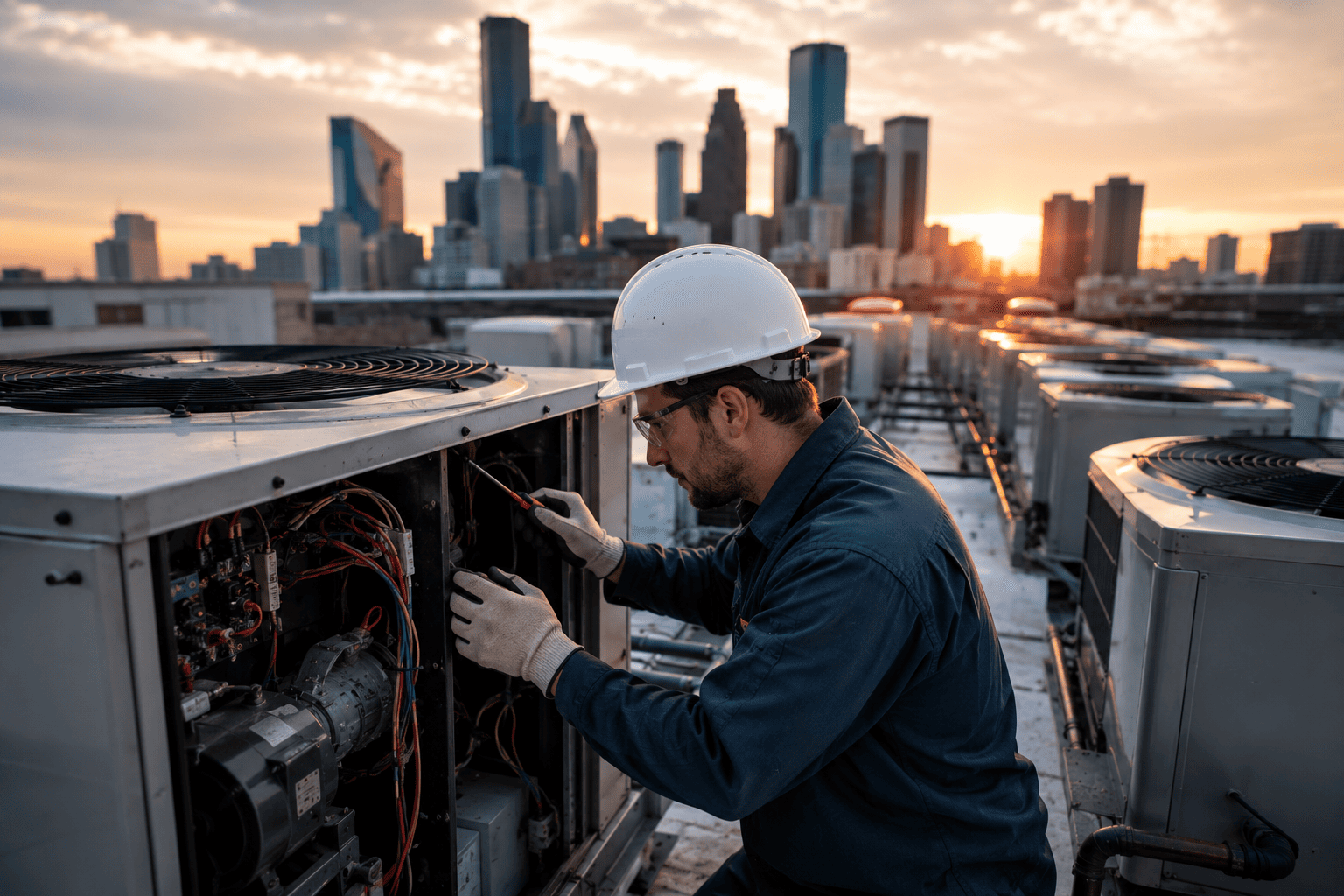
Professional rooftop HVAC maintenance Houston TX businesses rely on may include inspection of filters, coils, fans, belts, motors, electrical components, controls, drains, and refrigerant-system operation.
Check Condenser Condition
The condenser must release heat to outdoor air.
Dirty or obstructed condenser surfaces reduce heat-transfer performance. This problem can become especially significant during high ambient temperatures.
Reduced heat rejection may contribute to:
- Higher operating pressures
- Longer compressor runtime
- Reduced cooling capacity
- Increased energy consumption
- Compressor stress
- Safety shutdowns
Commercial HVAC coil cleaning may therefore be an important part of seasonal preparation when inspection shows contamination or restricted heat transfer.
Inspect Fans, Motors, and Belts
A rooftop unit depends on mechanical components to move air across coils and through the building.
A worn belt, weak motor, damaged fan, or airflow restriction can reduce cooling performance.
Facility managers may notice:
- Weak airflow
- Hot areas
- Unusual noises
- Longer equipment cycles
- Increasing indoor humidity
- Difficulty reaching setpoint
These symptoms should be investigated before peak conditions increase equipment demand.
Air Handlers Are Critical to Cooling Performance
Cooling capacity means little if conditioned air cannot move effectively through the building.
Air handlers are responsible for circulating air through many commercial HVAC systems.
Professional air handler maintenance Houston TX can include inspection of:
- Blower wheels
- Motors
- Bearings
- Belts
- Filters
- Evaporator coils
- Drain pans
- Condensate systems
- Dampers
- Electrical components
- Controls
Dirty filters or coils can restrict airflow. Worn mechanical components can reduce fan performance. Drain problems can contribute to water-related issues.
Because Houston businesses often operate cooling equipment for extended periods, maintaining proper airflow is important for both comfort and system efficiency.
Commercial Chillers Should Be Evaluated Before Heavy Loads
Commercial chillers serve larger buildings and facilities where cooling reliability can have a significant operational impact.
Commercial chiller maintenance Houston businesses schedule should be appropriate for the specific chiller design and application.
Depending on the system, technicians may evaluate operating temperatures, pressures, electrical conditions, controls, heat-transfer surfaces, pumps, and other related components.
Facility managers should also review previous operating history.
Recurring alarms, unusual temperature trends, unexplained increases in energy consumption, or previous repair recommendations should not be ignored before summer.
Condensate Management Matters in Houston’s Humidity
Commercial AC systems remove substantial amounts of moisture during humid weather.
That moisture must drain correctly.
Condensate problems can result from:
- Clogged drain lines
- Dirty drain pans
- Improper drainage
- Damaged piping
- Poor equipment condition
Water accumulation around HVAC equipment can damage building materials and create operational problems.
Seasonal HVAC maintenance should therefore include condensate-system inspection, particularly in Houston’s humid climate.
Industrial Refrigeration Needs Its Own Summer Preparation
Commercial comfort cooling is not the only equipment affected by extreme outdoor conditions.
Refrigeration systems also reject heat, making condenser performance and system condition particularly important during summer.
Professional industrial refrigeration summer maintenance Houston facilities schedule can help identify performance issues before high ambient temperatures increase system load.
A pre-season refrigeration inspection may include:
- Condenser condition
- Evaporator condition
- Compressor operation
- Fan motors
- Refrigerant-system performance
- Controls and sensors
- Electrical components
- Defrost operation
- Drainage
- Temperature performance
- Unusual noise or vibration
Facilities requiring industrial refrigeration maintenance Houston TX should base service frequency on equipment type, operating hours, environmental conditions, and the importance of refrigeration to business operations.
Refrigeration Condensers Must Reject Heat Efficiently
Condenser performance is particularly important during Houston summers.
If condenser surfaces are dirty or airflow is restricted, the refrigeration system may have to work harder to reject heat.
Professional refrigeration condenser maintenance Houston may involve inspecting condenser cleanliness, fan operation, airflow, mechanical condition, and other system-specific factors.
Poor condenser performance can contribute to:
- Increased compressor workload
- Longer operating cycles
- Reduced refrigeration capacity
- Higher energy consumption
- Temperature-control problems
- Increased equipment stress
A system that performs acceptably in moderate weather may struggle when outdoor temperatures rise substantially.
That is why condenser condition should be addressed before peak summer operation rather than after temperature problems develop.
Prepare Walk-In Coolers for Houston Summer
Restaurants, grocery businesses, food-service operations, and other commercial facilities depend on walk-in coolers every day.
Summer increases the refrigeration load because warm, humid outdoor or indoor air enters whenever doors are opened.
Professional walk-in cooler maintenance Houston should address both mechanical equipment and conditions around the refrigerated enclosure.
Important items include:
- Door gaskets
- Door closers
- Evaporator airflow
- Condenser condition
- Fan motors
- Temperature controls
- Defrost operation where applicable
- Drainage
- Refrigerant-system performance
Door Seals Matter More Than They Look
A damaged gasket can allow a continuous stream of warm, humid air into the cooler.
This creates additional heat and moisture that the refrigeration system must remove.
Possible consequences include:
- Longer compressor runtime
- Increased frost
- Condensation
- Temperature fluctuations
- Higher energy consumption
Replacing a damaged gasket can be a relatively simple corrective action compared with the operating problems that persistent infiltration can create.
Walk-In Freezers Require Extra Attention
Freezers maintain much lower temperatures than coolers, leaving less margin for poor performance during extreme heat.
Professional walk-in freezer maintenance Houston TX should include evaluation of door seals, evaporators, condensers, fans, defrost systems, controls, drains, and refrigeration operation.
Facility managers should watch for:
- Excessive frost
- Temperature fluctuations
- Long compressor cycles
- Frequent alarms
- Ice around doors
- Unusual fan or compressor noises
- Slow temperature recovery after door openings
These symptoms may indicate a developing issue that should be corrected before peak summer conditions increase system load.
Restaurant Refrigeration Maintenance Before Peak Season
Restaurants place unusually heavy demands on HVAC and refrigeration equipment.
Cooking appliances generate heat, exhaust systems remove conditioned air, exterior doors open frequently, and refrigeration equipment operates continuously.
Professional restaurant refrigeration maintenance Houston can help prepare:
- Walk-in coolers
- Walk-in freezers
- Reach-in equipment
- Evaporators
- Condensing units
- Refrigeration controls
Restaurant operators should also evaluate commercial HVAC performance because poor comfort cooling can affect employees, customers, kitchen conditions, and overall facility operation.
Preparing both systems together provides a more complete approach to peak-season reliability.
Cold Storage Facilities Cannot Afford Temperature Instability
Cold-storage operations often depend on refrigeration as a core part of the business rather than simply a building service.
For these facilities, temperature instability can create inventory and operational risks.
Cold storage refrigeration maintenance Houston should focus on maintaining stable operation under demanding ambient conditions.
Facility managers should review:
- Temperature history
- Alarm history
- Compressor runtime
- Condenser performance
- Evaporator condition
- Defrost operation
- Door performance
- Previous repair history
- Energy-use trends
Changes in any of these areas can indicate developing problems.
Warehouse HVAC Preparation Requires a Facility-Wide View
Warehouses present unique cooling challenges.
Large interior volumes, high ceilings, loading doors, equipment heat, occupancy patterns, and changing inventory layouts can influence HVAC performance.
Professional warehouse HVAC maintenance Houston TX should consider not only the equipment but also how the facility is currently being used.
For example, changes to shelving, production areas, partitions, or storage configurations can affect airflow.
Facility managers should identify hot zones and airflow complaints before summer demand peaks.
Improve Commercial HVAC Efficiency Before Summer
Seasonal maintenance can support commercial HVAC efficiency Houston TX businesses need during extended cooling periods.
Efficiency improvements do not always require equipment replacement.
Correcting basic problems can make an important difference.
Examples include:
- Replacing dirty filters
- Cleaning coils when necessary
- Correcting airflow restrictions
- Repairing damaged belts
- Addressing fan problems
- Correcting control issues
- Maintaining proper operating schedules
- Repairing duct leakage
- Addressing abnormal refrigerant-system operation
When equipment operates as intended, it is better positioned to handle peak cooling loads without unnecessary runtime.
Improve Industrial Refrigeration Efficiency Before Peak Heat
The same principle applies to industrial refrigeration efficiency Houston facilities depend on.
Refrigeration performance can deteriorate because of issues such as:
- Dirty condensers
- Poor airflow
- Fan problems
- Evaporator restrictions
- Defrost issues
- Refrigerant-system problems
- Control problems
- Door infiltration
- Compressor performance issues
Identifying these conditions before peak heat helps reduce the likelihood that they become critical during the most demanding part of the year.
Warning Signs That Should Be Addressed Before Summer
Do not wait for equipment to fail if it is already showing signs of poor performance.
Commercial HVAC warning signs include:
- Weak airflow
- Uneven temperatures
- Longer cooling cycles
- Increasing humidity
- Abnormal noises
- Frequent cycling
- Water around equipment
- Unexpected energy increases
- Difficulty maintaining setpoint
Refrigeration warning signs include:
- Temperature fluctuations
- Excessive frost
- Continuous compressor operation
- Slow temperature recovery
- Frequent alarms
- Condensation
- Unusual compressor or fan noise
- Ice accumulation
- Increasing energy consumption
These symptoms may justify commercial HVAC repair Houston TX or industrial refrigeration repair Houston before peak-season conditions arrive.
Peak Cooling Season Preparation Checklist
Before the most demanding cooling period, Houston businesses should consider the following:
- Schedule a professional HVAC inspection
- Inspect or replace air filters as appropriate
- Check evaporator and condenser coil condition
- Inspect rooftop unit fans, motors, and belts
- Evaluate air-handler performance
- Inspect electrical connections and components
- Verify thermostat and control operation
- Check condensate drainage
- Review unusual HVAC noises or vibration
- Inspect refrigeration condensers
- Check refrigeration fan operation
- Inspect walk-in cooler and freezer door gaskets
- Verify refrigeration temperatures
- Review defrost-system operation
- Check for excessive frost or ice
- Review temperature and alarm history
- Address outstanding repair recommendations
- Confirm that critical equipment has an appropriate service plan
The exact checklist should be adapted to the equipment installed at each facility.
Preventive Maintenance vs. Emergency Repair
Emergency service is sometimes unavoidable. Electrical components can fail unexpectedly, mechanical parts can break, and equipment can develop problems despite proper maintenance.
However, preventive maintenance gives technicians an opportunity to identify many developing conditions before failure.
Commercial HVAC preventive maintenance Houston TX can reduce the likelihood that dirty coils, worn belts, weak motors, airflow restrictions, or electrical problems go unnoticed.
Similarly, commercial refrigeration preventive maintenance Houston can identify condenser, evaporator, fan, control, door, defrost, and refrigeration-system problems before they cause temperature instability.
The goal is not to promise that equipment will never fail. It is to reduce avoidable risk and improve readiness for demanding operating conditions.
What Happens When Preparation Is Delayed?
Waiting until equipment fails during peak cooling season can create several business risks.
These may include:
- Uncomfortable commercial spaces
- Reduced employee productivity
- Customer complaints
- Refrigerated inventory risk
- Operational downtime
- Emergency repair costs
- Longer equipment stress
- Lost business opportunities
For critical facilities, emergency commercial HVAC repair Houston or emergency refrigeration repair Houston TX may be necessary when failure directly threatens operations.
Preparing equipment earlier gives businesses more control over when maintenance and non-emergency repairs are performed.
When Repair or Replacement Should Be Considered
Seasonal maintenance may reveal equipment that needs more than cleaning or adjustment.
A technician may identify worn motors, damaged electrical components, failing controls, compressor problems, refrigerant-system issues, or other conditions requiring repair.
Older equipment with recurring failures may also deserve a broader evaluation.
Consider:
| Factor | What to Review |
|---|---|
| Equipment age | Remaining useful service life |
| Repair history | Frequency and cost of previous failures |
| Current condition | Mechanical and electrical health |
| Energy performance | Whether operating costs are increasing |
| Cooling capacity | Ability to meet current facility needs |
| Parts availability | Difficulty obtaining critical components |
| Business impact | Consequences of an unexpected shutdown |
| Facility changes | Whether existing equipment still fits current demand |
A qualified commercial HVAC contractor Houston TX or industrial refrigeration contractor Houston can help determine whether maintenance, repair, optimization, or replacement is the appropriate next step.
Why Houston Businesses Choose ACF Mechanical
Preparing commercial cooling equipment for Houston’s peak season requires more than checking a thermostat.
ACF Mechanical works with commercial HVAC and refrigeration equipment and understands how demanding Texas operating conditions affect system performance.
Houston businesses choose ACF Mechanical for:
- Experienced technicians
- Commercial HVAC expertise
- Industrial refrigeration knowledge
- Preventive maintenance
- Professional inspections
- Commercial HVAC repair
- Refrigeration repair and maintenance
- Fast response
- Reliable service
- Walk-in cooler and freezer expertise
- Support for rooftop units, air handlers, chillers, and commercial AC systems
Our approach focuses on identifying actual equipment conditions and recommending appropriate maintenance or corrective action based on the needs of the facility.
Prepare Your Cooling Systems Before Houston’s Peak Heat
Peak cooling season is not the ideal time to discover that a rooftop unit has restricted airflow, a condenser is dirty, a fan motor is deteriorating, or a walk-in freezer is struggling to maintain temperature.
Preparation allows Houston businesses to identify these issues while there is still time to address them proactively.
For business owners, facility managers, restaurant operators, warehouse managers, industrial companies, and commercial property owners, seasonal HVAC and refrigeration maintenance can help protect comfort, temperature control, equipment reliability, and daily operations.
Professional Commercial HVAC & Industrial Refrigeration Services in Houston TX from ACF Mechanical can help prepare rooftop units, chillers, air handlers, commercial AC systems, refrigeration equipment, walk-in coolers, and freezers for demanding summer conditions.
Contact ACF Mechanical to schedule a commercial HVAC or refrigeration inspection, preventive maintenance, or repair before peak cooling demand puts your equipment to the test.