
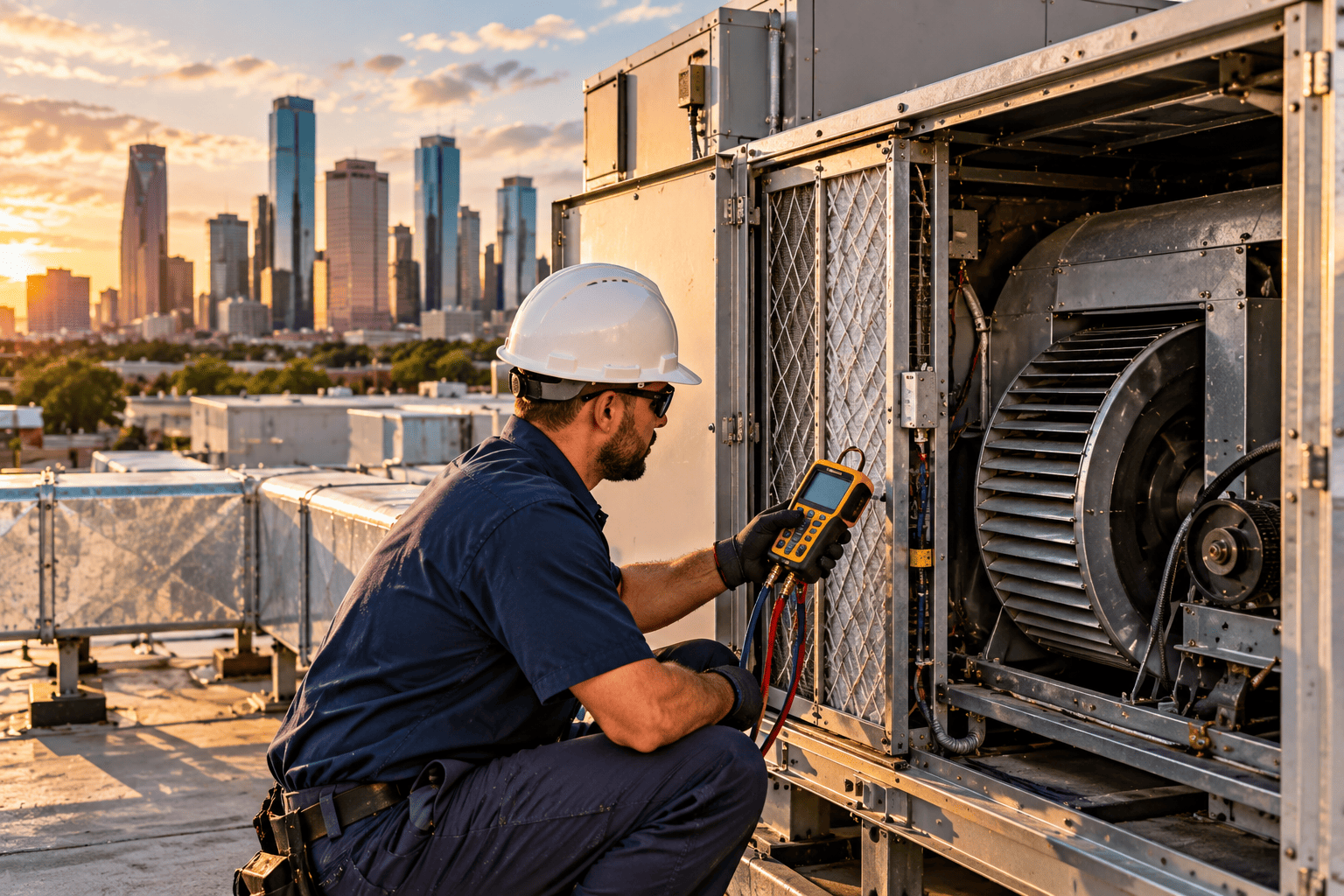
Weak airflow, uneven temperatures, noisy ductwork, long cooling cycles, and recurring comfort complaints do not always mean that a commercial HVAC unit lacks cooling capacity. In many buildings, the underlying problem is related to airflow resistance and abnormal static pressure. For Houston businesses searching for Commercial HVAC & Industrial Refrigeration Services in Houston TX, ACF Mechanical provides professional static pressure testing, airflow diagnostics, rooftop unit service, air handler inspection, and commercial HVAC repair designed to identify the actual cause of system performance problems.
Static pressure is an important diagnostic measurement, but it should never be interpreted by itself. Filters, coils, ductwork, dampers, blower performance, fan speed, VAV systems, and equipment configuration all affect the relationship between pressure and airflow. Accurate diagnosis requires measurements combined with an understanding of how the entire commercial HVAC system was designed to operate.
What Is Static Pressure in a Commercial HVAC System?
Static pressure is one of the measurements technicians use to evaluate resistance to airflow within an HVAC system.
A commercial blower or fan must move air through multiple components, including:
- Return grilles
- Return ductwork
- Filters
- Heating or cooling coils
- Air-handler components
- Supply ductwork
- Dampers
- VAV boxes
- Diffusers and registers
Each component can create resistance to airflow.
The fan must operate against the resistance created by the complete air-distribution system.
For this reason, Commercial HVAC static pressure Houston diagnostics can provide valuable information about whether the fan is operating under expected system conditions or dealing with excessive resistance.
Static Pressure Is Not the Same as Airflow
One of the most important concepts in HVAC diagnostics is that static pressure and airflow are related, but they are not the same measurement.
Static pressure does not directly tell a technician the exact amount of airflow moving through the system.
For example, two systems may have similar pressure measurements while operating at different airflow rates because they use different:
- Fans
- Fan speeds
- Motors
- Duct systems
- Equipment configurations
- Control strategies
Determining airflow may require additional information such as:
- Manufacturer fan-performance data
- Fan tables
- Airflow measurements
- Temperature measurements
- Fan speed
- Motor data
- Testing and balancing measurements
Professional Commercial HVAC airflow diagnostics Houston TX should therefore consider both pressure and airflow rather than treating one measurement as a substitute for the other.
Supply Static Pressure vs. Return Static Pressure
Commercial HVAC systems have both supply and return sides.
Return Static Pressure
Return air moves from occupied areas back toward the HVAC equipment.
Resistance on the return side may be affected by:
- Return duct sizing
- Return grilles
- Filters
- Duct restrictions
- Dampers
- Dirty components
- Damaged ductwork
Abnormal Commercial HVAC return static pressure Houston may indicate excessive resistance or another airflow problem that requires further diagnosis.
Supply Static Pressure
Supply air moves from the HVAC equipment toward the conditioned spaces.
Supply-side resistance may be influenced by:
- Supply ductwork
- Dampers
- VAV boxes
- Diffusers
- Duct restrictions
- Duct design
- Closed or improperly positioned components
Commercial HVAC supply static pressure Houston TX should be interpreted according to the actual equipment and system configuration.
What Is Total External Static Pressure?
Total external static pressure, often discussed as TESP, is an important measurement used on many HVAC systems.
In simplified terms, it represents the pressure difference the fan must work against across specified external components of the installed system.
However, the exact measurement locations depend on the equipment configuration.
A technician should compare measured Commercial HVAC total external static pressure Houston with:
- Manufacturer specifications
- Equipment documentation
- Fan-performance information
- Installed system configuration
There is no single universal static-pressure number that is correct for every commercial HVAC system.
What Causes High Static Pressure?
High static pressure generally indicates that the fan is operating against significant resistance somewhere in the air-distribution system.
Potential causes include:
- Dirty filters
- Overly restrictive filters
- Dirty evaporator coils
- Closed dampers
- Restricted ductwork
- Undersized ducts
- Blocked return grilles
- Blocked supply diffusers
- Incorrect VAV operation
- Damaged ductwork
- Poor duct transitions
- Excessive fittings
- Improper system modifications
Finding high pressure is only the beginning of the diagnosis.
The next step is determining where the excessive resistance exists.
Common High Static Pressure Symptoms
Potential Commercial HVAC high static pressure symptoms Houston TX may include:
- Weak airflow
- Noisy ductwork
- Air noise at grilles or diffusers
- Uneven temperatures
- Hot zones
- Long HVAC cycles
- Reduced system performance
- Blower-related problems
- Comfort complaints
- Difficulty maintaining temperature
However, these symptoms can have other causes.
For example, weak airflow can also result from blower problems, motor issues, belt slip, VFD problems, duct leakage, or incorrect controls.
Static pressure testing helps narrow the diagnosis.
What Can Cause Low Static Pressure?
Low measured static pressure should not automatically be interpreted as a healthy system.
Possible explanations may include:
- Duct leakage
- Disconnected ductwork
- Low fan speed
- Incorrect VFD command
- Blower problems
- Fan-drive problems
- Incorrect measurement location
- Control issues
- System configuration
The significance of Commercial HVAC low static pressure Houston depends on the fan, equipment, airflow, and measurement conditions.
A low pressure reading combined with poor airflow may point toward a different problem than high pressure combined with poor airflow.
Dirty Filters and Static Pressure
Filters are one of the most common sources of airflow resistance in commercial HVAC equipment.
As filters accumulate dirt and debris, pressure drop across the filter can increase.
The basic relationship is:
Dirty Filter → Increased Resistance → Higher Pressure Drop → Changed Airflow Conditions
However, filter selection also matters.
A high-efficiency filter is not automatically a problem. The filter should be appropriate for the HVAC system and installed according to equipment and building requirements.
Professional Commercial HVAC filter pressure drop Houston TX testing can help determine whether the filter is creating excessive resistance.
Technicians can compare pressure on each side of the filter rather than judging its condition only by appearance.
Dirty Coils and Pressure Drop
Air must also move through HVAC coils.
When an evaporator or cooling coil becomes restricted by dirt and debris, airflow resistance may increase.
Potential causes of excessive coil pressure drop include:
- Dirt accumulation
- Dust
- Debris
- Biological buildup where applicable
- Damaged fins
- Coil icing under abnormal operating conditions
A dirty coil may contribute to reduced airflow and impaired heat transfer.
Professional diagnosis may include measuring pressure before and after the coil when appropriate.
This helps distinguish Commercial HVAC coil pressure drop Houston from restrictions elsewhere in the system.
Ductwork Restrictions and Static Pressure
Commercial ductwork can create excessive resistance when it is improperly sized, damaged, obstructed, or modified incorrectly.
Potential duct-related problems include:
- Undersized ductwork
- Crushed or damaged duct sections
- Closed dampers
- Poor transitions
- Excessive bends
- Internal obstructions
- Improper modifications
- Restricted grilles
- Restricted diffusers
A Commercial HVAC duct restriction Houston TX can affect both airflow and pressure.
However, technicians should inspect the entire system before concluding that duct size is the problem.
Changing ductwork without confirming the actual cause can create new balancing or pressure issues.
Duct Leakage and Static Pressure
Duct leakage can also affect pressure measurements.
A significant supply leak may allow air to escape before reaching the intended areas.
Return leakage may allow unintended air to enter the system.
The effect on measured pressure depends on:
- Leak location
- Leak size
- Supply or return side
- Fan characteristics
- Duct configuration
- Measurement location
For this reason, duct leakage does not always cause pressure to change in the same direction.
Static pressure readings should be evaluated together with duct condition and actual airflow.
Dampers and Airflow Restrictions
Commercial HVAC systems often use dampers to control airflow.
These may include:
- Manual balancing dampers
- Zone dampers
- Outdoor-air dampers
- Return-air dampers
- Economizer dampers
- VAV dampers
A damper that is closed, incorrectly positioned, damaged, or improperly controlled can create airflow restrictions.
Potential Commercial HVAC damper airflow restriction Houston symptoms may include weak airflow, noisy ducts, pressure changes, and uneven zone temperatures.
The technician should determine whether the damper position is intentional, mechanically incorrect, or caused by a control problem.
VAV Systems and Static Pressure
Variable Air Volume systems can make static pressure diagnostics more complex.
VAV boxes regulate airflow to different zones based on building demand.
As VAV dampers change position, the system resistance also changes.
Many commercial systems use:
- Static pressure sensors
- Variable-frequency drives
- Fan-speed controls
- Building automation
The system may adjust fan speed to maintain a pressure target.
Potential Commercial HVAC VAV static pressure Houston TX problems may involve:
- Pressure sensors
- Incorrect setpoints
- VAV box operation
- VFD controls
- Damper problems
- Fan-speed control
- Building automation sequences
A single pressure reading may not explain the problem without understanding the control strategy.
How VFDs Affect Static Pressure
Variable Frequency Drives are commonly used to control fan speed in commercial air handlers and other HVAC equipment.
In many applications, the VFD changes fan speed in response to building demand or a static-pressure control signal.
Problems may occur when:
- The pressure sensor is inaccurate
- The setpoint is incorrect
- The VFD is not responding correctly
- Fan speed is limited
- Control programming is incorrect
- The airflow demand signal is wrong
Professional Commercial HVAC VFD static pressure Houston diagnosis should evaluate the mechanical system and control sequence together.
Replacing a VFD will not solve a pressure problem caused by a dirty filter or closed damper.
Fan Curves and System Resistance
Commercial HVAC fans operate according to their performance characteristics.
The duct system also creates resistance.
The point where fan performance and system resistance interact determines how the fan operates.
If system resistance changes because of a dirty filter, blocked coil, damper position, or duct modification, the fan’s operating point may also change.
This is why technicians should not diagnose airflow problems based only on fan speed.
Fan speed, pressure, airflow, and equipment specifications should be considered together.
Static Pressure and Blower Performance
A blower must operate within the conditions for which the equipment was designed.
Excessive resistance may contribute to poor airflow even when the blower itself is mechanically functional.
At the same time, low airflow can result from blower problems such as:
- Dirty blower wheels
- Worn belts
- Pulley problems
- Bearing wear
- Motor problems
- Incorrect fan speed
- VFD issues
Professional Commercial HVAC repair Houston TX should determine whether the problem is caused by system resistance, the blower assembly, controls, or a combination of factors.
Static Pressure and Motor Load
It is tempting to assume that higher static pressure always means higher motor amperage.
That is not universally correct.
Motor load depends on:
- Fan type
- Fan speed
- Motor type
- Control strategy
- Fan operating point
- System resistance
Different fan systems can respond differently to changes in pressure.
Technicians should measure motor amperage and compare it with equipment specifications rather than predicting electrical load from pressure alone.
Static Pressure Problems in Commercial Rooftop Units
Rooftop units are widely used in commercial buildings in Houston.
Potential sources of excessive resistance in an RTU system include:
- Dirty filters
- Dirty evaporator coils
- Blower problems
- Belt and pulley problems
- Economizer dampers
- Supply duct restrictions
- Return duct restrictions
- Building modifications
Professional Commercial HVAC rooftop unit repair Houston should include airflow and pressure diagnostics when symptoms suggest a distribution problem.
Testing may involve checking static pressure, fan condition, filters, coils, dampers, belts, fan speed, and connected ductwork.
Commercial Air Handler Static Pressure Problems
Large commercial air handlers often serve extensive duct systems and multiple building zones.
Potential Commercial air handler static pressure Houston TX problems may involve:
- Filters
- Cooling coils
- Heating coils
- Blowers
- VFDs
- Supply ductwork
- Return ductwork
- VAV boxes
- Dampers
- Static pressure sensors
Professional Commercial air handler repair Houston TX should consider both the air handler and the distribution system it serves.
In larger systems, pressure readings at multiple locations can help identify where resistance is occurring.
Static Pressure in Chilled-Water HVAC Systems
Chillers themselves are not normally diagnosed using the air-side static pressure measurements discussed in this article.
However, chilled-water systems commonly serve air handlers.
Those air handlers still rely on fans, filters, coils, dampers, and ductwork to distribute conditioned air.
A building may therefore have properly operating chilled-water equipment while still experiencing poor comfort because of an air-handler or duct-side airflow problem.
This distinction helps prevent unnecessary refrigeration-side repairs when the real problem is air distribution.
Static Pressure Problems in Different Houston Businesses
Airflow problems can affect commercial properties differently depending on how the building is used.
Restaurants
Restaurants may combine HVAC systems with kitchen exhaust and makeup-air equipment.
Pressure relationships can be particularly important because exhaust airflow can affect overall building conditions.
Warehouses
Large warehouse spaces may use extensive duct systems and high-volume air movement.
Restrictions or balancing problems can produce noticeable temperature differences across large areas.
Office Buildings
Office properties may experience recurring complaints from specific zones when airflow distribution is incorrect.
Retail Properties
Uneven airflow can affect customer comfort and employee working conditions.
Industrial Facilities
Industrial buildings may have process exhaust, ventilation requirements, dust, heat-generating equipment, and complex pressure relationships that require system-level diagnosis.
Houston Heat and Static Pressure Problems
Houston’s heat does not directly cause high static pressure.
However, high outdoor temperatures can increase cooling demand and extend HVAC runtime.
During peak cooling periods, existing airflow restrictions may become more noticeable because the equipment must operate for longer periods to maintain indoor conditions.
A system with dirty filters, restricted coils, closed dampers, or duct problems may struggle more visibly during periods of heavy cooling demand.
This is one reason preventive inspection is important before Houston’s peak cooling season.
Houston Humidity and HVAC Airflow
Humidity also makes proper airflow important.
Commercial HVAC equipment must remove sensible heat and moisture.
Airflow that is significantly different from design conditions can affect system performance.
However, indoor humidity depends on more than static pressure.
Other factors include:
- Equipment sizing
- Cooling-coil performance
- Ventilation
- Outdoor-air settings
- Controls
- Building envelope
- Latent load
- Operating schedules
Static pressure measurements should therefore be used as part of broader HVAC diagnostics rather than as the sole explanation for humidity complaints.
Static Pressure Symptoms and Possible Causes
| Symptom | Possible Cause |
|---|---|
| Weak airflow | Filter, coil, duct, damper, blower, fan-speed, or pressure problem |
| High measured static pressure | Excessive system resistance |
| Low measured static pressure | Leakage, fan/control issue, system configuration, or measurement condition |
| Hot or cold zones | Air distribution, zoning, airflow, controls, or building load |
| Noisy ductwork | High velocity, restriction, damper position, or duct design |
| Long HVAC cycles | Airflow, building load, controls, or equipment performance |
| Repeated blower problems | Excessive resistance may be one contributing factor |
| High energy costs | Airflow problems may be one of several contributing conditions |
These symptoms should guide diagnosis rather than replace actual measurements.
How ACF Mechanical Diagnoses Static Pressure Problems
Proper diagnosis starts with understanding what the building is experiencing.
Is the complaint low airflow, hot zones, noisy ductwork, long run times, humidity problems, or repeated blower issues?
Depending on the system, ACF Mechanical technicians may:
- Measure return-side static pressure
- Measure supply-side static pressure
- Determine relevant external static pressure
- Evaluate filter pressure drop
- Evaluate coil pressure drop where appropriate
- Inspect filters
- Inspect coils
- Inspect supply and return ductwork
- Check dampers
- Evaluate VAV operation
- Inspect blower condition
- Check belts and pulleys
- Check fan speed
- Evaluate VFD operation
- Measure motor amperage
- Compare measurements with manufacturer data
The objective is not simply to identify an abnormal pressure reading. It is to locate the component or condition responsible for the airflow problem.
Correcting Commercial HVAC Static Pressure Problems
The correct solution depends on the cause.
Potential repairs may include:
- Replacing dirty filters
- Selecting appropriate filters
- Cleaning dirty coils
- Correcting damaged ductwork
- Repairing duct leakage
- Opening or repairing dampers
- Correcting VAV problems
- Repairing blower components
- Correcting belt or pulley problems
- Adjusting fan speed where appropriate
- Repairing VFD or control issues
- Correcting restrictive duct sections
- Rebalancing airflow after system changes
The goal should be to restore appropriate system operation—not simply change pressure until a particular number appears on an instrument.
Preventing Static Pressure and Airflow Problems
Routine Commercial HVAC maintenance Houston can identify developing restrictions before they significantly affect building comfort.
Preventive maintenance may include:
- Replacing filters at appropriate intervals
- Checking filter pressure drop
- Inspecting coils
- Cleaning coils when needed
- Inspecting blower wheels
- Checking belts and pulleys
- Inspecting bearings
- Checking dampers
- Inspecting ductwork
- Evaluating VFD operation
- Checking pressure sensors
- Monitoring static pressure when appropriate
- Investigating recurring airflow complaints
- Performing airflow balancing after major system modifications
Commercial buildings change over time. Tenant improvements, new partitions, modified ductwork, equipment replacements, and control changes can all affect airflow.
HVAC performance should therefore be reevaluated after significant building modifications.
Facility Manager Static Pressure Checklist
Facility managers do not need to perform pressure testing themselves to recognize potential airflow problems.
Watch for:
- New weak-airflow complaints
- Persistent hot zones
- Increasing duct noise
- Rapidly dirty filters
- Repeated blower problems
- Long HVAC cycles
- Uneven temperatures
- Recurring VAV complaints
- Changes after building renovations
- HVAC equipment that struggles during peak cooling periods
If several of these conditions appear together, professional airflow and static-pressure testing may help identify the cause.
When Static Pressure Problems Require Prompt HVAC Service
Professional service should be scheduled promptly when:
- Airflow drops significantly
- A major area cannot maintain temperature
- Blower components repeatedly fail
- Duct noise becomes severe
- A fan or blower overheats
- VAV zones stop receiving adequate airflow
- Equipment repeatedly shuts down
- A restriction is suspected to be damaging equipment
- Airflow changes suddenly after building or duct modifications
Prompt diagnosis can help prevent a relatively localized airflow problem from creating additional stress on HVAC components.
Why Houston Businesses Choose ACF Mechanical
Static pressure problems require more than replacing filters or adjusting fan speed. Reliable diagnosis requires understanding how filters, coils, blowers, motors, belts, VFDs, dampers, ductwork, controls, and building airflow interact.
Houston businesses choose ACF Mechanical for:
- Experienced technicians
- Commercial HVAC expertise
- Industrial refrigeration knowledge
- Airflow and static pressure diagnostics
- Rooftop unit service
- Air handler experience
- Preventive maintenance
- Fast response
- Reliable service
ACF Mechanical works with business owners, facility managers, restaurant owners, warehouses, industrial companies, commercial property owners, and other Texas businesses that depend on reliable HVAC operation.
Restore Proper Airflow Before Pressure Problems Affect Performance
Static pressure is one of the most useful diagnostic tools for understanding commercial HVAC airflow, but the number alone does not identify the repair.
High pressure may point toward excessive resistance. Low pressure combined with poor airflow may suggest leakage, fan-speed problems, control issues, or other conditions. Filters, coils, dampers, ductwork, blowers, VFDs, and building modifications can all influence the final result.
For commercial buildings in Houston, airflow problems can become especially noticeable during periods of heavy cooling demand. Finding the source before peak conditions can help reduce comfort complaints, unnecessary equipment stress, and unexpected downtime.
With professional Commercial HVAC & Industrial Refrigeration Services in Houston TX, ACF Mechanical can perform static pressure testing, airflow diagnostics, inspect rooftop units and air handlers, identify system restrictions, and recommend appropriate commercial HVAC repairs.
If your building has weak airflow, hot zones, noisy ductwork, long HVAC cycles, or suspected pressure problems, contact ACF Mechanical for professional commercial HVAC diagnostics and repair in Houston, TX.