
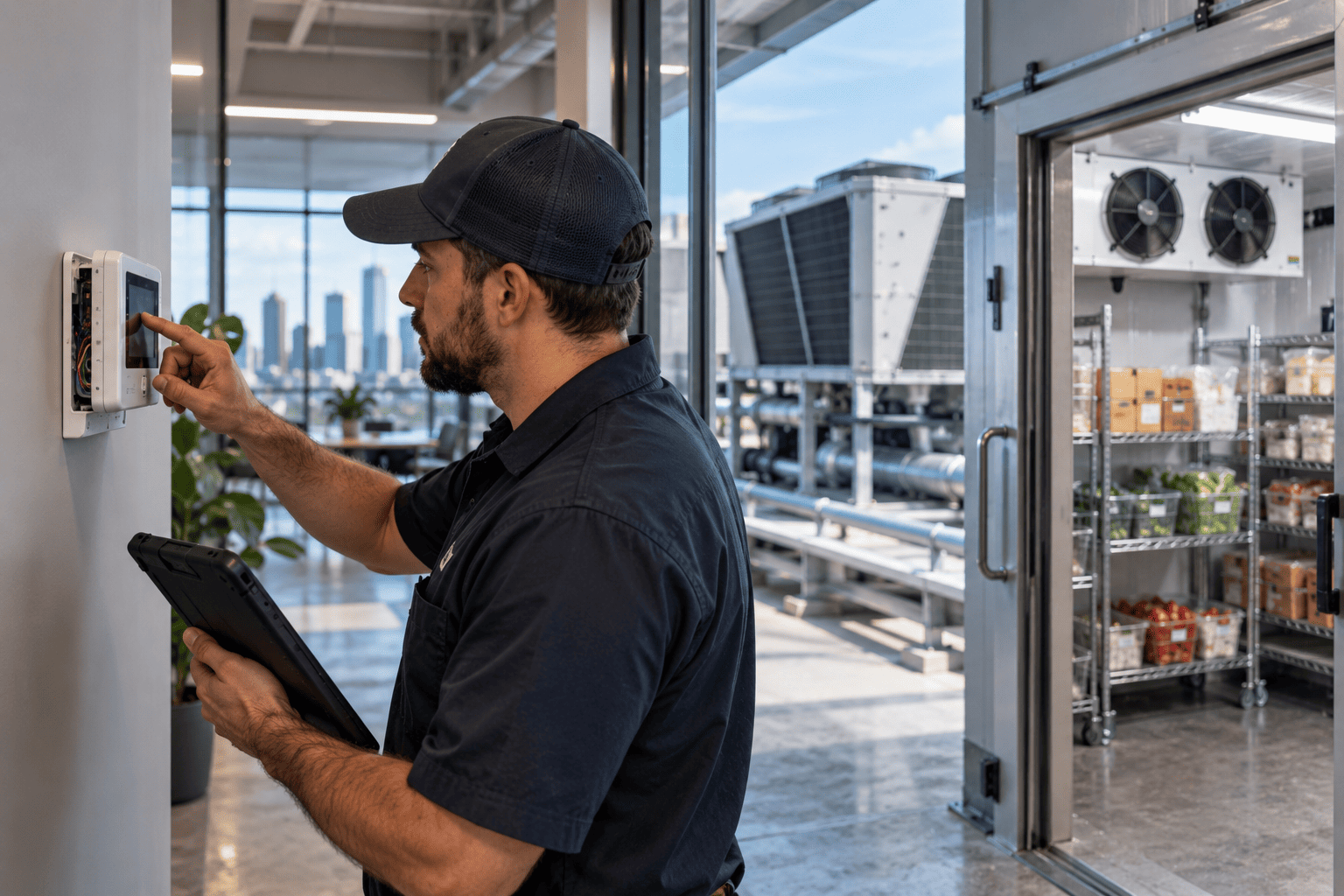
A commercial HVAC or refrigeration system can have functioning compressors, fans, coils, and electrical components yet still struggle to maintain the correct temperature when its thermostat or temperature sensors provide inaccurate information. For Houston businesses, professional Commercial HVAC & Industrial Refrigeration Services in Houston TX can help determine whether temperature fluctuations, excessive runtime, short cycling, false alarms, or inconsistent cooling are being caused by a sensor, thermostat, control system, or another equipment problem. ACF Mechanical provides commercial HVAC and refrigeration diagnostics, repair, and preventive maintenance throughout Houston, TX.
Why Accurate Temperature Measurement Matters
Modern commercial HVAC and refrigeration equipment depends on accurate information.
A thermostat or temperature sensor measures conditions and sends information to a controller. The control system then determines when equipment should start, stop, stage, modulate, or perform other functions.
Depending on the system, sensors may monitor:
- Room temperature
- Supply-air temperature
- Return-air temperature
- Outdoor temperature
- Evaporator temperature
- Refrigerated-space temperature
- Chilled-water temperature
- Discharge-air temperature
- Other equipment-specific conditions
When that information is inaccurate, the control system can make decisions based on conditions that do not actually exist.
The result may look like a mechanical failure even when major HVAC components remain operational.
Warning Signs of Thermostat and Temperature Sensor Problems
Temperature-control problems can appear in several ways.
Facility managers should pay attention to symptoms such as:
- Displayed temperature does not match actual conditions
- HVAC cannot maintain the setpoint
- Large temperature swings
- Some zones are consistently too warm or too cold
- Equipment runs longer than expected
- HVAC starts and stops too frequently
- Walk-in cooler temperatures fluctuate
- Freezer temperatures become inconsistent
- Unexpected temperature alarms occur
- Equipment behaves differently at certain times of day
- Cooling continues after the desired temperature appears to have been reached
These symptoms do not prove that a thermostat or sensor is defective.
They indicate that professional diagnostics may be needed.
How Faulty Sensors Can Affect Commercial HVAC Operation
Commercial HVAC controls depend on feedback.
If a sensor reports a temperature higher than the actual condition, the system may continue cooling longer than necessary.
If it reports a temperature lower than reality, cooling may stop too early.
Depending on the equipment and control strategy, inaccurate readings can contribute to:
- Occupant discomfort
- Excessive HVAC runtime
- Short cycling
- Temperature imbalance
- Unnecessary energy consumption
- Poor humidity control
- Equipment alarms
- Increased component wear
For commercial buildings in Houston, these problems can become especially noticeable during periods of high cooling demand.
Thermostat Problem or HVAC Equipment Problem?
One of the most important parts of professional diagnosis is determining whether the thermostat is actually responsible.
A commercial building that feels too warm could have a thermostat problem, but it could also have:
- Restricted airflow
- Dirty coils
- Fan motor problems
- Compressor problems
- Refrigerant issues
- Electrical faults
- Duct problems
- Control problems
- Excessive cooling load
- Equipment capacity problems
Replacing a thermostat without diagnosing the complete system may not solve the complaint.
The same principle applies when considering commercial HVAC repair Houston TX. The repair should address the actual cause rather than the most visible symptom.
Common Causes of Inaccurate Thermostat Readings
A thermostat can provide inaccurate information for several reasons.
Possible causes include:
- Sensor deterioration
- Calibration problems
- Wiring issues
- Loose electrical connections
- Control communication problems
- Improper thermostat location
- Physical damage
- Contamination
- Configuration problems
- Controller issues
Some problems require replacement, while others may be resolved through calibration, wiring repair, control correction, or relocation.
Sensor Location Can Cause Temperature-Control Problems
Not every inaccurate reading means the sensor itself has failed.
Location matters.
A thermostat or room sensor should measure conditions representative of the space it controls.
Readings may be affected when sensors are positioned near:
- Exterior doors
- Direct sunlight
- Supply-air diffusers
- Heat-producing appliances
- Commercial kitchen equipment
- Exterior walls
- Areas with unusual airflow
- Equipment generating significant heat
- Spaces that do not represent the controlled zone
For example, a sensor near a restaurant kitchen may detect conditions that differ substantially from the dining area it is expected to represent.
Similarly, a thermostat exposed to direct sunlight may report a temperature that does not accurately reflect the overall space.
Professional diagnostics should therefore consider both sensor accuracy and sensor location.
Commercial HVAC Temperature Sensor Calibration
Calibration compares the sensor’s reported value with an appropriate reference measurement.
If the readings differ, technicians can determine whether adjustment is possible or whether another problem exists.
Depending on the equipment, commercial HVAC sensor calibration may involve evaluating:
- Actual temperature
- Displayed temperature
- Sensor output
- Wiring
- Controller input
- Calibration offset
- Sensor location
- Equipment configuration
Not every commercial sensor is calibrated in the same way, and some sensors are better replaced when they fail.
The correct procedure depends on the equipment and control system.
Calibration vs. Sensor Replacement
An inaccurate reading does not automatically mean a new sensor is required.
A technician should first determine why the reading is incorrect.
Calibration May Be Appropriate When:
- The sensor is functional but slightly inaccurate
- The control allows proper field calibration
- Wiring and connections are in good condition
- Sensor location is appropriate
- No physical damage is present
Replacement May Be Appropriate When:
- The sensor has failed
- Readings are unstable
- Internal deterioration is confirmed
- Physical damage is present
- Calibration cannot restore proper accuracy
- The component is incompatible with the control system
- Replacement is more practical than repair
The goal is reliable temperature information, not simply replacing components.
Rooftop Unit Thermostat and Sensor Problems
Rooftop units are common in commercial buildings throughout Houston.
Depending on the equipment and control design, a rooftop system may use multiple sensors to control cooling, heating, airflow, economizer operation, staging, and safety functions.
Potential symptoms of rooftop sensor problems include:
- Unit does not respond correctly to space temperature
- Cooling starts or stops at the wrong time
- Temperature setpoint is not maintained
- Excessive cycling occurs
- Equipment runs continuously
- One zone remains uncomfortable
- Control alarms appear
Because rooftop equipment contains multiple interacting systems, professional diagnostics should verify whether the issue originates at the thermostat, sensor, controller, or mechanical equipment.
Temperature Sensors in Commercial Air Handlers
Air handlers may use temperature sensors to monitor and control air conditions throughout larger commercial HVAC systems.
Common measurements can include:
- Supply-air temperature
- Return-air temperature
- Mixed-air temperature
- Space temperature
A faulty sensor can affect control sequences even when the fan and cooling components remain operational.
For example, incorrect supply-air temperature information may cause a control system to respond differently than intended.
When diagnosing an air handler, technicians should consider sensor readings together with airflow, coils, fan operation, controls, and actual field conditions.
Commercial Chiller Temperature Sensors
Chiller systems depend on accurate temperature information for proper control.
Specific sensor configurations vary by chiller type and manufacturer, but systems may monitor conditions such as:
- Entering chilled-water temperature
- Leaving chilled-water temperature
- Condenser-water temperature
- Refrigerant-related temperatures
- Outdoor conditions
Incorrect readings can contribute to control problems, alarms, unexpected staging, or difficulty maintaining the required chilled-water conditions.
Professional diagnosis should compare control readings with actual system operation rather than assuming that every displayed value is correct.
How Sensor Problems Can Affect Energy Use
An inaccurate sensor can sometimes cause equipment to operate longer than required.
For example, if the control believes a commercial space is warmer than it actually is, cooling may continue unnecessarily.
This can contribute to:
- Longer runtime
- Additional electrical consumption
- Increased component operation
- Unnecessary cooling
- Higher operating costs
However, high utility costs should never be blamed on the thermostat alone.
Dirty coils, poor airflow, compressor problems, aging equipment, building load, controls, and many other factors can affect HVAC operating costs Houston businesses experience.
For businesses evaluating energy efficient commercial HVAC Houston TX, accurate controls and sensors are one part of overall system efficiency.
Temperature Sensors and Houston Humidity
Houston’s heat is only part of the challenge for commercial cooling systems. Humidity also matters.
Commercial HVAC equipment removes moisture as air passes across a properly operating cooling coil.
If inaccurate temperature information causes cooling cycles to end prematurely or produces abnormal equipment operation, comfort and moisture-control performance may be affected.
Possible symptoms include:
- Indoor spaces feel humid
- Temperature is acceptable but comfort remains poor
- Cooling cycles appear inconsistent
- Different building zones have different conditions
Humidity problems can also result from equipment sizing, airflow, building infiltration, mechanical problems, and other factors.
Sensor performance should therefore be evaluated as part of the complete system.
Industrial Refrigeration Temperature Sensors
Temperature accuracy becomes even more important in industrial refrigeration applications.
Controls may depend on temperature information to manage:
- Refrigeration operation
- Compressor staging
- Evaporator fans
- Defrost sequences
- Alarms
- Temperature monitoring
- Other equipment-specific functions
Industrial refrigeration repair Houston may be required when a failed sensor, wiring problem, controller issue, or mechanical refrigeration problem prevents the system from maintaining appropriate operating conditions.
Professional diagnostics should compare sensor data with actual measured conditions before determining the repair.
Walk-In Cooler Temperature Sensor Problems
Restaurants, food-service businesses, and other commercial facilities depend on walk-in coolers maintaining appropriate temperatures.
A faulty sensor may cause symptoms such as:
- Incorrect controller display
- Temperature fluctuations
- Refrigeration running too long
- Refrigeration stopping too early
- Unexpected alarms
- Poor temperature recovery
- Actual box temperature differing from the displayed value
However, a walk-in cooler that cannot maintain temperature may also have:
- Compressor problems
- Refrigerant issues
- Evaporator fan problems
- Dirty coils
- Door or gasket problems
- Defrost issues
- Electrical problems
Professional walk-in cooler repair Houston TX should therefore diagnose the complete refrigeration system.
Walk-In Freezer Temperature Sensor Problems
Walk-in freezers also rely on accurate temperature information.
Depending on system design, sensors may influence refrigeration operation, temperature monitoring, alarms, and defrost-related controls.
Warning signs include:
- Displayed temperature does not match actual conditions
- Freezer temperature fluctuates
- Equipment cycles unexpectedly
- Temperature alarms occur
- Excessive icing develops
- Refrigeration runs longer than expected
Icing should not automatically be attributed to a temperature sensor.
Airflow problems, defrost failures, door infiltration, drainage issues, and refrigeration conditions can also contribute.
Professional walk-in freezer repair Houston TX should identify the actual cause before components are replaced.
Temperature Sensors and Defrost Control
Commercial refrigeration systems may use temperature information as part of their defrost strategy.
The exact control sequence depends on the equipment.
A sensor or control problem can potentially affect:
- Defrost termination
- Fan operation
- Refrigeration restart
- Alarm conditions
- Temperature recovery
When a freezer develops repeated icing problems, technicians should evaluate the complete defrost and refrigeration system rather than assuming the temperature sensor is responsible.
Restaurant Refrigeration Temperature Control
Restaurants often operate several refrigeration systems simultaneously.
Reliable temperature control is important for:
- Walk-in coolers
- Walk-in freezers
- Reach-in equipment
- Prep refrigeration
- Other temperature-sensitive equipment
If the displayed temperature appears normal while actual product-space conditions are changing, professional inspection is important.
Restaurant operators should also continue following applicable food-safety requirements whenever refrigeration temperatures move outside appropriate ranges.
Cold Storage and Warehouse Temperature Sensors
Temperature monitoring can be especially important in warehouses and cold-storage facilities where large quantities of products may depend on stable refrigeration conditions.
Sensor problems can create:
- False alarms
- Missed temperature changes
- Incorrect equipment operation
- Temperature inconsistencies
- Unnecessary runtime
- Difficulty identifying actual refrigeration performance
For warehouse refrigeration systems Houston TX, technicians may need to evaluate multiple sensors and compare their readings across different areas.
One incorrect reading should not automatically be assumed to represent the entire refrigerated space.
Sensor Problem or Mechanical Failure?
Many temperature-control symptoms overlap with mechanical HVAC and refrigeration problems.
| Symptom | Possible Sensor/Control Problem | Other Possible Cause |
|---|---|---|
| Incorrect displayed temperature | Sensor calibration/failure | Poor sensor location |
| HVAC cannot reach setpoint | Thermostat/control problem | Cooling system problem |
| Short cycling | Incorrect sensor input | Refrigerant or compressor issue |
| Long runtime | Inaccurate reading | Dirty coils or high load |
| Uneven building temperature | Zone sensor problem | Airflow or duct issue |
| Walk-in temperature fluctuates | Refrigeration sensor problem | Compressor, fan or defrost |
| False temperature alarm | Sensor/controller problem | Actual temperature problem |
| Freezer icing | Defrost sensor/control | Airflow, door or refrigeration issue |
This is why accurate diagnostics matter.
Replacing mechanical components when the problem is actually a sensor can be expensive. Replacing a thermostat when the compressor, fan, coil, or refrigeration circuit is responsible will not solve the problem either.
When a Sensor Problem Requires Professional Repair
Professional service should be considered when:
- Displayed and actual temperatures differ significantly
- Equipment cannot maintain its setpoint
- Temperature changes are unexplained
- The system short cycles
- HVAC runs continuously
- Refrigeration alarms repeatedly occur
- Walk-in cooler or freezer temperatures fluctuate
- Controls show inconsistent readings
- Sensor wiring appears damaged
- A thermostat repeatedly loses control
For critical commercial HVAC or refrigeration equipment, early diagnosis can reduce the risk of operational disruption.
Can Thermostat Problems Mean the HVAC System Needs Replacement?
Usually, a thermostat or temperature sensor problem alone is not a reason to replace an entire commercial HVAC system.
A relatively minor control problem may be repairable even on larger equipment.
However, sensor complaints sometimes reveal broader problems in an aging system.
For an aging commercial HVAC system Houston businesses depend on, technicians may discover additional issues such as:
- Repeated compressor failures
- Deteriorated coils
- Obsolete controls
- Frequent electrical problems
- Poor efficiency
- Major airflow problems
- Multiple expensive repairs
In these cases, commercial HVAC replacement Houston TX may deserve consideration based on the overall condition of the equipment—not simply because a thermostat failed.
Repair or Replace Commercial HVAC Equipment?
When deciding whether to repair or replace commercial HVAC equipment, businesses should evaluate the complete system.
Important factors include:
- Equipment age
- Repair history
- Current reliability
- Availability of replacement parts
- Energy consumption
- Compressor condition
- Coil condition
- Controls
- Building requirements
- Cost of continued repairs
- Operational consequences of downtime
A thermostat or sensor repair may restore proper operation when the rest of the system is healthy.
If the equipment has reached the end of its practical service life and suffers repeated failures, a commercial HVAC equipment replacement Houston evaluation may be more appropriate.
The same principle applies to industrial refrigeration replacement Houston TX: replacement decisions should be based on the condition and economics of the complete system.
How Preventive Maintenance Helps Identify Sensor Problems
Professional commercial HVAC maintenance Houston should consider both mechanical equipment and controls.
Depending on the system, technicians may evaluate:
- Thermostat operation
- Sensor readings
- Control sequences
- Wiring
- Electrical connections
- Actual versus displayed temperatures
- Airflow
- Coils
- Fans
- Refrigeration operation
- Equipment alarms
Industrial refrigeration maintenance Houston can also help identify sensor drift, damaged wiring, abnormal readings, and control problems before they contribute to larger temperature-control issues.
Maintenance is particularly valuable for critical refrigeration equipment where unnoticed temperature problems can affect products or operations.
When Temperature-Control Problems Require Emergency Service
Not every inaccurate thermostat requires emergency service.
However, some temperature-control failures can become urgent.
Emergency commercial HVAC repair Houston may be appropriate when:
- Critical building cooling is lost
- Equipment repeatedly shuts down
- Important commercial areas cannot maintain acceptable conditions
- Control problems prevent HVAC operation
- Temperature-sensitive operations are affected
Emergency refrigeration service Houston TX may be needed when:
- Walk-in cooler temperatures are rising
- A freezer cannot maintain temperature
- Cold-storage products may be at risk
- Critical refrigeration equipment stops operating
- Temperature alarms indicate a real refrigeration failure
Businesses should verify actual conditions rather than assuming every alarm is caused by a faulty sensor.
Commercial Thermostat and Temperature Sensor Checklist
Facility managers can watch for these warning signs.
Commercial HVAC
- Thermostat reading appears inaccurate
- Room temperature does not match the display
- HVAC cannot maintain setpoint
- Equipment runs continuously
- Frequent cycling occurs
- Different zones have unexplained temperature differences
- Indoor humidity increases
- Sensor or controller alarms appear
Commercial Refrigeration
- Walk-in display differs from actual temperature
- Cooler temperature fluctuates
- Freezer temperature becomes unstable
- False alarms occur repeatedly
- Refrigeration cycles unexpectedly
- Defrost behavior changes
- Cold-storage zones show inconsistent readings
- Equipment runs longer than normal
Recording when these symptoms occur can also help technicians diagnose intermittent control problems.
Why Houston Businesses Choose ACF Mechanical
Temperature-control problems require more than replacing a thermostat and hoping the problem disappears.
Commercial HVAC and refrigeration systems contain interconnected controls, sensors, electrical components, compressors, fans, coils, and refrigerant circuits. Effective troubleshooting requires understanding how these systems work together.
Houston businesses choose ACF Mechanical for:
- Experienced technicians
- Commercial HVAC expertise
- Industrial refrigeration knowledge
- Professional diagnostics
- Temperature-control troubleshooting
- Preventive maintenance
- Fast response
- Reliable service
- Experience with rooftop units, chillers, air handlers, commercial AC systems, walk-in coolers, walk-in freezers, and industrial refrigeration equipment
ACF Mechanical serves business owners, facility managers, restaurants, warehouses, industrial companies, and commercial property owners throughout Houston, TX.
Get Temperature-Control Problems Diagnosed Before They Disrupt Operations
A faulty thermostat or temperature sensor can make a healthy HVAC or refrigeration system operate incorrectly, but the same symptoms can also indicate a mechanical, electrical, airflow, refrigerant, or control problem.
Professional Commercial HVAC & Industrial Refrigeration Services in Houston TX from ACF Mechanical can help determine what is actually causing inaccurate readings, temperature fluctuations, excessive runtime, short cycling, or refrigeration alarms.
For Houston businesses, early diagnostics can help prevent unnecessary component replacement, improve temperature control, and identify developing equipment problems before they lead to costly downtime.
If your commercial HVAC system, rooftop unit, air handler, chiller, walk-in cooler, walk-in freezer, or industrial refrigeration equipment is showing inaccurate temperatures or control problems, contact ACF Mechanical for professional diagnostics and service in Houston, TX.