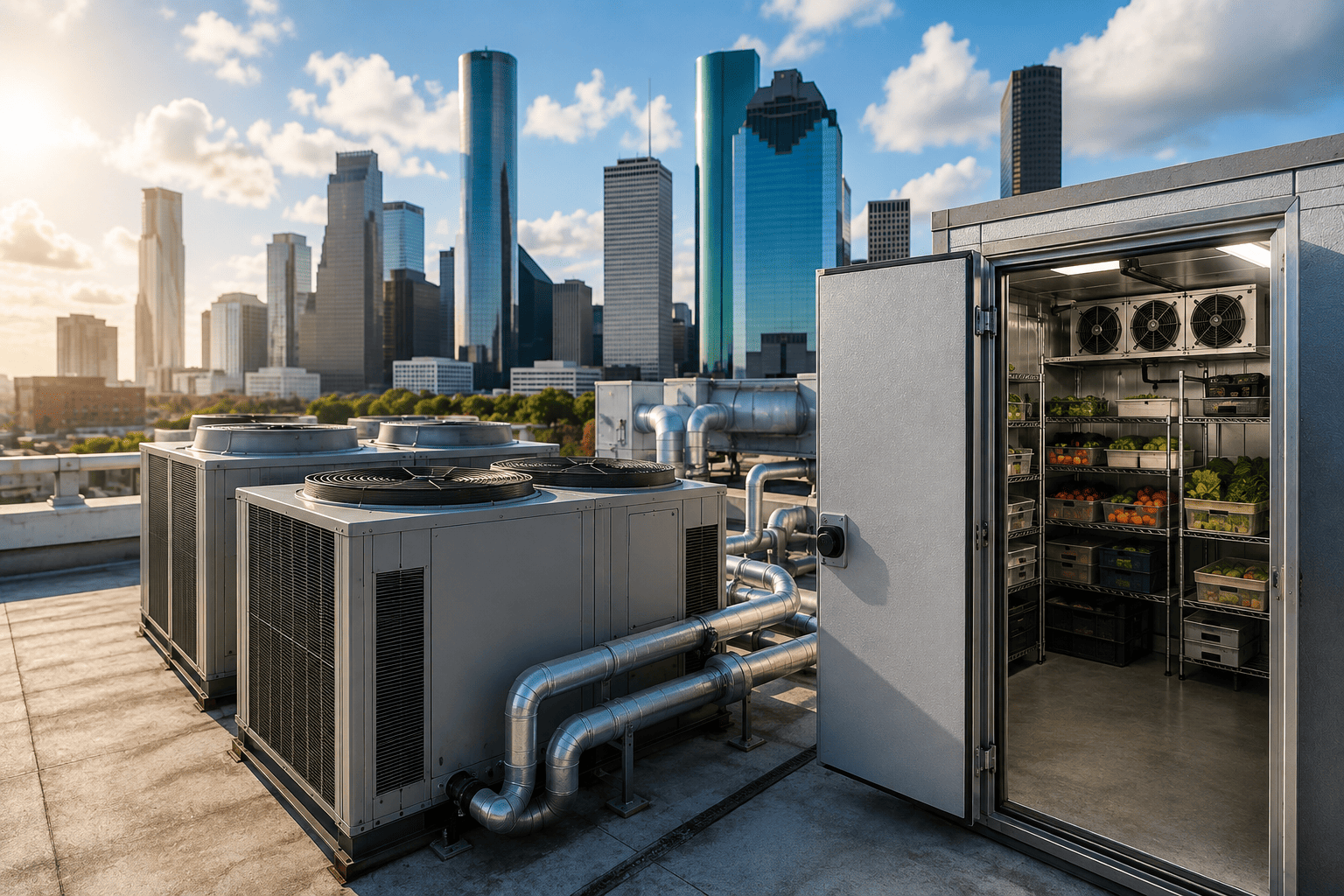
Businesses in Houston depend heavily on cooling and refrigeration equipment to maintain comfortable facilities, protect temperature-sensitive products, and keep daily operations moving. However, an HVAC or refrigeration system does not have to completely fail to become expensive. Declining efficiency, restricted airflow, dirty heat-transfer surfaces, improper controls, refrigerant issues, aging components, and deferred maintenance can all increase energy consumption long before a major breakdown occurs. Professional Commercial HVAC & Industrial Refrigeration Services in Houston TX can help businesses identify these efficiency losses, correct developing problems, and control long-term operating expenses.
At ACF Mechanical, we understand that energy efficiency is not simply an equipment specification. It depends on how the entire system operates under actual building loads and Houston’s demanding climate. Rooftop units, chillers, air handlers, commercial AC systems, walk-in coolers, freezers, and industrial refrigeration equipment all require the right combination of equipment condition, airflow, controls, maintenance, and system operation.
For Houston businesses looking to reduce commercial cooling costs, improving HVAC and refrigeration efficiency can provide benefits beyond lower utility expenses. Properly operating systems can also support more consistent indoor conditions, better temperature control, longer equipment life, and a lower risk of disruptive repairs.
Why Energy Efficiency Matters for Houston Businesses
Commercial HVAC and refrigeration equipment often operates for long hours, and in some facilities refrigeration systems run continuously. Even relatively small efficiency losses can therefore become meaningful operating expenses over months or years.
Houston’s hot and humid climate makes efficiency especially important. Commercial cooling equipment must frequently operate under demanding outdoor conditions while maintaining indoor temperatures and, in many facilities, controlling humidity.
Common sources of unnecessary energy consumption include:
- Dirty condenser and evaporator coils
- Restricted or incorrectly balanced airflow
- Clogged filters
- Worn motors and bearings
- Improper refrigerant conditions
- Compressor performance problems
- Poor thermostat or control settings
- Damaged or restrictive ductwork
- Failed sensors
- Refrigeration door gasket problems
- Excessive compressor cycling
- Incorrect equipment sizing
- Aging or inefficient equipment
- Lack of preventive maintenance
Individually, these issues may not immediately stop a system from operating. Together, however, they can increase runtime and place additional demand on compressors, fans, pumps, and other components.
Houston’s Heat and Humidity Increase Cooling Demands
Houston’s climate deserves special consideration when evaluating commercial HVAC efficiency.
During periods of intense Texas heat, commercial cooling systems may operate for extended periods to maintain indoor conditions. High humidity adds another challenge because HVAC systems must manage both temperature and moisture.
When equipment is dirty, improperly controlled, poorly maintained, or experiencing airflow problems, maintaining comfortable conditions can require longer operating cycles.
For Texas businesses, inefficient operation can contribute to:
- Higher electricity consumption
- Longer compressor runtime
- Increased component wear
- Difficulty maintaining indoor humidity
- Uneven building temperatures
- More frequent service requirements
- Reduced equipment reliability
An energy efficient commercial HVAC Houston TX strategy should therefore consider real operating conditions rather than focusing exclusively on equipment efficiency ratings.
Where Commercial HVAC Systems Lose Efficiency
Commercial HVAC systems consist of multiple components working together. A problem in one area can reduce the efficiency of the entire system.
Rooftop Units
Rooftop units are widely used in commercial buildings in Houston. Because they are exposed directly to outdoor conditions, they require regular inspection and maintenance.
Efficiency can decline because of:
- Dirty condenser coils
- Restricted filters
- Damaged belts
- Poor airflow
- Failing fan motors
- Refrigerant problems
- Sensor or thermostat issues
- Compressor wear
- Electrical problems
When a rooftop unit cannot reject heat efficiently or move the correct amount of air, it may need to run longer to satisfy the building’s cooling demand.
Improving rooftop HVAC unit efficiency in Houston starts with evaluating the complete system rather than treating each symptom as an isolated problem.
Air Handlers and Airflow
Airflow is a critical part of commercial HVAC performance.
A cooling system may have functioning compressors and refrigeration components but still operate inefficiently when airflow is restricted.
Potential causes include:
- Dirty filters
- Dirty evaporator coils
- Belt problems
- Fan or motor issues
- Duct restrictions
- Closed or incorrectly positioned dampers
- Poor air balancing
- Blocked supply or return paths
Poor airflow can reduce heat transfer and cause equipment to operate longer.
Airflow can also affect humidity management, which is especially important for commercial buildings in Houston. Maintaining proper airflow therefore supports both comfort and energy efficiency.
Commercial Chillers
Chillers are used in larger commercial and industrial facilities where even modest efficiency losses can have significant operational consequences.
Factors affecting commercial chiller efficiency Houston TX can include:
- Fouled heat-transfer surfaces
- Incorrect water flow
- Poor condenser performance
- Control problems
- Sensor calibration issues
- Pump inefficiency
- Compressor problems
- Improper operating sequences
Chiller optimization should consider the complete system, including pumps, controls, heat exchangers, and actual facility demand.
Why Industrial Refrigeration Efficiency Is Critical
For many Houston businesses, refrigeration is not simply another building system. It is essential to daily operations.
Restaurants, food-service businesses, warehouses, cold-storage operations, and industrial companies may depend on refrigeration equipment 24 hours a day.
When refrigeration efficiency declines, businesses can face two problems simultaneously: increasing energy consumption and greater risk to products or operations.
Common causes of poor industrial refrigeration energy efficiency Houston include:
- Dirty condenser coils
- Restricted evaporators
- Refrigerant problems
- Compressor wear
- Incorrect controls
- Failed sensors
- Defrost problems
- Poor door seals
- Excessive air infiltration
- Fan problems
- Improper temperature settings
- Deferred maintenance
Conditions that cause compressors to operate longer than necessary deserve particular attention because extended runtime can increase both energy use and component wear.
Walk-In Cooler and Freezer Energy Efficiency
Walk-in coolers and freezers are especially important for restaurants, food distributors, hospitality businesses, and other commercial operations.
A walk-in refrigeration system continuously removes heat entering through walls, doors, products, lighting, and air infiltration.
Efficiency problems can develop when:
- Doors do not close properly
- Door gaskets are damaged
- Evaporator coils become dirty or iced
- Condenser coils become restricted
- Fans are not operating correctly
- Defrost cycles are incorrect
- Temperature controls are improperly configured
- Refrigeration components begin losing capacity
For a cooler, these problems may result in longer operating cycles. Freezers face an additional challenge because moisture entering the space can freeze on evaporator surfaces and interfere with heat transfer.
Improving walk-in cooler energy efficiency Houston or walk-in freezer energy efficiency Houston TX requires identifying why the equipment is operating excessively rather than simply changing thermostat settings.
The Relationship Between Maintenance and Energy Costs
Preventive maintenance is one of the most practical ways to protect HVAC and refrigeration efficiency.
Maintenance allows technicians to identify developing conditions before they become expensive operational problems.
Commercial HVAC maintenance may include inspection of:
- Filters
- Coils
- Belts
- Blowers
- Motors
- Electrical connections
- Refrigerant conditions
- Drainage systems
- Thermostats and controls
- Supply and return airflow
- Compressor operation
Commercial refrigeration maintenance may involve evaluating:
- Condenser and evaporator condition
- Compressor performance
- Refrigerant circuit operation
- Fans and motors
- Defrost systems
- Temperature controls
- Sensors
- Electrical components
- Door seals and infiltration
- Operating pressures and temperatures
The purpose of professional maintenance is not simply to clean equipment. It provides an opportunity to evaluate how the entire system is operating and identify conditions that may be reducing efficiency.
For facilities focused on commercial HVAC maintenance for energy efficiency Houston, consistent preventive service can also make equipment performance easier to track over time.
Signs Your HVAC or Refrigeration System May Be Wasting Energy
Rising utility costs should not automatically be blamed on electricity rates or outdoor temperatures.
Businesses should investigate when energy consumption increases without a corresponding change in operating hours, occupancy, production, or facility size.
Potential warning signs include:
- Utility consumption increasing unexpectedly
- HVAC equipment running longer than normal
- Frequent compressor cycling
- Difficulty reaching thermostat settings
- Uneven indoor temperatures
- Increasing indoor humidity
- Hot or cold areas throughout the building
- Walk-in cooler temperatures fluctuating
- Freezers requiring longer recovery times
- Ice accumulation around evaporators
- Unusual equipment noises
- Motors or compressors operating excessively
- More frequent HVAC or refrigeration repairs
These symptoms do not automatically identify one specific failure. They indicate that the system should be professionally evaluated.
For Houston businesses dealing with high energy bills from commercial HVAC, identifying the underlying cause can prevent months of unnecessary energy consumption.
Energy-Efficient Equipment vs. Efficient System Operation
Installing high-efficiency equipment can help reduce energy consumption, but equipment ratings alone do not guarantee low operating costs.
Even modern high-efficiency equipment can waste energy when:
- It is incorrectly sized
- Ductwork is restrictive
- Airflow is improperly balanced
- Controls are poorly configured
- Coils are dirty
- Refrigerant conditions are incorrect
- Maintenance is neglected
That is why commercial HVAC efficiency improvement Houston should focus on complete system performance.
The same principle applies to refrigeration.
Energy-efficient refrigeration systems in Houston TX must still be properly installed, controlled, maintained, and operated. A high-efficiency refrigeration system with dirty coils, damaged door seals, incorrect temperature settings, or control problems can still consume more energy than necessary.
Repair, Optimize, or Replace?
One of the most important decisions for facility managers is determining whether inefficient equipment should be repaired, optimized, or replaced.
There is no universal answer.
Repair May Make Sense When:
- The equipment is otherwise in good condition
- A specific component is causing the efficiency problem
- Airflow restrictions can be corrected
- Controls or sensors are malfunctioning
- Maintenance has been deferred
- Repair costs remain reasonable compared with equipment condition
Optimization May Make Sense When:
- Equipment is functional but operating inefficiently
- Control sequences can be improved
- Airflow requires balancing
- Operating schedules do not match facility needs
- Multiple smaller problems are increasing energy consumption
Replacement May Be Appropriate When:
- Equipment is approaching the end of its practical service life
- Major components repeatedly fail
- Repair costs continue increasing
- Capacity no longer matches building requirements
- Older equipment consumes excessive energy
- Replacement could improve both reliability and efficiency
An experienced commercial HVAC contractor Houston TX can evaluate equipment condition, operating performance, maintenance history, and facility requirements before recommending a solution.
How Businesses Can Reduce Commercial Cooling Costs
Improving efficiency does not always require replacing an entire HVAC or refrigeration system.
A practical strategy should begin with the highest-impact operational problems.
| Equipment | Common Efficiency Problem | Recommended Action |
|---|---|---|
| Rooftop HVAC | Dirty coils or restricted airflow | Inspect, clean, and verify airflow |
| Air Handler | Fan or filter restriction | Check filters, belts, motors, and airflow |
| Chiller | Poor heat transfer | Evaluate condenser, evaporator, pumps, and controls |
| Walk-In Cooler | Excessive runtime | Check coils, doors, controls, and refrigeration operation |
| Walk-In Freezer | Frost or temperature instability | Inspect defrost system, evaporator, seals, and controls |
| Refrigeration System | High compressor runtime | Evaluate heat transfer, controls, and system operation |
| Building Controls | Incorrect schedules | Match operation to actual facility requirements |
Facility managers should also compare energy consumption over time rather than looking only at the dollar amount of each utility bill.
Tracking energy use alongside outdoor conditions, occupancy, production, and operating hours can help identify abnormal changes.
This information can also help technicians understand whether increasing energy consumption is connected to equipment performance or changing facility demand.
A Commercial HVAC and Refrigeration Efficiency Checklist
Houston businesses can use this checklist when reviewing their cooling and refrigeration systems:
- Check whether energy consumption has increased compared with similar operating periods.
- Review HVAC and refrigeration maintenance records.
- Confirm filters are being changed at appropriate intervals.
- Inspect condenser and evaporator coils.
- Check supply and return airflow.
- Look for unusual compressor cycling.
- Verify thermostat and refrigeration temperature settings.
- Check walk-in cooler and freezer doors and gaskets.
- Inspect refrigeration equipment for excessive frost or ice.
- Review equipment operating schedules.
- Investigate unusual noises or vibration.
- Monitor temperature and humidity trends.
- Schedule professional maintenance before peak cooling periods.
- Evaluate recurring repairs instead of treating them as isolated failures.
- Consider replacement when aging equipment becomes increasingly expensive to operate.
This approach can help businesses identify opportunities for HVAC system optimization Houston TX and refrigeration system optimization Houston before excessive energy consumption becomes a long-term expense.
Energy Efficiency for Different Houston Businesses
Different commercial facilities have different cooling and refrigeration requirements.
Restaurants and Food-Service Businesses
Restaurants often operate HVAC, cooking, ventilation, refrigeration, walk-in cooler, and freezer equipment simultaneously.
Heat generated by cooking equipment can increase the cooling load while refrigeration systems must maintain required temperatures continuously.
For these businesses, restaurant refrigeration energy savings Houston can depend on reliable condensers, clean evaporators, properly closing doors, accurate controls, and consistent maintenance.
Preventive refrigeration service can also help identify temperature or component problems before they create product risks or unexpected downtime.
Warehouses and Cold Storage Facilities
Cold-storage facilities can have substantial refrigeration demands.
Door traffic, product loading, building envelope conditions, evaporator performance, compressor operation, and control strategies can all influence warehouse refrigeration efficiency Houston.
Because refrigeration may be mission-critical, preventive maintenance supports more than energy savings. It can also help improve operating reliability and reduce the risk of temperature-related disruptions.
Offices and Commercial Properties
Office buildings and multi-tenant commercial properties commonly depend on rooftop units, split systems, air handlers, or chilled-water systems.
Efficiency priorities can include:
- Correct equipment scheduling
- Proper airflow
- Temperature control
- Humidity management
- Preventive maintenance
- Appropriate equipment capacity
- Properly functioning controls
Commercial property owners should avoid waiting for occupant complaints or complete equipment failure before evaluating system performance.
Industrial Facilities
Industrial environments may have process loads and operating schedules that differ significantly from conventional commercial buildings.
Industrial refrigeration efficiency optimization Houston should therefore consider actual process requirements, refrigeration demand, equipment configuration, operating conditions, and production schedules.
A solution appropriate for a restaurant or office building may not be appropriate for an industrial facility.
Why Preventive Maintenance Matters in Houston
Preventive maintenance becomes particularly valuable in Houston because cooling equipment can experience extended periods of heavy demand.
Texas heat and humidity place substantial demands on commercial HVAC and refrigeration systems. Equipment that already has dirty coils, poor airflow, worn components, or control problems may struggle even more during periods of high cooling demand.
Waiting until equipment completely fails can result in:
- Emergency repair costs
- Business disruption
- Temperature-control problems
- Product risks
- Employee or customer discomfort
- Additional stress on other system components
Preventive HVAC maintenance Houston TX and preventive refrigeration maintenance Houston give technicians an opportunity to identify problems while service can still be planned rather than performed after an unexpected shutdown.
Why Houston Businesses Choose ACF Mechanical
ACF Mechanical provides commercial HVAC and industrial refrigeration services designed around the operational requirements of Houston businesses.
Our approach focuses on identifying the underlying cause of equipment performance problems rather than simply addressing individual symptoms.
Businesses rely on ACF Mechanical for:
- Experienced technicians
- Commercial HVAC expertise
- Industrial refrigeration knowledge
- Preventive maintenance
- HVAC and refrigeration troubleshooting
- Service for rooftop units, chillers, air handlers, and commercial AC systems
- Walk-in cooler and freezer service
- Fast response when cooling equipment requires attention
- Reliable service for commercial and industrial facilities
Whether a facility is dealing with rising energy consumption, inconsistent temperatures, recurring repairs, or aging equipment, a professional evaluation can help determine the most practical next step.
Build a More Efficient HVAC and Refrigeration Strategy
Energy efficiency should be viewed as an ongoing operational strategy rather than a one-time equipment upgrade.
For Houston businesses, strong results come from combining appropriate equipment with professional installation, correct airflow, effective controls, regular maintenance, and timely repairs.
Rooftop units, chillers, air handlers, commercial AC systems, walk-in coolers, freezers, and industrial refrigeration equipment can all lose efficiency when developing problems are ignored.
A system that continues to cool a building or maintain refrigeration temperatures may still be consuming substantially more energy than necessary. Identifying efficiency problems early can help businesses control operating expenses while supporting equipment reliability.
If your facility is experiencing high energy bills, extended HVAC runtime, refrigeration temperature problems, inconsistent cooling, or recurring equipment issues, ACF Mechanical can evaluate the system and identify opportunities to improve performance.
Professional Commercial HVAC & Industrial Refrigeration Services in Houston TX can help businesses reduce unnecessary energy consumption while maintaining reliable cooling and refrigeration performance in Houston’s demanding climate.
Contact ACF Mechanical to schedule commercial HVAC or industrial refrigeration service and discuss opportunities to improve the efficiency of your facility.