
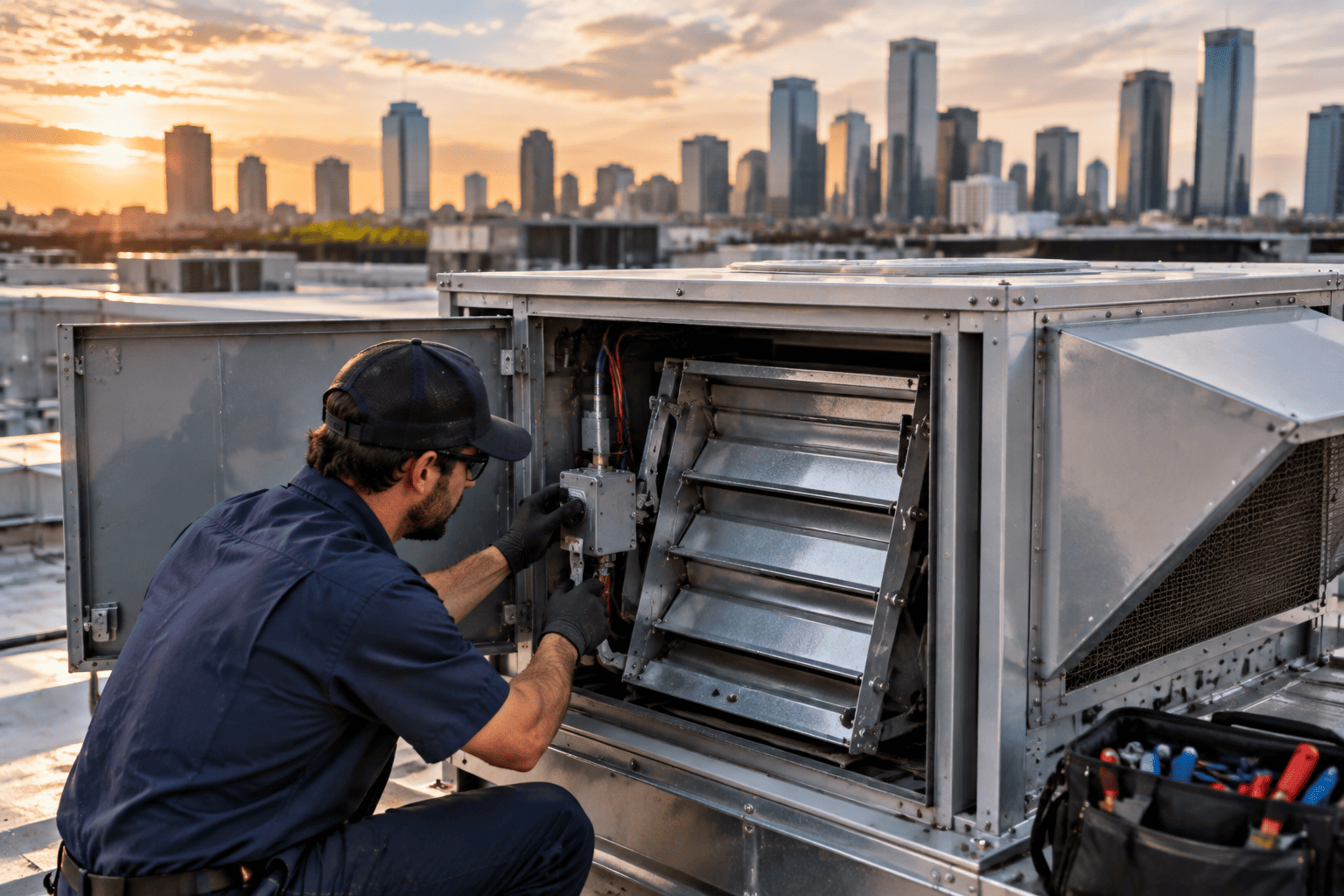
Houston businesses rely on commercial HVAC systems to maintain comfortable indoor conditions, manage ventilation, control humidity, and support daily operations. When an economizer, outdoor-air damper, actuator, sensor, or controller stops operating correctly, a rooftop unit may introduce too much hot, humid outdoor air or fail to use suitable outdoor air when conditions permit. For businesses looking for Commercial HVAC & Industrial Refrigeration Services in Houston TX, ACF Mechanical provides professional diagnostics and commercial HVAC service to identify economizer problems before they lead to comfort complaints, excessive humidity, unnecessary energy consumption, or equipment performance issues.
Economizer problems can be difficult to recognize because their symptoms often resemble other HVAC issues. A building that feels humid, does not cool properly, or experiences unusually long HVAC run times may have a refrigeration, airflow, controls, sensor, or economizer problem. Accurate diagnosis requires evaluating how the complete HVAC system responds to actual indoor and outdoor conditions.
What Does a Commercial HVAC Economizer Do?
A commercial HVAC economizer is a control and damper system designed to use outdoor air for cooling when outdoor conditions are suitable.
Instead of relying entirely on mechanical refrigeration, the HVAC system can increase outdoor airflow under appropriate conditions. This may reduce compressor operation and lower cooling energy consumption.
A typical economizer assembly may include:
- Outdoor-air dampers
- Return-air dampers
- Damper actuator
- Mechanical linkage
- Outdoor-air sensor
- Mixed-air sensor
- Controller
- Wiring and electrical connections
- Outdoor-air hood
- Filters or screens
- Humidity or enthalpy sensors on certain systems
Not every commercial HVAC economizer uses the same control strategy. Some systems use dry-bulb temperature, while others use enthalpy-based controls or more sophisticated building automation logic.
Proper Commercial HVAC economizer troubleshooting Houston therefore starts with identifying the actual equipment configuration and sequence of operation.
Why Economizer Problems Matter for Houston Businesses
Economizer performance is particularly important in a climate such as Houston’s.
During hot and humid conditions, introducing excessive outdoor air can substantially increase both sensible and latent cooling loads.
The HVAC system may have to remove:
- Additional heat
- Additional moisture
- Increased ventilation load
If the economizer is not operating according to its control sequence, a commercial building may experience:
- Higher indoor humidity
- Longer cooling cycles
- Increased energy consumption
- Temperature complaints
- Poor ventilation control
- Reduced occupant comfort
- Additional mechanical cooling demand
Because Houston businesses often depend on rooftop units for large portions of their commercial space, a relatively small damper or actuator problem can affect a significant area of the building.
Common Signs of Commercial HVAC Economizer Problems
Economizer problems do not always trigger an obvious alarm.
Facility managers may first notice changes in comfort or operating behavior.
Possible warning signs include:
- Indoor humidity suddenly increasing
- Building taking longer to cool
- HVAC running longer than normal
- Outdoor-air damper remaining open
- Outdoor-air damper failing to move
- Unusual damper noise
- Actuator moving without corresponding damper movement
- Temperature differences between similar zones
- Excessive outdoor airflow
- Insufficient outdoor airflow
- Unexpected mechanical cooling operation
- Economizer or controller fault codes
- Rising HVAC energy consumption
These symptoms can have several possible causes, so professional Commercial HVAC economizer diagnostics Houston should evaluate the economizer together with the rest of the HVAC system.
Commercial HVAC Economizer Damper Problems
The damper assembly controls how much outdoor and return air enters the HVAC unit.
Problems can develop because of:
- Corrosion
- Dirt and debris
- Bent damper blades
- Binding bearings or pivots
- Damaged linkage
- Loose hardware
- Failed actuator
- Incorrect adjustment
- Physical obstruction
A damper may appear functional during a visual inspection but still fail to reach the commanded position.
Technicians should verify both actuator operation and actual damper movement.
What Happens When an Economizer Damper Is Stuck Open?
A Commercial HVAC economizer damper stuck open Houston problem can become particularly noticeable during hot and humid weather.
If the system continuously introduces more outdoor air than intended, the HVAC equipment may need to handle additional heat and moisture.
Possible effects include:
- Higher cooling load
- Increased indoor humidity
- Longer compressor run times
- Difficulty maintaining temperature
- Higher energy consumption
- Comfort complaints
The effect depends on damper position, HVAC capacity, exhaust operation, building pressure, outdoor conditions, and the system’s ventilation design.
A stuck-open damper should not automatically be blamed for every humidity problem, but it is an important condition to check.
What Happens When an Economizer Damper Is Stuck Closed?
A stuck-closed economizer damper creates a different set of problems.
When outdoor conditions are appropriate for economizer cooling, the HVAC system may be unable to take advantage of that outdoor air.
Possible consequences include:
- Lost economizer cooling opportunity
- Additional mechanical cooling operation
- Reduced energy-saving potential
- Incorrect economizer sequence
Depending on system design, ventilation may also be affected.
However, a stuck economizer damper does not automatically mean that a building receives no required outdoor air. Some systems maintain minimum ventilation through the same damper assembly, while others use different configurations.
Technicians need to understand the specific HVAC design before determining the impact.
Economizer Actuator Problems
The actuator converts an electrical control signal into mechanical movement that positions the dampers.
Common Commercial HVAC economizer actuator problems Houston include:
- Failed actuator motor
- Stripped gears
- Broken actuator shaft
- Loose linkage
- Incorrect control voltage
- Wiring problems
- Incorrect control signal
- Improper calibration
- Mechanical binding
Sometimes an actuator can be heard operating while the damper remains stationary because the linkage has failed.
In other cases, the actuator itself may not receive the correct command.
That distinction matters because replacing a working actuator will not correct a controller, sensor, wiring, or mechanical damper problem.
Economizer Linkage Problems
Mechanical linkage connects the actuator to the damper assembly.
Over time, linkage can become:
- Loose
- Misaligned
- Disconnected
- Bent
- Corroded
- Worn
A linkage problem can produce misleading symptoms.
For example, the actuator may rotate normally, leading someone to assume that the economizer is functioning. But if the linkage is disconnected, the actual damper position may not change.
Professional inspection should confirm commanded position, actuator movement, linkage operation, and actual damper position.
Commercial HVAC Economizer Sensor Problems
Economizer controls depend on sensor information to determine whether outdoor conditions are suitable.
Depending on system design, sensors may monitor:
- Outdoor-air temperature
- Return-air temperature
- Mixed-air temperature
- Outdoor humidity
- Return-air humidity
- Enthalpy
A dirty, damaged, incorrectly positioned, or improperly calibrated sensor can provide inaccurate information.
The controller may then make an incorrect decision even though the actuator and dampers are mechanically functional.
This makes Commercial HVAC economizer sensor problems Houston TX an important part of economizer diagnosis.
Outdoor-Air Temperature Sensor Problems
A dry-bulb economizer may use outdoor temperature as part of its changeover strategy.
If the outdoor-air sensor reports an incorrect temperature, the controller may enable or disable economizer operation at the wrong time.
Technicians may compare sensor readings with actual measured conditions and verify the manufacturer’s expected sensor characteristics.
Simply replacing the damper actuator will not solve an incorrect outdoor-air temperature input.
Enthalpy Sensor and Control Problems
Some commercial HVAC economizers use enthalpy-based control.
Enthalpy represents the heat content of air while accounting for both temperature and moisture.
This can be especially relevant in humid climates because outdoor air that appears moderately warm may still contain significant moisture.
Potential Commercial HVAC enthalpy control problems Houston include:
- Sensor drift
- Failed sensor
- Incorrect controller settings
- Wiring problems
- Sensor contamination
- Incorrect changeover logic
Not every rooftop unit uses enthalpy control, so the control strategy must be identified before troubleshooting.
Mixed-Air Sensor Problems
When outdoor air and return air combine, the result is mixed air entering the downstream HVAC section.
A mixed-air sensor may be used for economizer control, low-temperature protection, or other functions depending on system design.
Incorrect mixed-air temperature readings can affect:
- Damper position
- Economizer operation
- Cooling sequence
- Protection logic
Technicians evaluating Commercial HVAC mixed air temperature problems Houston TX should verify whether the sensor is properly located and whether its reading represents the actual mixed-air condition.
Houston Humidity and Economizer Operation
Houston’s humidity creates an important challenge for commercial HVAC systems.
Air conditioning is responsible not only for lowering temperature but also for controlling moisture.
If an economizer introduces excessive humid outdoor air, the HVAC system may experience increased latent load.
Possible building symptoms include:
- High indoor relative humidity
- Occupants describing the building as clammy
- Longer HVAC operation
- Temperature setpoint being reached while humidity remains high
- Condensation on cold surfaces under certain conditions
A Commercial HVAC economizer high humidity problem Houston should be evaluated together with airflow, cooling coil performance, refrigerant operation, ventilation requirements, controls, and building load.
Humidity alone does not prove an economizer failure.
Houston Heat and Outdoor-Air Load
Texas heat can place substantial demand on commercial rooftop units and other air-conditioning systems.
When outdoor temperatures are high, excessive outdoor airflow increases the sensible cooling load.
If the outdoor air is also humid, the system must handle both additional heat and moisture.
A stuck or incorrectly commanded economizer damper during peak summer conditions can therefore make an existing HVAC capacity or maintenance problem more noticeable.
For commercial buildings in Houston, verifying outdoor-air control should be part of diagnosing unexplained high cooling loads.
Economizer Cooling vs. Mechanical Cooling
Economizer cooling and mechanical refrigeration perform related but different functions.
| Economizer Cooling | Mechanical Cooling |
|---|---|
| Uses suitable outdoor air | Uses the refrigeration cycle |
| Depends heavily on outdoor conditions | Operates across a broader range of outdoor conditions |
| Relies on dampers, sensors, actuators, and controls | Relies on compressors, coils, refrigerant, fans, and controls |
| Can reduce mechanical cooling demand | Provides active cooling |
| Requires correct outdoor-air control | Requires proper refrigeration-system operation |
Many commercial systems coordinate both methods rather than using only one.
An economizer may provide partial cooling while mechanical cooling operates as required by the system’s sequence.
Can Economizer Problems Increase Energy Costs?
Yes, certain economizer failures can increase HVAC energy consumption.
Two opposite failures are particularly important.
Economizer Fails to Open When Conditions Are Suitable
The HVAC system may miss an opportunity to reduce mechanical cooling demand.
Compressors may operate when suitable outdoor-air cooling could otherwise reduce their workload.
Economizer Remains Too Far Open During Unfavorable Conditions
The HVAC system may receive excessive hot or humid outdoor air.
That can increase cooling and dehumidification requirements.
For Houston businesses, both conditions can reduce the energy-saving benefit expected from properly functioning economizer controls.
Rooftop Unit Economizer Problems
Economizers are commonly associated with packaged rooftop HVAC units used in commercial buildings.
A typical rooftop economizer assembly may include:
- Outdoor-air hood
- Outdoor-air damper
- Return-air damper
- Relief or exhaust components depending on design
- Actuator
- Linkage
- Controller
- Temperature sensors
- Humidity or enthalpy sensors where applicable
- Wiring
Common rooftop unit economizer problems Houston TX may result from mechanical wear, weather exposure, corrosion, failed actuators, dirty sensors, damaged wiring, or incorrect settings.
Because rooftop equipment is exposed to Houston weather throughout the year, regular inspection can help identify deterioration before the economizer becomes completely inoperative.
Economizer Problems in Air Handlers
Economizer or outdoor-air control problems are not limited to packaged rooftop units.
Larger commercial air handlers may use:
- Outdoor-air dampers
- Return-air dampers
- Relief-air dampers
- Building automation controls
- Temperature and humidity sensors
- Actuators
The same diagnostic principle applies: technicians need to verify the complete sequence rather than focusing on one component.
For larger commercial buildings in Houston, economizer operation may also interact with building automation and ventilation controls.
Economizers, Chillers, and Central HVAC Systems
A central HVAC system using chillers may still incorporate air-side economizer strategies at air-handling equipment.
In these systems, outdoor-air cooling can potentially reduce the amount of mechanical cooling required when conditions permit.
However, the control strategy can be more complex because it may coordinate:
- Air handlers
- Chilled-water valves
- Supply-air temperature
- Outdoor-air dampers
- Return-air dampers
- Building automation
- Chiller operation
An apparent economizer problem may therefore originate in the air handler, controls, sensors, or central cooling sequence.
Economizer Problems vs. General Airflow Problems
Poor HVAC performance does not always mean the economizer has failed.
Similar symptoms can result from:
- Dirty filters
- Fan or motor problems
- Duct restrictions
- Dirty evaporator coils
- Incorrect fan speed
- Closed fire or balancing dampers
- Building pressure problems
- Supply or return airflow restrictions
For this reason, Commercial HVAC economizer airflow problems Houston should be diagnosed as part of the complete airside system.
Economizer Problems vs. Refrigeration Problems
A building that does not cool properly may have an economizer problem, but refrigeration components can produce similar symptoms.
Possible refrigeration-related causes include:
- Low refrigerant charge
- Refrigerant restriction
- Dirty condenser coil
- Compressor problems
- Expansion valve problems
- Electrical faults
- Control problems
Technicians should verify whether the HVAC unit is receiving excessive outdoor load, failing to provide sufficient mechanical cooling, or experiencing both conditions.
Economizer Problems vs. Controls Problems
A damper that is positioned incorrectly does not necessarily mean the damper or actuator is defective.
The controller may be commanding that position because of:
- Incorrect sensor input
- Wrong setpoint
- Failed controller
- Incorrect programming
- Wiring problem
- Building automation command
- Improper configuration
Effective Commercial HVAC controls repair Houston requires verifying inputs, control logic, outputs, and mechanical response.
Building Pressure and Outdoor-Air Control
Outdoor airflow can affect building pressure.
The actual result depends on:
- Supply airflow
- Return airflow
- Exhaust systems
- Relief-air systems
- Door openings
- Building envelope
- Outdoor-air quantity
Too much or too little outdoor air relative to exhaust and return conditions can contribute to pressure problems.
Possible signs include:
- Doors difficult to open or close
- Air moving strongly through entrances
- Uncontrolled infiltration
- Comfort complaints near doors
- Unusual drafts
These symptoms require building-level airflow evaluation rather than simply adjusting an economizer without measurements.
Economizer Minimum Position
Many systems maintain a minimum outdoor-air damper position or use another control method to provide required ventilation.
The correct position should not be guessed.
It may depend on:
- System design
- Occupancy
- Airflow
- Building use
- Applicable ventilation requirements
- Control sequence
Setting a damper farther open does not automatically improve indoor air quality and can unnecessarily increase cooling and humidity loads.
Similarly, closing it excessively may interfere with the intended ventilation strategy.
Economizer Calibration
Proper economizer calibration may involve verifying:
- Outdoor-air sensor accuracy
- Mixed-air sensor accuracy
- Humidity or enthalpy sensor operation
- Actuator travel
- Damper position
- Minimum-position setting
- Changeover settings
- Controller configuration
- Mechanical linkage
Calibration should confirm that the physical equipment responds correctly to the controller’s commands.
Why Economizer Commissioning Matters
Replacing a failed actuator or sensor does not automatically prove that the complete economizer is working properly.
A good commissioning process evaluates the full sequence:
Sensor input → Controller decision → Control output → Actuator response → Damper movement → HVAC response
For example, technicians may simulate or observe appropriate operating conditions and verify that:
- Sensors report reasonable values
- Controller responds correctly
- Actuator receives the expected command
- Dampers reach the intended position
- Mechanical cooling responds according to the sequence
- Mixed-air conditions are appropriate
This approach helps prevent repeated service calls caused by incomplete repairs.
Economizer Corrosion and Weather Exposure
Rooftop economizers operate in an environment exposed to outdoor air, dust, rain, humidity, and temperature changes.
Over time, these conditions can affect:
- Damper blades
- Linkage
- Electrical connectors
- Sensors
- Actuator mounting
- Outdoor-air hood
Houston’s humid environment can contribute to corrosion of exposed components, although equipment condition also depends on materials, installation, drainage, maintenance, and exposure.
Regular inspection can identify corrosion before it prevents proper damper movement.
Commercial HVAC Economizer Repair vs. Replacement
Not every economizer problem requires complete replacement.
Repair may be appropriate when the issue involves:
- Loose linkage
- Wiring
- Sensor failure
- Actuator failure
- Calibration
- Controller settings
- Minor mechanical damage
More extensive replacement may be considered when:
- Damper assembly is badly corroded
- Multiple mechanical components have failed
- Controls are obsolete or unavailable
- Assembly is severely damaged
- Repair cost is disproportionate to equipment condition
The correct decision depends on equipment age, parts availability, overall rooftop-unit condition, and the nature of the failure.
Preventing Commercial HVAC Economizer Problems
Preventive HVAC maintenance can identify many economizer problems before they become major comfort or energy issues.
A professional inspection may include:
- Inspecting outdoor-air dampers
- Checking return-air dampers
- Testing actuator operation
- Inspecting linkage
- Checking damper movement
- Inspecting outdoor-air hood
- Cleaning accessible debris
- Testing temperature sensors
- Checking humidity or enthalpy sensors where applicable
- Inspecting wiring
- Reviewing controller settings
- Verifying minimum position
- Checking mixed-air temperature
- Testing economizer sequence
- Looking for corrosion
Professional Commercial HVAC economizer maintenance Houston is particularly useful before periods of heavy cooling demand.
Economizer Inspection Checklist for Facility Managers
Facility managers can watch for operational changes between scheduled HVAC service visits.
Indoor Conditions
Look for:
- Higher humidity
- Hot or cold complaints
- Unusual drafts
- Areas that suddenly become difficult to cool
HVAC Operation
Monitor:
- Longer run times
- Unexpected compressor operation
- Frequent HVAC alarms
- Changes in supply-air temperature
- Unusual damper or actuator noises
Outdoor-Air Components
Without opening energized HVAC equipment, visually note:
- Damaged outdoor-air hood
- Visible debris
- Physical damage
- Severe corrosion
- Loose exterior components
Electrical and internal mechanical diagnostics should be performed by qualified technicians.
When to Schedule Commercial HVAC Economizer Service
Houston businesses should consider professional HVAC service when:
- Economizer damper does not move
- Damper appears stuck open
- Damper appears stuck closed
- Actuator repeatedly fails
- Indoor humidity rises unexpectedly
- Building becomes difficult to cool
- HVAC run time increases significantly
- Economizer fault appears
- Energy consumption changes without an obvious operational reason
- Ventilation complaints develop
Early diagnosis can often prevent a relatively small control or damper problem from contributing to larger HVAC performance issues.
Why Houston Businesses Choose ACF Mechanical
Commercial economizer problems require knowledge of more than a single actuator or sensor.
Technicians need to understand airflow, refrigeration, electrical systems, HVAC controls, ventilation, humidity, rooftop-unit operation, and the sequence connecting those components.
Houston businesses choose ACF Mechanical for:
- Experienced technicians
- Commercial HVAC expertise
- Rooftop unit diagnostics
- HVAC controls knowledge
- Economizer and ventilation troubleshooting
- Refrigeration knowledge
- Preventive maintenance
- Fast response
- Reliable service
ACF Mechanical works with business owners, facility managers, restaurants, warehouses, industrial companies, commercial property owners, and other Texas businesses that depend on reliable HVAC operation.
Keep Your Commercial HVAC Economizer Working Properly
A properly functioning economizer can support ventilation and reduce mechanical cooling demand when outdoor conditions are appropriate. But when dampers, actuators, sensors, linkage, wiring, or controls fail, the economizer can become a source of cooling, humidity, ventilation, and energy problems.
Houston’s combination of high temperatures and humidity makes accurate outdoor-air control especially important for commercial HVAC systems.
With professional Commercial HVAC & Industrial Refrigeration Services in Houston TX, ACF Mechanical can evaluate rooftop economizers, outdoor-air dampers, actuators, sensors, controls, airflow, mechanical cooling, and overall system operation.
If your commercial building is experiencing high humidity, unusually long HVAC run times, outdoor-air damper problems, economizer faults, or unexplained cooling issues, contact ACF Mechanical for professional commercial HVAC diagnostics and service in Houston, TX.