
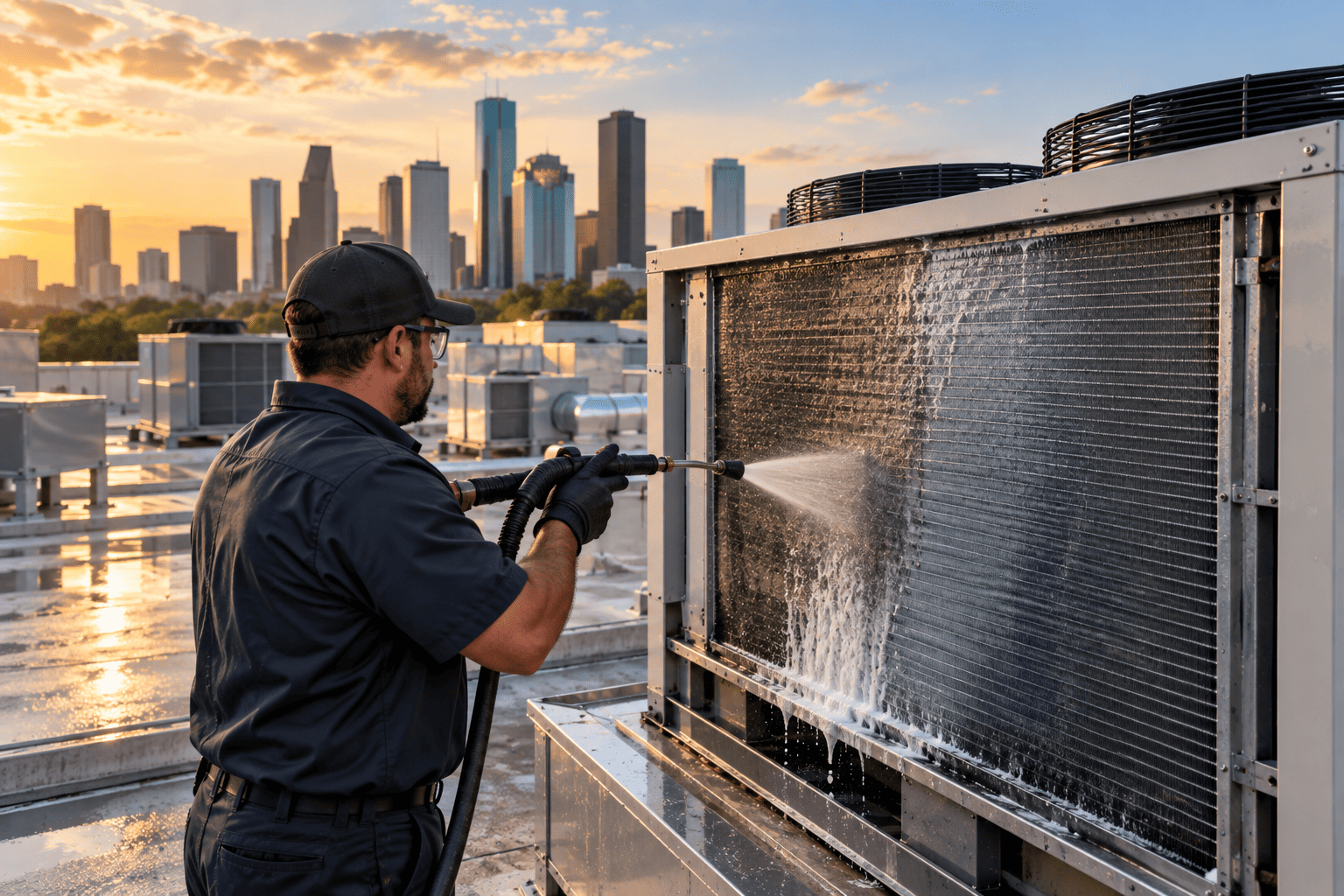
Dirty evaporator and condenser coils can gradually reduce the performance of commercial HVAC and refrigeration equipment without causing an immediate shutdown. As dirt, dust, grease, pollen, and other contaminants accumulate on heat-transfer surfaces, equipment may run longer, cooling capacity may decline, and operating conditions can become more demanding. For Houston businesses, professional Commercial HVAC & Industrial Refrigeration Services in Houston TX can determine whether dirty coils are contributing to poor cooling, airflow restrictions, high operating costs, evaporator icing, or condenser problems. ACF Mechanical provides professional inspection, cleaning, diagnostics, repair, and preventive maintenance for commercial HVAC and refrigeration systems throughout Houston, TX.
Why Evaporator and Condenser Coils Are Critical
HVAC and refrigeration systems depend on heat transfer.
Although system designs vary, two major heat exchangers commonly involved in the refrigeration cycle are the evaporator and condenser.
What Does an Evaporator Coil Do?
The evaporator absorbs heat from the air or process being cooled.
In a commercial air handler, return air passes across the evaporator coil. Refrigerant inside the coil absorbs heat, and the conditioned air is then distributed through the building.
Commercial refrigeration evaporators perform a similar heat-transfer function inside refrigerated spaces such as:
- Walk-in coolers
- Walk-in freezers
- Cold-storage rooms
- Refrigerated warehouses
- Food-service refrigeration systems
If dirt or other material covers the evaporator surface, heat transfer and airflow can be affected.
What Does a Condenser Coil Do?
The condenser rejects heat absorbed by the refrigeration system.
Air-cooled condensers rely on airflow across the condenser surface to release heat to the surrounding air.
When a condenser becomes heavily contaminated, heat rejection becomes more difficult.
This can be especially important for equipment operating outdoors during Houston’s high summer temperatures.
How Dirty HVAC Coils Reduce Heat Transfer
Coil fins provide a large surface area for exchanging heat with the surrounding air.
Accumulated contamination can act as an unwanted barrier between the air and the heat-transfer surface.
Depending on the severity and location of contamination, dirty coils may contribute to:
- Reduced heat transfer
- Restricted airflow
- Longer equipment runtime
- Reduced cooling capacity
- Higher energy consumption
- Unstable operating conditions
- Additional compressor stress
- Evaporator icing in some situations
- High condensing temperatures or pressures
The exact effect depends on the equipment, coil condition, airflow, refrigeration charge, load, and other operating factors.
A professional commercial HVAC coil inspection Houston TX should therefore evaluate more than visible dirt alone.
Signs of a Dirty Commercial HVAC Evaporator Coil
A dirty evaporator can create symptoms similar to several other HVAC problems.
Possible warning signs include:
- Weak cooling
- Reduced supply airflow
- Longer cooling cycles
- Uneven temperatures
- Difficulty controlling indoor humidity
- Evaporator icing
- Increased energy consumption
- Poor temperature recovery
- Equipment operating longer than expected
A dirty evaporator coil commercial HVAC Houston businesses discover should be inspected along with the filters, blower, ductwork, refrigerant system, controls, and other airflow components.
Cleaning the evaporator may improve performance when contamination is the root problem, but it should not be treated as the automatic solution to every airflow or cooling complaint.
What Causes Commercial Evaporator Coils to Become Dirty?
Air passing through an HVAC system can carry airborne contamination.
Normally, properly selected and maintained filtration helps capture much of this material before it reaches the evaporator.
Coil contamination may become more likely when there are:
- Dirty filters
- Missing filters
- Incorrect filter installation
- Gaps around filter racks
- Damaged filters
- Inadequate filtration
- Heavy airborne dust
- Construction activity
- Poor maintenance
- Contaminated return-air conditions
Over time, fine particles can collect on coil fins.
When moisture is present on an operating cooling coil, some contaminants can adhere more easily to the surface.
Commercial HVAC Evaporator Coil Icing
A dirty evaporator can sometimes contribute to coil icing by restricting airflow and changing heat-transfer conditions.
However, commercial HVAC evaporator coil icing Houston TX should not automatically be blamed on dirt.
Other possible causes include:
- Dirty filters
- Blower problems
- Fan motor problems
- Closed or restricted airflow paths
- Refrigerant problems
- Control issues
- Low load conditions
- Sensor problems
When a commercial evaporator freezes, technicians should diagnose the reason rather than simply removing the ice.
Repeated icing can indicate a condition that requires repair or maintenance.
Signs of a Dirty Commercial HVAC Condenser Coil
Outdoor condenser coils face different contamination than indoor evaporators.
Depending on location, they may collect:
- Dust
- Pollen
- Leaves
- Grass or landscaping debris
- Construction dust
- Grease and airborne contaminants near commercial kitchens
- General environmental debris
A dirty condenser coil commercial HVAC Houston TX may contribute to:
- Reduced cooling capacity
- Longer compressor runtime
- Higher condensing temperature
- Increased condensing pressure
- Increased electrical consumption
- Compressor stress
- Protective shutdowns under severe operating conditions
These symptoms can also have other causes, making proper diagnosis important.
Houston Heat and Dirty Condenser Coils
Houston commercial cooling systems often operate under demanding outdoor conditions.
During periods of high Texas heat, an air-cooled condenser must reject heat into already hot outdoor air.
A clean condenser does not eliminate the challenges created by high ambient temperatures, but adequate airflow and clean heat-transfer surfaces help equipment operate as intended.
When a condenser is heavily contaminated, the system may have greater difficulty rejecting heat.
The combination of:
- High outdoor temperature
- Heavy cooling demand
- Restricted condenser airflow
- Dirty heat-transfer surfaces
can create more demanding operating conditions for compressors and condenser fans.
For commercial buildings in Houston, condenser cleanliness should therefore be part of a broader preventive-maintenance strategy.
Can Dirty Condenser Coils Cause High Head Pressure?
A heavily restricted or dirty air-cooled condenser can contribute to elevated condensing pressure because heat is not being rejected effectively.
However, commercial HVAC high head pressure dirty condenser Houston should not be treated as a complete diagnosis.
High condensing pressure can also be associated with:
- Condenser fan problems
- Airflow restrictions
- Refrigerant conditions
- Incorrect system operation
- Recirculation of hot condenser air
- High ambient temperature
- Other mechanical issues
Technicians should evaluate the complete refrigeration circuit before deciding that cleaning alone will solve the problem.
Rooftop Unit Coil Cleaning in Houston
Rooftop HVAC units are common on offices, restaurants, retail buildings, warehouses, and other commercial properties.
Because much of the equipment is outdoors, condenser coils can be exposed continuously to environmental contaminants.
Potential rooftop-unit coil concerns include:
- Dust accumulation
- Pollen
- Leaves and debris
- Grease near restaurant exhaust
- Construction contamination
- Damaged fins
- Corrosion
- Restricted condenser airflow
Professional rooftop unit coil cleaning Houston should be performed using methods appropriate for the coil construction and level of contamination.
The technician should also inspect fan operation, electrical components, refrigerant performance, filters, drains, and other relevant components rather than treating the coil as an isolated part.
Rooftop Unit Evaporator Coil Problems
The evaporator inside a rooftop unit may be less visible than the condenser, allowing contamination to develop unnoticed.
A rooftop unit dirty evaporator coil Houston businesses experience may contribute to:
- Reduced airflow
- Lower cooling capacity
- Longer runtime
- Poor humidity control
- Coil icing
- Increased operating costs
Inspection may require access to internal sections of the rooftop unit.
Filters, blower components, drain pans, and the downstream side of the coil may also need evaluation.
Air Handler Evaporator Coil Cleaning
Commercial air handlers can move large volumes of air through a building.
When an air handler evaporator becomes contaminated, the effect can extend beyond the coil itself.
Restricted airflow can influence:
- Supply-air volume
- Space temperature
- Humidity control
- Fan operation
- Equipment runtime
- Overall comfort
Professional air handler evaporator coil cleaning Houston should be combined with an assessment of why the contamination occurred.
If poorly fitted filters allow dust to bypass the filtration system, cleaning the coil without correcting the filter issue may result in rapid recontamination.
Commercial Chiller Coil Maintenance
The term “chiller coil cleaning” can refer to different maintenance procedures depending on chiller design.
Air-cooled chillers typically use outdoor condenser coils that depend on ambient airflow for heat rejection.
For these systems, air-cooled chiller condenser coil cleaning Houston can be an important maintenance task when contamination restricts airflow or covers heat-transfer surfaces.
Water-cooled chillers use different heat exchangers and water circuits, so their cleaning and maintenance requirements differ significantly.
A professional technician should identify the chiller type and follow equipment-specific procedures rather than applying the same cleaning approach to every chiller.
Industrial Refrigeration Evaporator Coil Problems
Industrial refrigeration evaporators may operate in warehouses, processing facilities, cold-storage spaces, and other demanding environments.
A dirty industrial refrigeration evaporator coil Houston TX can restrict airflow and reduce heat-transfer performance.
Possible contamination depends on the facility and may include:
- Dust
- Packaging debris
- Food-related residue
- Airborne particles
- Frost or ice
- Process contaminants
It is important to distinguish between dirt accumulation and ice accumulation.
A coil blocked by frost may indicate a defrost, airflow, infiltration, or refrigeration problem rather than a need for conventional coil cleaning.
Industrial Refrigeration Condenser Cleaning
Industrial refrigeration systems may use different condenser designs, including air-cooled, evaporative, or water-cooled arrangements.
Maintenance requirements vary accordingly.
For air-cooled equipment, dirty condenser surfaces can restrict airflow and reduce heat rejection.
Other condenser types require different inspection and maintenance procedures.
Professional industrial refrigeration condenser coil cleaning Houston should therefore be based on actual equipment design rather than a one-size-fits-all cleaning method.
Walk-In Cooler Evaporator Coil Cleaning
Walk-in coolers depend on unobstructed airflow across the evaporator to maintain stable temperatures.
Potential warning signs of a dirty evaporator include:
- Weak airflow
- Uneven box temperatures
- Longer compressor runtime
- Reduced refrigeration capacity
- Visible contamination
- Temperature recovery problems
Professional walk-in cooler evaporator coil cleaning Houston TX should include inspection of the evaporator fans, drain system, door condition, controls, and refrigeration performance.
If the coil is covered in ice instead of dirt, technicians should determine why the icing is occurring before treating it as a cleaning problem.
Walk-In Cooler Condenser Coil Problems
Many walk-in cooler condensing units rely on air-cooled condensers.
When condenser surfaces become dirty, refrigeration performance may deteriorate.
A walk-in cooler dirty condenser coil Houston may contribute to:
- Longer compressor runtime
- Elevated condensing conditions
- Reduced cooling capacity
- Higher energy use
- Compressor stress
- Unexpected shutdowns
Restaurants should pay particular attention to condenser contamination where equipment is exposed to grease, dust, or other kitchen-related airborne material.
Walk-In Freezer Coil Maintenance
Walk-in freezers operate under low-temperature conditions and may accumulate both contamination and frost.
These are not the same problem.
Walk-in freezer evaporator coil cleaning Houston may be appropriate for physical contamination, while heavy ice accumulation may require diagnosis of:
- Defrost controls
- Heaters
- Sensors
- Door infiltration
- Fan operation
- Drainage
- Refrigeration conditions
Proper diagnosis prevents unnecessary cleaning when the actual issue is a defrost-system failure.
Restaurant Refrigeration Coil Cleaning
Commercial kitchens can create challenging environments for refrigeration equipment.
Grease, dust, heat, and airborne cooking residue can accumulate around refrigeration condensers, particularly when equipment is poorly located or maintenance is neglected.
Restaurant refrigeration coil cleaning Houston can help maintain heat-transfer performance when contamination is present.
Restaurant refrigeration maintenance should also consider:
- Condenser fan operation
- Door gaskets
- Evaporator airflow
- Drainage
- Refrigeration temperatures
- Compressor condition
- Electrical components
Coil cleaning works best as part of complete equipment maintenance rather than as an isolated service.
Cold Storage and Warehouse Refrigeration Coils
Cold-storage facilities and refrigerated warehouses may use large evaporators and condensers serving significant product loads.
Reduced heat-transfer performance can affect more than comfort—it can influence temperature stability and business operations.
Warehouse refrigeration coil cleaning Houston TX may be appropriate when dirt or facility-related contamination affects evaporator or condenser performance.
Technicians should also evaluate:
- Loading activity
- Door traffic
- Air infiltration
- Evaporator fan operation
- Defrost performance
- Refrigeration controls
- Temperature history
This broader evaluation helps distinguish contamination from operational or mechanical problems.
Dirty Coil, Fan Problem, or Refrigerant Problem?
Many HVAC and refrigeration problems produce similar symptoms.
| Symptom | Possible Coil Problem | Other Possible Cause |
|---|---|---|
| Weak cooling | Dirty evaporator | Refrigerant problem |
| Low airflow | Dirty evaporator | Filter or fan problem |
| Long runtime | Poor heat transfer | Controls or excessive load |
| High condensing pressure | Dirty condenser | Fan or refrigerant problem |
| Evaporator icing | Restricted airflow | Refrigerant/control problem |
| High energy use | Dirty coils | Multiple equipment issues |
| Compressor overheating | Poor heat rejection | Electrical/mechanical problem |
| Uneven temperatures | Reduced airflow | Distribution/control issue |
This is why professional diagnostics are more valuable than replacing or cleaning components based only on one symptom.
Can Dirty Coils Increase Commercial HVAC Energy Costs?
Dirty heat-transfer surfaces can make equipment operate less efficiently.
If a system must run longer to satisfy the same cooling load, electricity consumption may increase.
However, commercial HVAC high energy bills dirty coils Houston TX is only one possible explanation for rising utility costs.
Other causes may include:
- Extreme outdoor temperatures
- Building load changes
- Refrigerant problems
- Fan or motor problems
- Control issues
- Poor scheduling
- Aging equipment
- Duct leakage
- Building-envelope problems
Coil inspection should therefore be part of a complete performance evaluation.
Can Dirty Coils Damage a Compressor?
A dirty coil does not automatically cause compressor failure.
However, severe heat-transfer problems can force equipment to operate under more demanding conditions.
A heavily contaminated condenser may contribute to elevated condensing temperature and pressure, while a restricted evaporator may reduce airflow and alter refrigeration conditions.
Over time, abnormal operating conditions can increase equipment stress.
The best approach is to address coil contamination before it becomes severe and to diagnose any compressor-related symptoms separately.
Coil Dirt vs. Coil Corrosion
Cleaning and repair are not interchangeable.
Surface contamination may often be removable with an appropriate professional cleaning procedure.
Corrosion is physical deterioration of the coil material and requires a different assessment.
Possible commercial HVAC coil corrosion Houston TX concerns include:
- Deteriorating fins
- Damaged tubing
- Reduced structural integrity
- Refrigerant leaks
- Loss of heat-transfer surface
- Progressive equipment deterioration
Cleaning cannot repair corroded tubing or stop an active refrigerant leak.
If corrosion is severe, technicians may need to evaluate repair or coil replacement.
Bent Fins and Physical Coil Damage
Coil fins are relatively delicate.
Bent fins can restrict airflow through portions of the heat exchanger.
Damage may occur because of:
- Improper cleaning
- Pressure washing
- Physical impact
- Maintenance errors
- Debris
- Weather-related damage
Professional inspection should distinguish between contamination and physical coil damage.
This is one reason aggressive cleaning methods should not be used indiscriminately.
Why Improper Pressure Washing Can Damage HVAC Coils
Using excessive water pressure on a coil can bend fins and damage delicate surfaces.
Improper cleaning may also:
- Push debris deeper into the coil
- Damage coatings
- Affect electrical components
- Leave cleaning chemicals improperly rinsed
- Create drainage problems
- Damage surrounding equipment
Professional commercial HVAC coil cleaning Houston TX should use cleaning methods appropriate for the coil type, contamination, equipment design, and manufacturer requirements.
The goal is to restore heat-transfer surfaces without damaging them.
How Professional Coil Cleaning Is Approached
The appropriate procedure varies by equipment.
A technician may first evaluate:
- Coil construction
- Type of contamination
- Severity of buildup
- Fin condition
- Equipment accessibility
- Electrical components nearby
- Drainage
- Manufacturer requirements
- Environmental and facility conditions
Cleaning methods can then be selected for the specific application.
After cleaning, equipment performance should be evaluated rather than assuming that visible cleanliness alone confirms proper operation.
When Coil Cleaning Is Not Enough
Coil cleaning can restore heat-transfer performance when dirt is the actual problem.
It will not repair:
- Refrigerant leaks
- Severe coil corrosion
- Failed fan motors
- Damaged compressors
- Defective sensors
- Electrical failures
- Control problems
- Major duct restrictions
- Defrost-system failures
- Physical coil damage
If performance remains poor after contamination is addressed, professional commercial HVAC repair Houston TX or industrial refrigeration diagnostics may be necessary.
This is why ACF Mechanical focuses on system condition rather than treating every cooling problem as a cleaning issue.
Preventive Commercial HVAC Coil Maintenance
Professional commercial HVAC maintenance Houston TX can help prevent heavy coil contamination and identify developing problems earlier.
A maintenance visit may include evaluation of:
- Evaporator cleanliness
- Condenser cleanliness
- Filters
- Airflow
- Fan operation
- Coil fins
- Drain pans
- Condensate drainage
- Refrigeration performance
- Electrical components
- Controls
- Operating temperatures
The exact scope depends on equipment type and maintenance requirements.
Regular inspection is particularly valuable for commercial buildings in Houston where cooling equipment may operate heavily for much of the year.
Preventive Industrial Refrigeration Coil Maintenance
Professional industrial refrigeration maintenance Houston TX should consider the condition of heat-transfer equipment as part of the complete refrigeration system.
Depending on the facility, maintenance may include:
- Evaporator inspection
- Condenser inspection
- Fan operation
- Frost and ice patterns
- Defrost performance
- Drainage
- Refrigeration controls
- Temperature monitoring
- Compressor operation
- Electrical components
The maintenance approach should reflect the equipment design and operating environment.
When Dirty Coils Can Become an Urgent Problem
A dirty coil is not always an emergency.
However, immediate professional attention may be appropriate when contamination is associated with:
- Loss of critical cooling
- High-pressure shutdowns
- Compressor overheating
- Walk-in cooler temperature rise
- Walk-in freezer temperature rise
- Repeated equipment shutdowns
- Critical product-temperature concerns
- Severe evaporator icing
- Failure to maintain commercial building conditions
Emergency refrigeration repair Houston TX or commercial HVAC service may be necessary when equipment can no longer maintain required operating conditions.
Commercial HVAC and Refrigeration Coil Checklist
Facility managers can use the following warning signs to decide when professional inspection may be needed.
Evaporator Warning Signs
- Visible dirt or debris
- Reduced airflow
- Weak cooling
- Coil icing
- Long equipment runtime
- Poor humidity control
Condenser Warning Signs
- Visible contamination
- Debris blocking the coil
- Longer compressor runtime
- Reduced cooling performance
- Repeated high-pressure problems
- Equipment shutdowns during hot weather
Refrigeration Warning Signs
- Walk-in temperature instability
- Poor evaporator airflow
- Compressor running unusually long
- Dirty condenser surfaces
- Repeated icing
- Slow temperature recovery
Visible dirt is useful information, but technicians should still evaluate the complete equipment condition.
Why Houston Businesses Choose ACF Mechanical
Coil maintenance requires more than making a heat exchanger look clean.
Technicians must understand how evaporator and condenser condition affects airflow, refrigeration pressures, compressors, fans, controls, and overall equipment performance.
Houston businesses choose ACF Mechanical for:
- Experienced technicians
- Commercial HVAC expertise
- Industrial refrigeration knowledge
- Professional coil inspection and cleaning
- Preventive maintenance
- HVAC and refrigeration diagnostics
- Fast response
- Reliable service
- Experience with rooftop units, air handlers, chillers, commercial AC systems, walk-in coolers, walk-in freezers, and industrial refrigeration equipment
ACF Mechanical works with business owners, facility managers, restaurants, warehouses, industrial companies, and commercial property owners throughout Houston, TX.
Keep Commercial HVAC and Refrigeration Coils Working Efficiently
Dirty evaporator and condenser coils can gradually reduce heat-transfer performance, restrict airflow, increase equipment runtime, and create more demanding operating conditions.
The solution begins with determining whether contamination is actually causing the problem.
Professional Commercial HVAC & Industrial Refrigeration Services in Houston TX from ACF Mechanical can identify dirty coils, airflow restrictions, condenser problems, refrigeration issues, fan failures, corrosion, and other conditions that may be affecting system performance.
For Houston businesses, proactive coil inspection and preventive maintenance can help support reliable cooling, stable refrigeration temperatures, efficient operation, and longer equipment life.
If your rooftop unit, air handler, chiller, walk-in cooler, walk-in freezer, or industrial refrigeration system is experiencing poor cooling, long runtime, dirty coils, or reduced heat-transfer performance, contact ACF Mechanical for professional inspection and service in Houston, TX.