
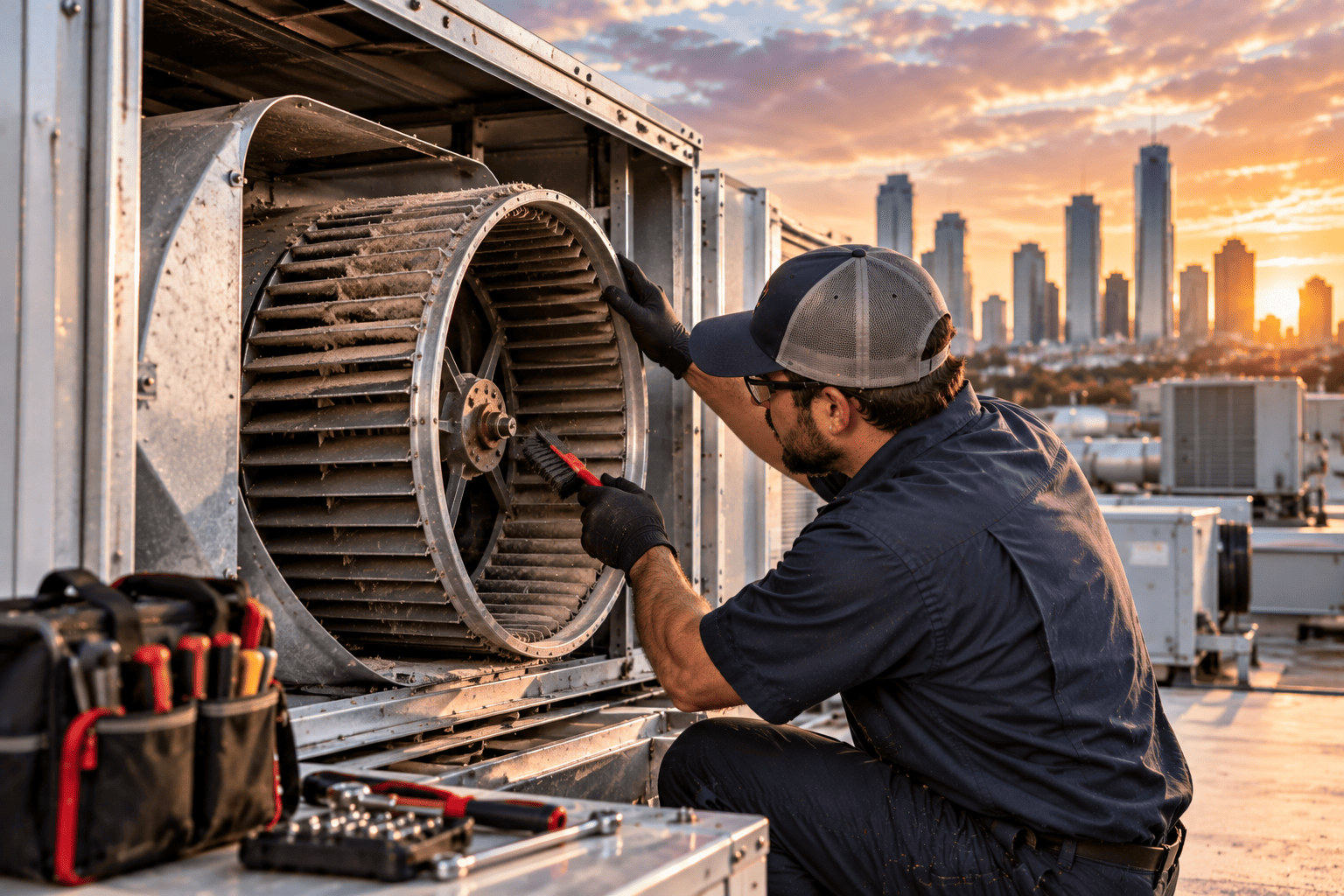
Commercial buildings depend on their HVAC blowers to move conditioned air reliably throughout occupied spaces. When a blower wheel becomes heavily contaminated, damaged, or unbalanced, airflow can decline while noise, vibration, and mechanical stress increase. For Houston businesses searching for Commercial HVAC & Industrial Refrigeration Services in Houston TX, ACF Mechanical provides professional diagnostics, cleaning, repair, and preventive maintenance for rooftop units, air handlers, commercial AC systems, blowers, motors, bearings, and related HVAC components.
Blower wheel problems are not always obvious. A system may continue operating while the wheel gradually accumulates dirt or develops mechanical wear. Facility managers may first notice weak airflow, unusual vibration, increased noise, uneven temperatures, or longer HVAC operation. Proper diagnosis requires evaluating the complete air-moving system rather than assuming every airflow problem comes from a dirty blower wheel.
What Does a Commercial HVAC Blower Wheel Do?
A blower wheel converts mechanical rotation into airflow.
Depending on the equipment design, an electric motor may drive the blower directly or transfer power through belts and pulleys. As the wheel rotates, its blades move air through the HVAC cabinet, coils, duct system, and occupied spaces.
Commercial equipment may use different fan and blower designs, including centrifugal blower wheels commonly found in air handlers and rooftop units.
The basic airflow process can be simplified as:
Motor → Blower Drive → Blower Wheel → Airflow → Duct System → Commercial Space
If the wheel cannot move air as intended, the performance of the entire air-distribution system may be affected.
Common Signs of Blower Wheel Problems
The symptoms of Commercial HVAC blower wheel problems Houston TX vary depending on whether the issue involves contamination, imbalance, mechanical damage, bearings, the motor, or another component.
Common warning signs include:
- Reduced supply airflow
- Uneven airflow between areas
- Unusual vibration
- Rattling or scraping sounds
- Increasing blower noise
- Visible dirt on blower blades
- Dust accumulation inside the blower section
- Longer HVAC operating cycles
- Difficulty maintaining indoor temperature
- Blower wheel wobble
- Repeated bearing problems
- Motor overheating
- Blower not operating correctly
These symptoms should be diagnosed professionally because several different HVAC problems can produce similar results.
Why Do Commercial HVAC Blower Wheels Get Dirty?
Air moving through an HVAC system can carry dust, fibers, grease, debris, and other airborne contaminants.
Filters are designed to capture contaminants before they reach downstream equipment, but no filtration system is perfect. Contamination can become more significant when filters are neglected, improperly installed, damaged, bypassing air, or unsuitable for the application.
Potential contributors to blower wheel buildup include:
- Dust accumulation
- Poor filter maintenance
- Filter bypass
- Construction debris
- Fibers and particulate matter
- Grease or airborne contaminants
- Dirty HVAC cabinets
- Extended operation between maintenance visits
Restaurants, warehouses, industrial facilities, retail buildings, and other commercial properties may experience different contamination patterns depending on their operations and indoor environment.
How a Dirty Blower Wheel Affects Airflow
A centrifugal blower wheel depends on its blade geometry to move air.
When substantial dirt accumulates on the blades, their effective shape and surface condition change. Heavy contamination can interfere with the wheel’s ability to move air efficiently.
A Commercial HVAC dirty blower wheel Houston problem may contribute to:
- Reduced airflow
- Changed fan performance
- Poor air distribution
- Increased HVAC operating time
- Difficulty maintaining temperature
- Increased mechanical load under some conditions
However, a dirty blower wheel should not automatically be blamed whenever airflow is low.
Other possible causes include:
- Dirty air filters
- Dirty evaporator coils
- Closed or restricted dampers
- Duct restrictions
- Belt and pulley problems
- Motor problems
- VFD problems
- Incorrect fan speed
- Static-pressure problems
- Economizer problems
Professional diagnosis should evaluate the entire airflow path.
Dirty Blower Wheels and Static Pressure
Static pressure is an important part of commercial HVAC airflow diagnostics.
A blower operates as part of a system that includes filters, coils, ductwork, dampers, grilles, diffusers, and other restrictions.
If airflow is poor, technicians may need to determine whether the blower itself is underperforming or whether excessive system resistance is limiting airflow.
A dirty blower wheel static pressure Houston complaint therefore cannot be diagnosed from the blower wheel alone.
Depending on the equipment, technicians may evaluate:
- Supply static pressure
- Return static pressure
- Total external static pressure
- Filter pressure drop
- Coil condition
- Fan speed
- Motor load
- Duct restrictions
This helps separate blower problems from airflow restrictions elsewhere in the system.
What Causes a Blower Wheel to Become Unbalanced?
A blower wheel should rotate smoothly around its shaft.
When mass is distributed unevenly around the rotating assembly, imbalance can produce vibration.
Possible causes include:
- Uneven dirt buildup
- Missing balance weights
- Physical damage
- Bent components
- Loose wheel mounting
- Foreign material attached to the wheel
- Corrosion
- Wheel deterioration
A Commercial HVAC unbalanced blower wheel Houston TX may become more noticeable as fan speed increases.
Cleaning can correct some contamination-related imbalance, but mechanical damage may require repair or blower wheel replacement.
Why Blower Wheel Vibration Matters
Vibration should not be treated as only a noise or comfort problem.
Continued vibration can transmit mechanical forces into surrounding components.
Depending on severity and equipment design, excessive vibration may contribute to wear involving:
- Blower bearings
- Motor bearings
- Shafts
- Mounting hardware
- Belts
- Pulleys
- Motor mounts
- Blower housing
A Commercial HVAC blower wheel vibration Houston issue should therefore be investigated before additional components are affected.
Blower Wheel Problems vs. Belt and Pulley Problems
Belt-driven air handlers and rooftop units contain several components capable of creating similar symptoms.
For example, vibration may result from:
- Blower wheel imbalance
- Belt misalignment
- Worn belts
- Worn pulleys
- Incorrect belt tension
- Bearing wear
- Loose motor mounts
- Fan wheel damage
Low airflow can also result from a slipping belt even when the blower wheel itself is relatively clean.
Professional Commercial HVAC repair Houston TX should identify the actual source rather than replacing components based on symptoms alone.
Blower Wheel Problems vs. Motor Problems
The blower wheel and motor work together, but a problem with one should not automatically be diagnosed as a problem with the other.
A blower that rotates slowly or stops may involve:
- Motor failure
- Electrical problems
- VFD or control problems
- Mechanical binding
- Bearing failure
- Belt failure
- Damaged blower assembly
Likewise, motor overheating does not automatically prove that the blower wheel is dirty.
Technicians may need to evaluate motor amperage, electrical supply, mechanical resistance, fan speed, bearing condition, and blower operation before determining the cause.
Blower Bearings and Shaft Problems
Bearings support the rotating blower shaft and allow the assembly to operate smoothly.
Bearing wear can create:
- Rumbling
- Grinding
- Vibration
- Excessive shaft movement
- Heat
- Mechanical resistance
Shaft problems can also cause the wheel to rotate incorrectly.
When diagnosing Commercial HVAC blower bearing problems Houston TX, technicians should determine whether bearing damage is the primary failure or whether another condition—such as imbalance or alignment problems—has contributed to the wear.
Blower Wheel Noise: What Different Sounds May Indicate
Unusual sounds can provide useful clues, but sound alone should not be used for a final diagnosis.
Rattling
Possible causes include loose hardware, wheel damage, cabinet vibration, or debris.
Scraping
A blower wheel may be contacting its housing, or another mechanical component may have shifted.
Rumbling or Grinding
Bearing wear or other rotating-component problems may be involved.
Repetitive Vibration or Pulsation
Wheel imbalance, drive problems, or mounting issues may be contributing.
Humming
Electrical or motor issues may need to be investigated.
A professional inspection can determine whether the noise originates from the blower wheel, motor, bearings, belt drive, cabinet, or another component.
Rooftop Unit Blower Wheel Problems
Rooftop units are widely used in commercial buildings in Houston.
Depending on design, an RTU may contain a belt-driven or direct-drive supply fan. The blower section operates whenever conditioned air must be delivered to the building.
Potential rooftop unit blower wheel problems Houston TX include:
- Dirt buildup
- Wheel imbalance
- Damaged blades
- Loose wheel mounting
- Bearing problems
- Belt-drive problems
- Motor problems
- Vibration
Professional Commercial HVAC rooftop unit repair Houston should consider the blower as part of the entire rooftop HVAC system.
Technicians may also inspect filters, coils, belts, pulleys, motors, electrical components, dampers, controls, and airflow conditions.
Commercial Air Handler Blower Problems
Large air handlers can move substantial volumes of air through commercial buildings.
A blower problem in a central air handler can therefore affect multiple spaces or operating zones.
Potential Commercial air handler blower problems Houston TX include:
- Contaminated blower wheels
- Bearing wear
- Fan imbalance
- Shaft problems
- Belt-drive problems
- Motor problems
- VFD problems
- Incorrect fan speed
- Excessive vibration
Professional Commercial air handler repair Houston TX should evaluate the complete fan assembly and the system conditions affecting it.
Blower Wheels in Commercial AC Systems
Commercial AC performance depends on more than refrigerant pressures and compressor operation.
The air side of the system must also function correctly.
A blower that cannot provide appropriate airflow may affect:
- Heat transfer
- Space temperature
- Air distribution
- Occupant comfort
- Equipment operating conditions
For this reason, airflow diagnosis should be part of a comprehensive commercial HVAC service strategy.
How Blower Problems Can Affect Energy Use
A dirty blower wheel does not produce the same energy effect in every HVAC system.
The result depends on fan type, motor type, controls, system resistance, fan speed, and operating conditions.
However, reduced fan performance can cause the HVAC system to operate differently from its intended design.
Potential effects may include:
- Longer operating periods
- Poor temperature control
- Incorrect airflow
- Increased motor load in some conditions
- Reduced system performance
Claims about energy consumption should therefore be based on actual system measurements rather than assuming every dirty blower automatically causes the same increase in power use.
Houston Heat and Commercial HVAC Blowers
Houston’s long cooling season creates demanding operating conditions for commercial HVAC systems.
During hot Texas weather, rooftop units and air handlers may accumulate significant operating hours.
Heat itself does not make a blower wheel dirty or automatically cause imbalance. However, extended equipment operation can allow existing contamination, bearing wear, vibration, or mechanical problems to become more significant.
A blower assembly that is already marginal may show more obvious performance problems during periods of heavy cooling demand.
Houston Humidity and HVAC Equipment
Humidity is another important operating consideration in Houston.
Commercial HVAC systems often run extensively to maintain indoor temperature and humidity conditions.
Depending on building conditions and equipment exposure, moisture can also contribute to corrosion on some metal components.
However, blower wheel problems should not automatically be attributed to humidity. Contamination, filtration, equipment condition, maintenance history, bearings, fan speed, and mechanical integrity should all be evaluated.
Blower Wheel Problems in Different Houston Businesses
The consequences of airflow problems vary by facility.
Restaurants
Restaurants can have substantial internal heat loads and airborne contaminants. HVAC equipment may operate for long hours while serving kitchens, dining areas, and support spaces.
Warehouses
Large commercial spaces depend on effective air movement and may use multiple rooftop units or large air handlers.
Office Buildings
Poor airflow can produce hot or cold zones and comfort complaints across occupied areas.
Retail Properties
Uneven temperature and weak airflow can affect customer and employee comfort.
Industrial Facilities
Dust, process conditions, extended schedules, and equipment loads may create additional HVAC maintenance demands.
Preventive inspection helps Houston businesses identify blower problems before they result in more significant system disruption.
When Does a Blower Wheel Need Cleaning?
Cleaning may be appropriate when inspection confirms significant contamination affecting the wheel.
Professional Commercial HVAC blower wheel cleaning Houston TX should remove accumulated material without damaging the wheel, balance components, motor, bearings, or surrounding equipment.
Before cleaning, technicians may consider:
- Amount of buildup
- Type of contamination
- Wheel condition
- Blade condition
- Access requirements
- Motor and bearing condition
- Equipment manufacturer recommendations
Cleaning should be part of a broader inspection rather than an automatic response to every airflow complaint.
When Does a Blower Wheel Need Replacement?
Not every blower problem can be corrected through cleaning.
Commercial HVAC blower wheel replacement Houston TX may be appropriate when the wheel is physically damaged or cannot operate reliably.
Possible replacement conditions include:
- Cracked components
- Severely damaged blades
- Significant corrosion
- Deformation
- Persistent mechanical imbalance
- Damaged hub
- Unsafe wheel condition
The technician should also determine what caused the damage so the replacement wheel does not experience the same problem.
How ACF Mechanical Diagnoses Blower Wheel Problems
Effective diagnosis starts with the complete HVAC system.
Depending on the equipment and symptoms, ACF Mechanical technicians may evaluate:
- Blower wheel cleanliness
- Wheel condition
- Wheel mounting
- Blower shaft
- Bearings
- Belt condition
- Pulley alignment
- Motor condition
- Motor amperage
- Fan speed
- Vibration
- Filters
- Coils
- Dampers
- Static pressure
- Airflow
- VFD operation
- Electrical controls
This approach helps distinguish a dirty wheel from mechanical imbalance, bearing wear, drive problems, motor issues, or airflow restrictions elsewhere in the system.
Dirty Blower Wheel vs. Unbalanced Blower Wheel
Although the conditions can be related, they are not identical.
| Condition | Typical Concern | Possible Service |
|---|---|---|
| Light surface contamination | Maintenance condition | Inspect and monitor |
| Heavy blade buildup | Fan performance may be affected | Professional cleaning |
| Uneven contamination | Possible imbalance and vibration | Cleaning and inspection |
| Damaged blade | Mechanical imbalance | Repair or replacement evaluation |
| Loose wheel | Vibration and mechanical risk | Secure and inspect assembly |
| Worn bearings | Noise and shaft movement | Bearing diagnosis/repair |
| Bent or damaged wheel | Persistent vibration | Replacement evaluation |
| Low airflow with clean wheel | Another system problem may exist | Full airflow diagnosis |
A technician should confirm the cause before selecting the repair.
Why Simply Cleaning the Blower May Not Solve Low Airflow
Blower cleaning can be valuable when contamination is significant, but it is not a universal solution for airflow problems.
If airflow remains low, technicians may need to investigate:
- Dirty filters
- Coil restrictions
- Duct problems
- Closed dampers
- Economizer faults
- Belt slip
- Incorrect fan speed
- Motor problems
- VFD settings or faults
- Excessive static pressure
This is why professional Commercial HVAC airflow repair Houston requires system-level diagnosis.
Preventing Commercial HVAC Blower Wheel Problems
Routine Commercial HVAC maintenance Houston can help identify blower contamination and mechanical problems before they develop into unexpected failures.
Preventive maintenance may include:
- Inspecting blower wheel cleanliness
- Inspecting fan blades
- Checking for unusual vibration
- Inspecting bearings
- Checking the shaft
- Inspecting belts and pulleys
- Checking motor mounting
- Inspecting filters
- Checking coils
- Verifying fan operation
- Measuring motor amperage where appropriate
- Evaluating static pressure when needed
- Checking airflow performance
The appropriate maintenance interval depends on the equipment, operating hours, building use, contamination levels, and manufacturer recommendations.
Facility Manager Blower Wheel Checklist
Facility managers can watch for changes without disassembling operating HVAC equipment.
Look for:
- Noticeably weaker airflow
- New vibration
- Rattling or scraping sounds
- Increasing blower noise
- Uneven temperatures
- Repeated bearing problems
- Blower shutdowns
- Unusual motor heat
- HVAC systems running longer than normal
- Recurring airflow complaints
If these conditions develop, schedule professional inspection.
Fan compartments, guards, and moving equipment should not be accessed while equipment is operating by unqualified personnel.
When Blower Problems Require Prompt HVAC Repair
Prompt service may be appropriate when:
- The blower stops operating
- Airflow falls significantly
- Severe vibration develops
- Scraping or grinding sounds occur
- The wheel is visibly damaged
- Bearings show signs of failure
- The motor repeatedly overheats
- The fan assembly becomes loose
- HVAC zones cannot maintain temperature
- Mechanical problems repeatedly return
Ignoring severe vibration or rotating-component damage can allow a blower problem to affect additional components.
Why Houston Businesses Choose ACF Mechanical
Blower wheel problems require more than visual inspection. Correct service involves understanding how the fan, motor, bearings, belt drive, controls, static pressure, filters, coils, and duct system work together.
Houston businesses choose ACF Mechanical for:
- Experienced technicians
- Commercial HVAC expertise
- Industrial refrigeration knowledge
- Rooftop unit diagnostics
- Air handler service
- Airflow troubleshooting
- Preventive maintenance
- Fast response
- Reliable service
ACF Mechanical serves business owners, facility managers, restaurants, warehouses, industrial companies, commercial property owners, and other Texas businesses that rely on dependable HVAC operation.
Keep Commercial HVAC Airflow Reliable
A commercial HVAC blower wheel may continue rotating even when contamination, imbalance, bearing wear, or mechanical damage is beginning to affect performance.
Addressing these problems early can help prevent weak airflow, excessive vibration, recurring mechanical wear, and unexpected fan failures.
For commercial buildings in Houston, regular inspection is especially valuable because HVAC systems can accumulate substantial operating hours throughout the long Texas cooling season.
With professional Commercial HVAC & Industrial Refrigeration Services in Houston TX, ACF Mechanical can inspect rooftop units and air handlers, diagnose blower and airflow problems, clean contaminated components when appropriate, repair mechanical issues, and help maintain reliable HVAC operation.
If your system has weak airflow, excessive vibration, unusual blower noise, recurring bearing problems, or a damaged blower wheel, contact ACF Mechanical for professional commercial HVAC diagnostics and repair in Houston, TX.