
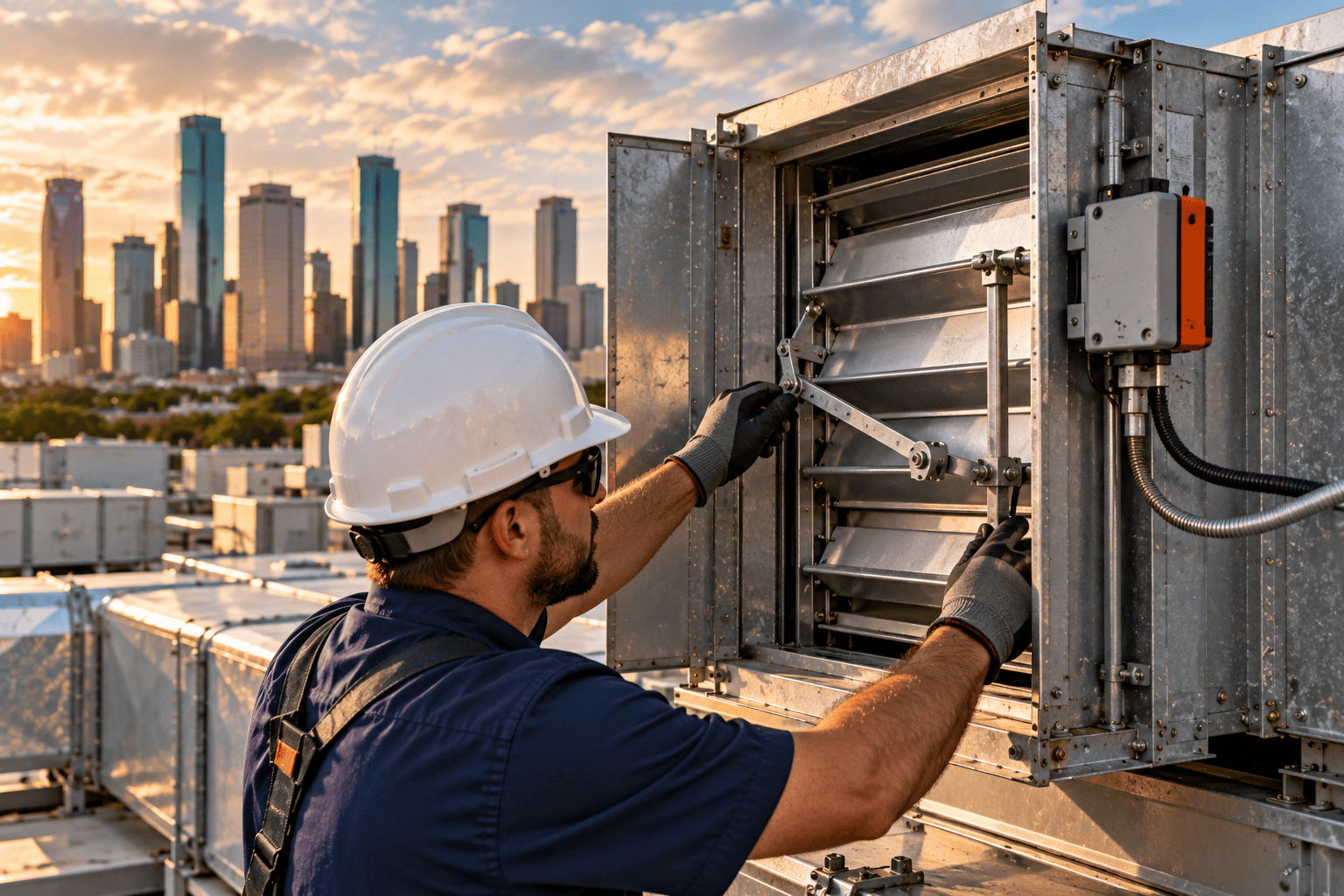
A commercial HVAC system can have properly operating compressors, coils, fans, and controls yet still leave parts of a building too hot, too cold, or without enough airflow. One possible cause is a damper that is stuck, damaged, incorrectly positioned, or not responding to its controls. For Houston businesses searching for Commercial HVAC & Industrial Refrigeration Services in Houston TX, ACF Mechanical provides professional airflow diagnostics, damper inspection, rooftop unit service, air handler troubleshooting, and commercial HVAC repair to identify the actual source of building comfort problems.
Commercial HVAC dampers regulate or balance airflow through duct systems, outdoor-air sections, VAV boxes, and other air-distribution components. When their actual position does not match the position required by the system, airflow can be redirected, restricted, or increased in the wrong areas. Proper diagnosis requires technicians to evaluate the damper itself, its actuator and linkage, control signals, airflow, static pressure, and the equipment connected to it.
What Do Dampers Do in Commercial HVAC Systems?
A damper is a mechanical device installed in an air path to regulate, balance, redirect, or stop airflow depending on its function.
Commercial buildings may contain several different types of dampers.
Common examples include:
- Balancing dampers
- Volume-control dampers
- Motorized control dampers
- Zone dampers
- VAV dampers
- Outdoor-air dampers
- Return-air dampers
- Mixed-air dampers
- Economizer dampers
These devices do not all perform the same job.
Some are manually positioned during system balancing. Others move automatically according to signals from thermostats, controllers, sensors, building automation systems, or economizer controls.
This distinction is important when diagnosing Commercial HVAC damper problems Houston TX because the correct repair depends on the damper’s purpose and control method.
Balancing Dampers
Balancing dampers help regulate how much air is delivered through different branches of a commercial duct system.
During proper system balancing, technicians may adjust damper positions so that each area receives an appropriate amount of airflow.
A balancing damper that is incorrectly positioned can contribute to:
- Weak airflow in one area
- Excessive airflow in another area
- Uneven temperatures
- Hot and cold zones
- Noise
- Comfort complaints
However, adjusting dampers without measuring airflow can simply move the problem from one zone to another.
Professional Commercial HVAC airflow balancing Houston should consider the complete distribution system rather than making random damper adjustments.
Motorized Dampers and Damper Actuators
Many commercial dampers are controlled by electric or pneumatic actuators.
The actuator provides the force required to move the damper between positions.
Potential Commercial HVAC damper actuator problems Houston TX include:
- Failed actuator motors
- Damaged internal gears
- Incorrect control signals
- Electrical problems
- Loose mounting
- Incorrect setup
- Failed position feedback
- Binding damper mechanisms
One important diagnostic principle is:
Actuator Movement Does Not Always Mean Damper Movement
An actuator may rotate while a loose or broken linkage prevents the damper blade from moving correctly.
For this reason, technicians should verify actual blade movement rather than assuming the damper works because the actuator appears to operate.
Damper Linkage Problems
Linkages mechanically connect actuators to damper shafts or blades.
Potential Commercial HVAC damper linkage problems Houston TX include:
- Loose connections
- Broken linkage components
- Slipping hardware
- Disconnected linkage
- Misalignment
- Worn components
A linkage problem can create confusing symptoms because the control system may command the actuator to move while the actual airflow remains unchanged.
This is why commanded damper position and actual damper position should be verified separately.
What Happens When a Damper Is Stuck Closed?
A stuck or incorrectly closed damper may restrict airflow to a branch, zone, or part of the HVAC system.
Potential symptoms include:
- Weak airflow
- Little or no air from diffusers
- Hot zones during cooling
- Cold zones during heating
- Temperature imbalance
- Increased branch resistance
- Occupant complaints
A Commercial HVAC damper stuck closed Houston TX may also affect pressure relationships within the duct system.
However, it would be inaccurate to say that every closed damper automatically causes high total system static pressure.
The actual effect depends on:
- Damper location
- Number of affected zones
- Fan type
- Fan controls
- VFD operation
- Duct design
- Other damper positions
What Happens When a Damper Is Stuck Open?
A damper stuck open can create a different set of problems.
A zone damper stuck open may allow excessive airflow into one area.
Possible effects include:
- Excessive cooling
- Cold zones
- Air noise
- Difficulty balancing nearby zones
- Temperature complaints
- Unnecessary conditioning
The impact can be particularly important when an outdoor-air damper is stuck open.
In Houston, hot and humid outdoor air can add significant sensible and latent load to a commercial HVAC system.
The cooling equipment may then need to remove additional heat and moisture that the system was not intended to handle continuously.
Mechanical Damper Problems vs. Control Problems
Not every damper problem is an actuator failure.
Technicians should distinguish between mechanical and control-related faults.
Mechanical Problems
Potential mechanical problems include:
- Bent blades
- Seized shafts
- Corrosion
- Damaged linkage
- Loose hardware
- Physical obstruction
- Binding components
- Damaged damper frames
Control Problems
Potential control-related issues include:
- Incorrect control signals
- Failed sensors
- Controller problems
- Incorrect setpoints
- BAS communication problems
- Actuator power problems
- Failed position feedback
- Incorrect programming
Professional Commercial HVAC damper troubleshooting Houston TX should determine whether the failure is mechanical, electrical, or control-related before replacing components.
Damper Problems vs. Duct Leakage
Weak airflow can result from either damper problems or duct leakage.
The two conditions affect the air-distribution system differently.
With a restrictive damper, airflow may be prevented from entering or passing through a branch correctly.
With duct leakage, air may leave the intended airflow path before reaching the conditioned space.
Both can contribute to:
- Weak airflow
- Uneven temperatures
- Comfort complaints
- Poor air distribution
Professional Commercial HVAC airflow diagnostics Houston should determine where the airflow is being restricted or lost before repairs are recommended.
Damper Problems vs. Blower Problems
A blower problem can also create symptoms that resemble a damper failure.
Potential blower-related causes of low airflow include:
- Dirty blower wheels
- Worn belts
- Pulley problems
- Bearing problems
- Motor issues
- Incorrect fan speed
- VFD problems
If weak airflow exists throughout the building, technicians may investigate the central fan or air handler.
If the problem affects only one branch or zone, a local damper, VAV box, duct restriction, or balancing issue may deserve closer inspection.
The actual system configuration determines the correct diagnostic approach.
How Dampers Affect Static Pressure
Damper position changes airflow resistance.
As a damper closes, resistance through that airflow path generally increases.
But the overall effect on the HVAC system depends on several factors, including:
- Fan characteristics
- VFD controls
- Number of zones
- Damper location
- Duct configuration
- Static pressure controls
- VAV operation
In a variable-air-volume system, for example, fan speed may automatically change as zone dampers reposition.
This means Commercial HVAC static pressure damper Houston problems cannot be diagnosed accurately by looking at damper position alone.
Airflow, pressure, controls, and fan response should be evaluated together.
How VAV Damper Problems Affect Commercial Buildings
Variable Air Volume systems use VAV boxes to regulate airflow to individual zones.
A typical VAV box may include:
- Damper assembly
- Actuator
- Airflow sensor
- Controller
- Temperature input
- Communication connection
Depending on the system, it may also include heating components.
Potential Commercial HVAC VAV damper problems Houston include:
- Damper stuck open
- Damper stuck closed
- Failed actuator
- Damaged linkage
- Incorrect airflow sensor reading
- Controller problems
- Incorrect minimum airflow settings
- Communication problems
- Building automation issues
A VAV zone that is too warm does not automatically have a failed damper.
The problem could involve the thermostat, airflow sensor, actuator, controller, ductwork, central air handler, or actual building load.
Diagnosing VAV Airflow Problems
Professional VAV troubleshooting may include:
- Checking zone temperature
- Verifying thermostat or sensor readings
- Commanding damper movement
- Confirming actual blade position
- Checking airflow readings
- Comparing commanded and actual airflow
- Inspecting actuator operation
- Checking static pressure
- Evaluating BAS commands
- Inspecting downstream ductwork
This system-level approach helps prevent unnecessary actuator or VAV box replacement.
Outdoor-Air Damper Problems in Houston
Outdoor-air dampers play an important role in commercial ventilation.
They regulate outdoor air entering the HVAC system according to the equipment design and control strategy.
An outdoor-air damper stuck too far open may allow excessive hot and humid air into the system.
Potential consequences include:
- Increased cooling demand
- Increased moisture load
- Indoor humidity complaints
- Longer cooling operation
- Comfort problems
- Difficulty maintaining space conditions
An outdoor-air damper stuck closed may reduce intended ventilation.
The required outdoor-air quantity depends on building design, occupancy, use, applicable requirements, and HVAC configuration.
Technicians should therefore diagnose the actual ventilation system rather than assuming a universal damper position is correct.
Houston Humidity and Damper Operation
Houston’s humidity makes outdoor-air damper operation particularly important.
Commercial cooling equipment must remove both sensible heat and moisture.
If an outdoor-air damper introduces substantially more humid outdoor air than intended, the cooling coil may experience an increased latent load.
Possible symptoms can include:
- Elevated indoor humidity
- Longer HVAC operation
- Comfort complaints
- Condensation risk
- Increased cooling demand
However, humidity problems do not automatically prove that an outdoor-air damper is malfunctioning.
Other potential causes include:
- Equipment sizing
- Building-envelope leakage
- Ventilation settings
- Cooling-coil performance
- Controls
- Drainage problems
- Occupancy
- Exhaust and makeup-air imbalance
The complete system should be evaluated.
Economizer Damper Problems
Commercial rooftop units may use economizer systems that include outdoor-air and return-air dampers.
Depending on the system, relief or exhaust components may also be involved.
Economizer performance can be affected by:
- Failed actuators
- Damaged linkage
- Stuck blades
- Sensor problems
- Control problems
- Incorrect sequences
- Mechanical binding
Commercial HVAC economizer damper problems Houston TX may therefore produce airflow, ventilation, temperature, or humidity symptoms.
Economizer troubleshooting should evaluate both mechanical damper operation and the controls commanding the dampers.
Rooftop Unit Damper Problems
Commercial rooftop units are common throughout Houston.
Depending on their configuration, rooftop units may include:
- Outdoor-air dampers
- Return-air dampers
- Economizer dampers
- Motorized actuators
- Mixed-air sections
Potential rooftop unit damper problems Houston TX may contribute to:
- Poor ventilation
- Excessive outdoor-air intake
- Reduced airflow
- Humidity problems
- Temperature complaints
- Incorrect economizer operation
Professional Commercial HVAC rooftop unit repair Houston should evaluate damper operation together with filters, coils, blower performance, controls, sensors, and connected ductwork.
Commercial Air Handler Damper Problems
Large commercial air handlers can use multiple dampers to regulate airflow and mixing.
Depending on the system, these may include:
- Outdoor-air dampers
- Return-air dampers
- Mixing dampers
- Isolation dampers
- Downstream zone dampers
Potential Commercial air handler damper problems Houston TX should be evaluated together with:
- Blower operation
- VFD control
- Filters
- Coils
- Static pressure
- Airflow sensors
- Building automation
- VAV systems
Professional Commercial air handler repair Houston TX requires understanding how these components interact rather than diagnosing each part in isolation.
A Note About Fire and Smoke Dampers
Commercial buildings may also contain fire and smoke dampers.
These components serve life-safety functions and are different from ordinary comfort-control or balancing dampers.
They should be inspected, tested, and serviced according to applicable requirements and approved procedures.
Comfort-related airflow adjustments should never involve unauthorized modification of life-safety damper systems.
Damper Problems in Restaurants
Restaurants have complex airflow requirements because HVAC systems operate alongside kitchen exhaust and makeup-air systems.
Building pressure depends on the relationship between:
- HVAC supply
- HVAC return
- Kitchen exhaust
- Makeup air
- Outdoor air
- Building leakage
Incorrect damper operation may contribute to pressure or comfort problems, but it is only one possible cause.
Restaurant troubleshooting should evaluate the complete airflow relationship.
Damper Problems in Warehouses
Warehouses may contain large HVAC zones, long duct runs, and substantial air volumes.
Damper problems may create:
- Uneven cooling
- Weak airflow in distant areas
- Excessive airflow in nearby areas
- Temperature differences
- Difficulty balancing large zones
Warehouse airflow problems should be evaluated according to the actual duct layout and equipment design.
Damper Problems in Office Buildings
Office buildings commonly use zoning and VAV systems.
Different zones may include:
- Conference rooms
- Perimeter offices
- Interior spaces
- Tenant areas
- Shared spaces
A VAV or zone damper problem can therefore create a localized comfort complaint even while the central HVAC equipment continues operating normally.
Damper Problems in Retail and Industrial Buildings
Retail buildings depend on balanced airflow to maintain customer and employee comfort across large floor areas.
Industrial buildings may combine HVAC with process exhaust, ventilation, and specialized pressure requirements.
In both environments, damper problems should be evaluated as part of the overall air-distribution system.
Common Damper Symptoms and Possible Causes
| Symptom | Possible Cause |
|---|---|
| Weak airflow in one zone | Damper, VAV, duct, diffuser, or balancing problem |
| Excessive airflow | Damper stuck open or incorrect balancing |
| Hot zone | Closed damper, low airflow, control issue, or building load |
| Cold zone | Excessive airflow, control issue, or sensor problem |
| High indoor humidity | Outdoor-air damper may be one possible cause |
| Building pressure problem | Dampers, exhaust, makeup air, ductwork, or controls |
| Actuator moves but airflow does not change | Linkage, blade, shaft, or mechanical problem |
| Repeated actuator failure | Binding damper, electrical issue, or control problem |
| Air noise | High velocity, damper position, duct restriction, or balancing issue |
The symptoms help guide diagnosis, but actual testing should confirm the cause.
How ACF Mechanical Diagnoses Commercial HVAC Damper Problems
Reliable diagnosis involves checking both the mechanical damper and the system controlling it.
Depending on the equipment, ACF Mechanical technicians may:
- Inspect damper blades
- Inspect shafts
- Inspect linkage
- Inspect actuator mounting
- Command the damper open and closed
- Verify actual blade movement
- Verify actuator movement
- Check control signals
- Evaluate position feedback
- Check thermostat and sensor inputs
- Inspect VAV boxes
- Measure airflow
- Check static pressure
- Inspect ductwork
- Evaluate VFD operation
- Review building automation operation where applicable
A key diagnostic principle is:
Commanded Position ≠ Actual Damper Position
The controller may indicate that a damper should be open while a mechanical linkage problem leaves the actual blades partially or fully closed.
Visual verification and airflow measurements help identify these conditions.
How Commercial HVAC Damper Problems Are Repaired
The correct repair depends on the actual failure.
Potential Commercial HVAC damper repair Houston solutions may include:
- Actuator replacement
- Linkage repair
- Linkage adjustment
- Blade repair
- Shaft repair
- Obstruction removal
- Electrical repair
- Control correction
- Sensor replacement
- VAV service
- Airflow balancing
- Complete damper replacement
Replacing the actuator alone will not correct a seized blade or damaged linkage.
Similarly, repairing a mechanical damper will not correct an incorrect BAS control signal.
The cause should be confirmed before parts are replaced.
When Should a Commercial Damper Be Replaced?
Some damper problems can be repaired.
Replacement may be appropriate when:
- Blades are severely damaged
- Shafts are damaged
- Corrosion is extensive
- The frame is compromised
- Mechanical binding cannot be reliably corrected
- Components repeatedly fail
- The existing assembly cannot provide reliable operation
The decision should consider accessibility, damper condition, control compatibility, and the role of the component in the HVAC system.
Preventing Commercial HVAC Damper Problems
Routine Commercial HVAC maintenance Houston can help identify damper and actuator problems before they create major comfort complaints.
Preventive inspection may include:
- Checking actuator operation
- Inspecting linkage
- Verifying damper travel
- Inspecting blades
- Checking for binding
- Listening for unusual actuator noise
- Verifying control signals
- Checking VAV operation
- Inspecting outdoor-air dampers
- Checking economizer sequences
- Investigating airflow complaints
- Measuring static pressure when appropriate
- Performing airflow testing when needed
Commercial buildings also change over time.
Renovations, tenant improvements, new partitions, duct modifications, and changes in occupancy can alter airflow requirements.
Air distribution should be reevaluated after significant building modifications.
Facility Manager Damper Problem Checklist
Facility managers can watch for several warning signs:
- One zone suddenly becomes too hot
- One zone receives unusually strong airflow
- Airflow disappears from specific diffusers
- VAV zones stop responding correctly
- Indoor humidity increases unexpectedly
- Outdoor-air intake appears abnormal
- HVAC noise changes
- Comfort complaints repeatedly come from the same area
- Problems begin after building renovations
- Airflow remains poor despite filter replacement
These symptoms do not prove that a damper has failed, but they are useful reasons to schedule professional airflow diagnostics.
When Damper Problems Require Prompt Service
Prompt Commercial HVAC repair Houston TX may be appropriate when:
- A critical business area loses airflow
- A damper becomes completely stuck
- Outdoor-air control fails
- Indoor humidity rises significantly
- VAV zones cannot maintain temperature
- An actuator repeatedly fails
- Building pressure changes unexpectedly
- Damper noise indicates mechanical binding
- Airflow changes suddenly
- The HVAC system cannot maintain normal building conditions
Early diagnosis can prevent a localized damper problem from becoming a larger comfort or operational issue.
Why Houston Businesses Choose ACF Mechanical
Damper problems can involve mechanical components, actuators, controls, airflow, static pressure, VAV systems, rooftop units, air handlers, and building automation. Reliable diagnosis requires understanding how these components work together.
Houston businesses choose ACF Mechanical for:
- Experienced technicians
- Commercial HVAC expertise
- Industrial refrigeration knowledge
- Airflow diagnostics
- Damper and actuator troubleshooting
- Rooftop unit experience
- Air handler expertise
- Preventive maintenance
- Fast response
- Reliable service
ACF Mechanical works with business owners, facility managers, restaurant owners, warehouses, industrial companies, commercial property owners, and other Texas businesses that depend on consistent commercial HVAC performance.
Restore Proper Airflow and Building Comfort
A malfunctioning damper can create significant comfort problems even when the central HVAC equipment continues to operate.
Stuck blades, failed actuators, damaged linkage, incorrect control signals, VAV problems, outdoor-air damper faults, and poor balancing can all affect how conditioned air reaches different areas of a commercial building.
For commercial buildings in Houston, outdoor-air damper problems can be especially important because excessive hot and humid air may increase both cooling and moisture loads.
Professional diagnosis should confirm whether the problem originates with the damper, actuator, control system, blower, ductwork, static pressure, or another component before repairs are performed.
With professional Commercial HVAC & Industrial Refrigeration Services in Houston TX, ACF Mechanical can inspect dampers and actuators, diagnose airflow problems, evaluate rooftop units and air handlers, troubleshoot VAV systems, and recommend appropriate commercial HVAC repairs.
If your commercial building has weak airflow, hot or cold zones, abnormal humidity, VAV problems, or suspected damper failure, contact ACF Mechanical for professional HVAC diagnostics and service in Houston, TX.