
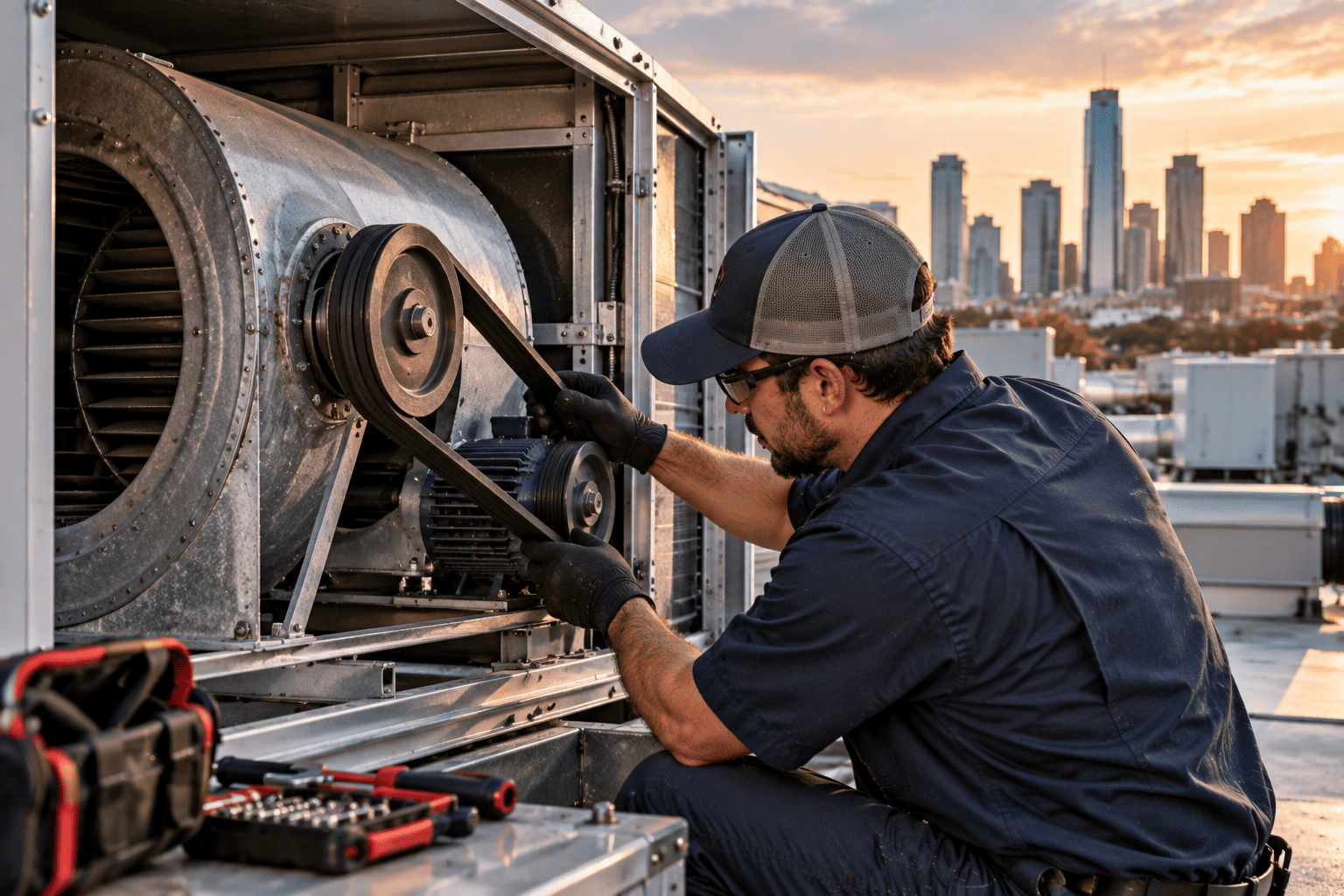
Commercial buildings in Houston depend on reliable airflow to maintain indoor comfort, protect equipment, and support daily business operations. A worn, loose, overtightened, or misaligned HVAC belt can reduce blower performance, create vibration, increase mechanical stress, and eventually stop airflow completely. For businesses searching for Commercial HVAC & Industrial Refrigeration Services in Houston TX, ACF Mechanical provides professional commercial HVAC diagnostics, repair, and preventive maintenance for belt-driven rooftop units, air handlers, blowers, motors, pulleys, and related components.
Belt problems can appear simple, but repeatedly replacing a failed belt without identifying why it failed may lead to the same problem again. Correct diagnosis involves evaluating belt condition, tension, pulley alignment, sheave wear, bearings, blower operation, motor load, and the overall fan-drive system.
What Do Belts and Pulleys Do in Commercial HVAC Systems?
Many commercial HVAC systems use belt-driven fans or blowers.
In a typical arrangement, the motor turns a drive pulley or sheave. A belt transfers that rotational force to a driven sheave connected to the blower shaft. As the shaft turns, the blower moves conditioned air through the HVAC system and ductwork.
The basic drive sequence is:
Motor → Drive Sheave → Belt → Driven Sheave → Blower Shaft → Blower Wheel → Airflow
When any part of this mechanical drive system develops a problem, fan speed and airflow can be affected.
Not every commercial HVAC fan uses belts and pulleys. Some modern rooftop units, air handlers, and commercial AC systems use direct-drive motors, electronically commutated motors, or other fan arrangements. Technicians must first identify the actual equipment design before diagnosing a belt-drive problem.
Common Signs of Commercial HVAC Belt Problems
Facility managers may notice changes in sound, airflow, or HVAC performance before a belt fails completely.
Common warning signs include:
- Squealing or chirping noises
- Visible belt cracking
- Frayed belt edges
- Glazed or shiny belt surfaces
- Belt dust around the drive assembly
- Excessive vibration
- Reduced supply airflow
- Blower speed changes
- Burning-rubber odor
- Belt repeatedly slipping
- Belt repeatedly breaking
- Blower not turning
- Uneven belt wear
Professional Commercial HVAC repair Houston TX should determine whether the symptom originates from the belt itself or from another mechanical, electrical, or airflow problem.
What Causes Commercial HVAC Belt Failure?
A belt is a wear component, but premature failure often indicates another issue.
Possible causes of Commercial HVAC belt problems Houston TX include:
- Incorrect belt tension
- Pulley misalignment
- Worn sheaves
- Incorrect belt size or type
- Bearing problems
- Loose motor mounts
- Mechanical binding
- Contamination
- Excessive fan load
- Incorrect fan speed
- Damaged pulleys
- Improper installation
- Normal wear after extended operating hours
A professional inspection should identify the reason for the failure rather than treating every broken belt as an isolated event.
Loose HVAC Belts
A belt that is too loose may slip instead of efficiently transferring motor power to the blower.
Possible consequences include:
- Reduced blower speed
- Lower airflow
- Squealing
- Belt heating
- Glazing
- Accelerated belt wear
- Belt dust
- Inconsistent fan operation
A Commercial HVAC loose belt Houston problem can become particularly noticeable when the system operates under heavier cooling loads.
Simply tightening the belt as much as possible is not the correct solution. Belt tension should be appropriate for the drive design and manufacturer requirements.
HVAC Belts That Are Too Tight
Overtightening can create a different set of problems.
Excessive belt tension may increase loads on:
- Motor bearings
- Blower bearings
- Shafts
- Pulleys
- Motor mounts
A belt can therefore be tight enough to stop slipping while still being incorrectly adjusted.
Professional Commercial HVAC belt tension Houston TX service should consider the belt type, drive configuration, span, manufacturer specifications, and condition of the other mechanical components.
Belt Slipping and Squealing
Squealing is often associated with belt slip, but noise alone does not confirm the cause.
Potential causes include:
- Insufficient tension
- Worn belt
- Glazed belt surface
- Worn pulley grooves
- Misalignment
- Mechanical resistance
- Incorrect belt
- Contamination
A Commercial HVAC squealing belt Houston should be inspected rather than simply treated with temporary belt products or excessive tension.
The underlying reason for the slip must be corrected.
Cracked, Glazed, and Frayed Belts
Visible belt condition can provide useful diagnostic information.
Cracking
Cracks may indicate aging, wear, environmental exposure, or deterioration.
Glazing
A shiny or polished belt surface may indicate slipping and excessive friction.
Frayed Edges
Edge wear can be associated with alignment problems, damaged sheaves, or improper belt tracking.
Belt Dust
Excessive rubber dust near the drive assembly can indicate accelerated wear.
A technician should inspect the complete drive rather than replacing a visibly damaged belt and assuming the problem is solved.
Pulley and Sheave Problems
In commercial HVAC service, “pulley” and “sheave” are often used when discussing belt-drive components.
A worn or damaged sheave can prevent a new belt from operating correctly.
Potential Commercial HVAC pulley problems Houston TX include:
- Worn grooves
- Damaged surfaces
- Loose mounting
- Incorrect alignment
- Shaft problems
- Incorrect sheave size
- Adjustable sheave problems
If the grooves are significantly worn, installing a new belt may provide only temporary improvement.
The belt and sheaves operate as a system and should be evaluated together.
Pulley Misalignment and Uneven Belt Wear
Motor and blower sheaves should be aligned according to the drive design.
Misalignment can cause:
- Uneven belt wear
- Frayed edges
- Belt tracking problems
- Vibration
- Noise
- Increased mechanical losses
- Reduced belt life
Professional Commercial HVAC belt alignment Houston TX may involve checking sheave position, shaft alignment, mounting, and drive geometry.
Alignment should be corrected before repeatedly installing replacement belts.
Why Does an HVAC Belt Keep Breaking?
Repeated belt failure is a strong indication that the drive system needs further investigation.
Possible causes include:
- Incorrect tension
- Misaligned pulleys
- Worn sheave grooves
- Bearing failure
- Blower resistance
- Incorrect replacement belt
- Loose components
- Excessive motor or fan load
- Contamination
- Damaged shaft
- Incorrect fan-drive setup
When a Commercial HVAC belt keeps breaking Houston TX, replacing the belt alone may not provide a reliable repair.
The root cause should be identified before the equipment returns to normal operation.
Why Does an HVAC Belt Keep Slipping?
Recurring belt slip can also have several causes.
A loose belt is one possibility, but technicians may also find:
- Worn pulley grooves
- Incorrect belt profile
- Contamination
- Mechanical binding
- Alignment problems
- Incorrect adjustment
- Damaged drive components
This is why belt tension should not be adjusted without inspecting the rest of the fan-drive system.
How Belt Problems Affect HVAC Airflow
The blower is responsible for moving air through many commercial HVAC systems.
If a belt slips, the driven blower may rotate more slowly than intended. If the belt breaks completely, a belt-driven blower may stop.
Reduced airflow can affect:
- Supply-air delivery
- Space temperature control
- Cooling performance
- Heating performance
- Air distribution
- Equipment operation
- Building comfort
However, Commercial HVAC low airflow Houston does not automatically indicate a belt problem.
Other potential causes include:
- Dirty filters
- Dirty coils
- Duct restrictions
- Damper problems
- Economizer problems
- Fan motor problems
- VFD problems
- Blower wheel problems
- Static-pressure issues
Professional diagnosis should distinguish a mechanical drive problem from other airflow restrictions.
Belt Problems and Commercial Cooling Performance
Commercial AC equipment depends on appropriate airflow across heat-transfer surfaces.
If blower airflow falls substantially, the HVAC system may no longer operate as intended.
Possible consequences can include:
- Uneven building temperatures
- Longer operating cycles
- Reduced comfort
- Poor air distribution
- Increased equipment stress
- Cooling complaints from occupied areas
A belt problem is therefore not just a mechanical maintenance issue. It can affect overall commercial HVAC performance.
Rooftop Unit Belt Problems
Rooftop units are common on commercial buildings in Houston, including offices, restaurants, retail properties, warehouses, and other facilities.
Depending on design, an RTU may use a belt-driven supply fan.
Potential rooftop unit belt problems Houston TX include:
- Loose belt
- Broken belt
- Misaligned sheaves
- Worn pulleys
- Bearing wear
- Loose motor mount
- Incorrect tension
- Blower vibration
Professional Commercial HVAC rooftop unit repair Houston should evaluate the complete fan-drive assembly when belt failures or airflow problems occur.
Replacing a belt without checking the motor, sheaves, bearings, and blower can leave the underlying cause unresolved.
Commercial Air Handler Belt Problems
Large commercial air handlers may also use belt-driven fans.
These systems can serve substantial areas of a commercial property, so a fan-drive failure can affect multiple rooms, floors, or operating zones.
Potential Commercial HVAC air handler belt problems Houston TX include:
- Belt wear
- Incorrect tension
- Pulley misalignment
- Bearing problems
- Motor mounting issues
- Fan vibration
- Reduced fan speed
- Mechanical wear
Professional air-handler diagnostics should also evaluate filters, coils, dampers, static pressure, controls, and other factors that influence airflow.
Multiple-Belt HVAC Drives
Larger fans may use multiple belts operating together.
These drives require additional attention because the belts share the load.
Depending on manufacturer requirements, multiple-belt systems may require a properly matched belt set rather than replacing only one worn belt.
Installing belts with different wear levels or characteristics can result in uneven load distribution.
Technicians should inspect:
- All belts
- Sheave grooves
- Belt tension
- Alignment
- Bearings
- Shaft condition
- Motor position
The correct service procedure depends on the specific equipment and drive design.
Adjustable Sheaves and Fan Speed
Some belt-driven commercial HVAC systems use adjustable sheaves to establish fan speed.
Changing sheave adjustment changes the relationship between motor speed and blower speed.
That can affect:
- Airflow
- Static pressure
- Motor load
- Noise
- Fan performance
- HVAC capacity
An adjustable sheave should not be changed simply to “get more airflow” without evaluating the system.
Increasing blower speed can increase motor load and may move the fan away from the intended operating point.
After adjustments, technicians may verify airflow, static pressure, motor amperage, fan speed, and equipment specifications.
Motor Amperage and Belt-Drive Adjustments
A mechanical fan adjustment can affect the electrical load on the motor.
For that reason, professional belt and pulley service may include checking motor current after adjustments.
A technician may evaluate:
- Motor amperage
- Motor nameplate data
- Fan speed
- Belt tension
- Sheave configuration
- Airflow
- Static pressure
The objective is to ensure that correcting one mechanical issue does not create another operating problem.
Belt Problems vs. Bearing Problems
Noise and vibration are not always caused by belts.
Similar symptoms can originate from:
- Motor bearings
- Blower bearings
- Damaged fan wheel
- Wheel imbalance
- Loose hardware
- Bent shaft
- Worn pulley
- Motor mounting problems
A Commercial HVAC belt bearing noise Houston complaint therefore requires mechanical inspection rather than diagnosis based only on sound.
Commercial HVAC Vibration Problems
Excessive vibration can accelerate wear throughout the fan assembly.
Potential sources include:
- Belt misalignment
- Worn belt
- Damaged pulley
- Loose sheave
- Bearing wear
- Fan imbalance
- Loose motor mount
- Mechanical damage
Ignoring Commercial HVAC vibration problems Houston TX can allow a relatively small mechanical issue to affect additional components.
Houston Heat and Belt-Driven HVAC Equipment
Houston’s long cooling season can result in substantial operating hours for commercial HVAC equipment.
During periods of high outdoor temperature, rooftop units and air handlers may operate for extended periods to meet building cooling loads.
Texas heat does not automatically cause an HVAC belt to fail.
However, longer operating hours can make existing wear more noticeable and accelerate the point at which already deteriorated components require service.
A marginal belt, worn sheave, or bearing problem that remains unnoticed during lighter operation may become more apparent during peak cooling demand.
Houston Humidity and Mechanical Components
Houston’s humid environment can also influence equipment conditions, particularly for exposed rooftop and outdoor mechanical components.
Depending on materials, equipment condition, drainage, and exposure, moisture may contribute to corrosion on:
- Pulleys
- Shafts
- Fasteners
- Motor mounts
- Equipment panels
Humidity does not directly explain every belt failure. Mechanical condition, alignment, tension, operating hours, and equipment maintenance remain critical factors.
Belt Problems in Commercial Buildings in Houston
Different facilities place different demands on HVAC systems.
Restaurants
Long operating hours and significant internal heat loads can place substantial demand on rooftop HVAC equipment.
Warehouses
Large spaces may depend on multiple rooftop units or air handlers for airflow and temperature control.
Office Buildings
A failed supply fan can affect comfort across multiple occupied zones.
Retail Properties
Airflow problems can quickly create noticeable customer and employee comfort issues.
Industrial Facilities
HVAC equipment may operate alongside process loads and demanding facility schedules.
For these Houston businesses, preventive mechanical inspection can help reduce unexpected fan-drive failures.
How ACF Mechanical Diagnoses Belt and Pulley Problems
Professional diagnosis may include:
- Inspecting belt condition
- Checking belt tension
- Checking pulley alignment
- Inspecting sheave grooves
- Checking motor mounts
- Inspecting blower bearings
- Inspecting motor bearings
- Checking shafts
- Evaluating blower rotation
- Checking fan speed
- Measuring motor amperage where appropriate
- Checking vibration
- Evaluating airflow
- Reviewing static pressure where appropriate
The goal is to determine why the drive is not operating correctly, not simply replace the most visible worn component.
When Belt Replacement Is Enough — and When It Is Not
A worn belt may sometimes be the only component requiring replacement.
In other situations, additional repairs may be needed.
| Condition | Possible Service Need |
|---|---|
| Normally worn belt | Belt replacement |
| Loose but undamaged belt | Correct tension and inspection |
| Frayed belt edge | Alignment and sheave inspection |
| Heavy belt dust | Drive and pulley inspection |
| Repeated broken belts | Root-cause diagnosis |
| Worn sheave grooves | Pulley/sheave replacement |
| Excessive vibration | Belt, pulley, bearing, and blower inspection |
| Blower not turning | Mechanical and electrical diagnosis |
The repair should address the condition of the entire drive assembly.
Preventing Commercial HVAC Belt and Pulley Problems
Routine Commercial HVAC maintenance Houston can identify wear before a belt fails during peak operating conditions.
A preventive maintenance inspection may include:
- Inspecting belt surfaces
- Checking for cracking
- Checking for glazing
- Looking for frayed edges
- Checking belt tension
- Checking pulley alignment
- Inspecting sheave grooves
- Checking belt dust accumulation
- Inspecting bearings
- Checking motor mounting
- Checking fasteners
- Verifying blower operation
- Checking unusual vibration
- Verifying motor current where appropriate
The appropriate inspection frequency depends on equipment design, operating hours, environment, and manufacturer recommendations.
Facility Manager Belt and Pulley Checklist
Facility managers do not need to perform mechanical adjustments themselves to identify possible warning signs.
Watch for:
- New squealing sounds
- Increased vibration
- Reduced airflow
- HVAC zones becoming warmer than normal
- Repeated fan shutdowns
- Burning-rubber odor
- Blower not operating
- Recurring belt replacements
If these symptoms appear, schedule professional inspection before the fan-drive system experiences a more significant failure.
Guards and access panels should not be removed from operating equipment by unqualified personnel.
When Belt Problems Require Prompt HVAC Repair
Prompt service may be appropriate when:
- The blower has stopped
- A belt has broken
- Airflow has fallen substantially
- The belt repeatedly slips
- The system has excessive vibration
- A burning odor is present
- Belts repeatedly fail
- A pulley is loose or damaged
- The motor is overheating
- Commercial spaces cannot maintain temperature
A broken supply-fan belt can quickly affect a commercial building during Houston’s hottest weather.
Professional service can determine whether the repair requires only belt replacement or additional work on pulleys, bearings, motors, or blower components.
Why Houston Businesses Choose ACF Mechanical
Commercial HVAC belt and pulley problems require more than replacing a worn piece of rubber. Reliable service depends on understanding the relationship between the motor, belt drive, blower, airflow, static pressure, and HVAC system operation.
Houston businesses choose ACF Mechanical for:
- Experienced technicians
- Commercial HVAC expertise
- Industrial refrigeration knowledge
- Rooftop unit experience
- Air-handler diagnostics
- Fan and blower troubleshooting
- Preventive maintenance
- Fast response
- Reliable service
ACF Mechanical works with business owners, facility managers, restaurants, warehouses, industrial companies, commercial property owners, and other Texas businesses that depend on reliable HVAC operation.
Protect Your Commercial HVAC Equipment from Belt and Pulley Failures
Belts, pulleys, sheaves, bearings, motors, and blowers operate as one mechanical drive system. A loose belt may reduce airflow, but repeated belt failures can indicate alignment problems, worn sheaves, bearing issues, incorrect tension, or another mechanical condition.
For commercial buildings in Houston, preventive inspection is particularly valuable before and during periods of heavy cooling demand.
With professional Commercial HVAC & Industrial Refrigeration Services in Houston TX, ACF Mechanical can inspect belt-driven rooftop units and air handlers, identify mechanical problems, restore proper blower operation, and help businesses reduce the risk of unexpected HVAC downtime.
If your commercial HVAC system has a broken belt, squealing drive, reduced airflow, excessive vibration, worn pulleys, or recurring belt failures, contact ACF Mechanical for professional commercial HVAC diagnostics and repair in Houston, TX.