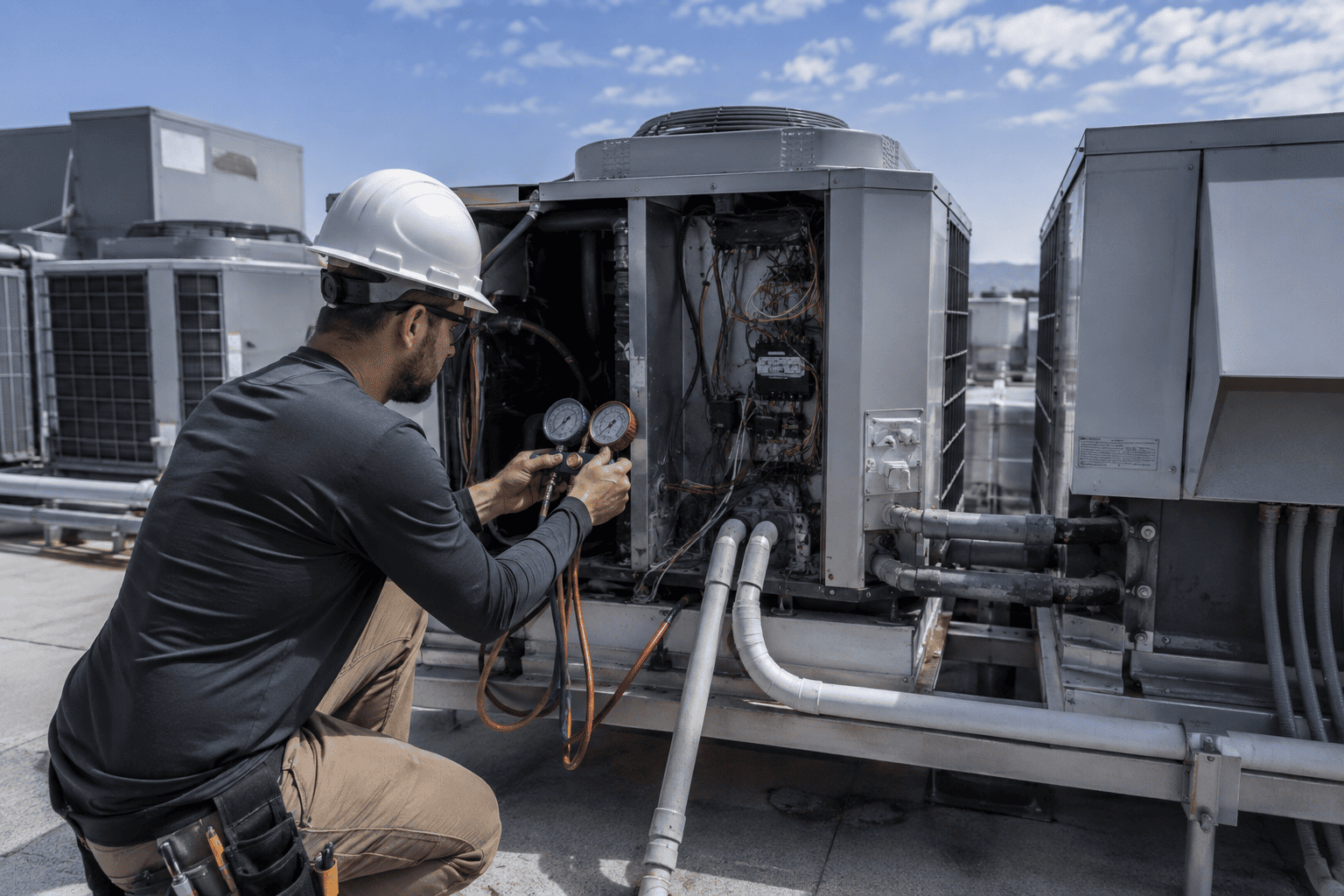
Businesses searching for Commercial HVAC & Industrial Refrigeration Services in Houston TX are often dealing with more than a minor comfort issue. A failing rooftop unit can make a commercial building difficult to operate, while refrigeration problems can threaten temperature-sensitive inventory, disrupt food service, and create costly downtime. In Houston’s heat and humidity, small equipment problems can become serious operational issues quickly.
ACF Mechanical helps Houston businesses identify, troubleshoot, repair, and maintain commercial HVAC and refrigeration equipment. Knowing the warning signs of equipment failure allows business owners and facility managers to schedule service before an inefficient system becomes an emergency.
Whether your facility relies on rooftop units, commercial AC systems, air handlers, chillers, walk-in coolers, freezers, or industrial refrigeration equipment, changes in temperature, performance, noise, energy consumption, or operating cycles should never be ignored.
Why HVAC and Refrigeration Problems Require Fast Attention in Houston
Commercial cooling equipment in Houston operates under demanding conditions. Long periods of high outdoor temperatures, heavy cooling loads, humidity, and extended operating hours place significant stress on mechanical systems.
During periods of Texas heat, HVAC equipment may run for long cycles to maintain indoor conditions. Refrigeration equipment must simultaneously reject heat while keeping products and storage areas within required temperature ranges.
When a component begins to deteriorate, the additional workload can accelerate the problem.
For Houston businesses, delayed repairs can result in:
- Higher electricity consumption
- Poor indoor comfort
- Unstable temperatures
- Increased humidity
- Reduced equipment performance
- Product or inventory losses
- Unexpected shutdowns
- Increased wear on compressors, motors, and other components
- Emergency service calls
- Business downtime
A timely commercial HVAC service in Houston can help determine whether the problem is caused by airflow restrictions, electrical components, controls, refrigerant-related issues, mechanical wear, or another system condition.
1. Your HVAC System Is No Longer Maintaining the Set Temperature
One of the clearest signs of commercial HVAC trouble is an inability to maintain the desired indoor temperature.
A commercial building may feel warm even though the system runs continuously. Some rooms may cool properly while others remain uncomfortable.
Possible causes include:
- Restricted airflow
- Dirty coils
- Fan or blower problems
- Control or thermostat issues
- Refrigerant circuit problems
- Compressor performance issues
- Damaged ductwork
- Clogged filters
- Failing electrical components
- Improper equipment operation
Temperature problems are particularly noticeable during Houston’s hottest months because HVAC systems operate under greater load.
If changing the thermostat does not solve the problem, professional commercial HVAC troubleshooting in Houston can help identify the underlying cause rather than allowing the equipment to continue operating inefficiently.
2. Energy Costs Increase Without an Obvious Explanation
An unexpected increase in energy consumption can be an early warning sign of HVAC or refrigeration problems.
Commercial cooling systems account for a significant portion of energy use in many facilities. When equipment loses efficiency, it may need to operate longer to produce the same cooling capacity.
For example, a rooftop unit with restricted airflow may run longer than normal. A refrigeration system with dirty condenser coils may have difficulty rejecting heat. A walk-in freezer with deteriorated door seals may experience increased heat infiltration.
Facility managers should compare utility consumption with:
- Previous months
- Similar weather periods
- Building occupancy
- Operating hours
- Production or refrigeration loads
If energy consumption rises without a corresponding operational change, the cooling equipment should be inspected.
Professional commercial HVAC maintenance and repair in Houston can identify efficiency problems before they develop into major failures.
3. Your HVAC Equipment Runs Constantly or Cycles Too Frequently
Commercial HVAC equipment should operate according to building load and control requirements. Significant changes in cycling behavior can indicate a problem.
Constant Operation
A system that rarely shuts off may be struggling to reach its setpoint.
Possible reasons include dirty coils, airflow restrictions, control problems, equipment degradation, excessive building heat load, or mechanical issues.
Frequent Short Cycling
Short cycling occurs when equipment repeatedly starts and stops over short periods.
This behavior can increase wear on:
- Compressors
- Contactors
- Motors
- Electrical components
Frequent cycling can also reduce efficiency and temperature control.
Because repeated starts place additional stress on mechanical and electrical components, persistent short cycling should be investigated rather than treated as normal operation.
4. You Hear New or Unusual Equipment Noises
Commercial HVAC and refrigeration equipment naturally produces operating noise, but experienced facility teams often recognize when that sound changes.
Warning noises can include:
- Grinding
- Rattling
- Screeching
- Banging
- Buzzing
- Clicking
- Unusual compressor sounds
- Excessive vibration
Different sounds can point to different mechanical or electrical conditions.
Rattling may indicate loose components. Grinding or squealing can be associated with motor, bearing, belt, or fan issues. Electrical buzzing may require inspection of electrical components.
Ignoring unusual sounds can allow a relatively manageable repair to become more extensive.
For rooftop units, air handlers, chillers, and commercial AC systems, technicians should inspect abnormal equipment noise before prolonged operation causes additional damage.
5. Airflow Has Become Weak or Uneven
Poor airflow is another common sign that a commercial HVAC system needs attention.
Employees or customers may notice that certain areas receive significantly less conditioned air than others.
Possible causes include:
- Dirty filters
- Blocked coils
- Blower problems
- Fan issues
- Belt problems
- Duct restrictions
- Damper problems
- Control issues
Poor airflow affects more than comfort. Reduced airflow can make cooling equipment work harder and may contribute to coil temperature problems and inefficient operation.
For commercial buildings in Houston, where HVAC systems may operate for extended periods during hot weather, maintaining correct airflow is particularly important.
6. Indoor Humidity Is Becoming Difficult to Control
Houston businesses must manage both heat and humidity.
A commercial HVAC system that cools the space but fails to control moisture effectively may have an operational problem.
High indoor humidity can contribute to:
- Uncomfortable conditions
- Condensation
- Musty odors
- Moisture accumulation
- Building material concerns
- Increased cooling demand
Humidity issues can have several causes, including airflow problems, equipment operation, control settings, system sizing, or mechanical conditions.
Because Houston’s climate creates a substantial latent cooling load, humidity complaints should be evaluated as part of overall HVAC system performance rather than treated only as a thermostat issue.
7. Your Walk-In Cooler Cannot Hold Temperature
Restaurants, food-service businesses, warehouses, and other facilities depend on reliable refrigeration.
If a walk-in cooler begins operating above its normal temperature range, professional attention may be required.
Warning signs include:
- Increasing box temperature
- Long compressor run times
- Frequent cycling
- Ice buildup
- Condensation
- Unusual noises
- Warm areas inside the cooler
- Door sealing problems
Potential causes can range from airflow and coil problems to controls, fans, door seals, defrost components, or refrigeration circuit issues.
Timely walk-in cooler repair in Houston TX can help reduce the risk of product loss and prevent additional stress on the refrigeration system.
Businesses should never rely on repeatedly adjusting temperature controls to compensate for a system that cannot maintain its required operating range.
8. Your Commercial Freezer Shows Ice Buildup or Temperature Changes
Commercial freezers must maintain stable operating conditions despite frequent door openings and demanding refrigeration loads.
Excessive frost or ice accumulation may indicate:
- Defrost system problems
- Door gasket issues
- Air infiltration
- Fan problems
- Airflow restrictions
- Control problems
Temperature fluctuations may also indicate a developing mechanical or refrigeration issue.
Professional commercial freezer repair in Houston should address the cause of the problem rather than simply removing visible ice.
For restaurants, cold storage operations, and other Texas businesses, reliable freezer operation is essential for protecting inventory and maintaining consistent operations.
9. Refrigeration Compressors Are Running Longer Than Normal
The compressor is one of the most important components in a refrigeration system.
If compressors begin operating significantly longer than usual, the system may be struggling to remove the required heat.
Potential causes can include:
- Dirty condenser coils
- Poor condenser airflow
- High ambient temperatures
- Refrigerant circuit problems
- Increased refrigeration load
- Evaporator airflow restrictions
- Control issues
- Mechanical wear
Houston’s high ambient temperatures can make heat rejection especially demanding for refrigeration equipment.
A system that already has a developing problem may experience significantly greater stress during hot weather.
Professional industrial refrigeration service in Houston TX can evaluate system conditions and determine what is causing abnormal operation.
10. You Notice Water, Oil, or Other Signs of Leakage
Visible moisture around commercial HVAC or refrigeration equipment should be investigated.
Water may result from:
- Condensate drainage problems
- Frozen coils
- Drain pan issues
- Excessive condensation
- Insulation problems
Oil residue around refrigeration components can sometimes indicate a location that requires closer professional inspection.
Technicians can determine the source of the leak and evaluate whether other equipment has been affected.
Addressing leaks early may help prevent water damage, equipment deterioration, or a larger mechanical problem.
11. Your Refrigeration Equipment Is Struggling During Peak Business Hours
Some refrigeration problems only become obvious when system demand increases.
A restaurant walk-in cooler, for example, may appear to operate normally early in the morning but struggle during busy periods when doors open frequently and new product enters the space.
Similarly, industrial refrigeration equipment may experience performance problems when production loads increase.
This pattern can indicate that the system has lost enough capacity that it can handle light conditions but not peak demand.
Businesses requiring restaurant refrigeration repair in Houston TX or cold storage refrigeration repair in Houston should have equipment evaluated when performance consistently declines under normal peak loads.
12. Your Equipment Requires More Frequent Repairs
An isolated component failure does not necessarily mean an entire system needs replacement.
However, increasing repair frequency deserves attention.
Facility managers should consider:
- Equipment age
- Repair history
- Frequency of breakdowns
- Cost of recent repairs
- Energy consumption
- Availability of replacement parts
- Current operating performance
- Business consequences of downtime
Repeated emergency repairs can become more expensive than developing a planned repair, maintenance, or replacement strategy.
An experienced commercial HVAC contractor in Houston TX can evaluate equipment condition and help businesses determine whether continued repair remains practical.
Repair or Replace? What Houston Businesses Should Consider
Not every HVAC or refrigeration problem requires new equipment.
Many problems can be corrected with proper diagnostics and targeted repair. However, aging systems with repeated failures may eventually reach a point where replacement deserves consideration.
| Factor | Repair May Make Sense | Replacement May Be Worth Evaluating |
|---|---|---|
| Equipment age | Relatively newer equipment | Older equipment approaching end of useful service |
| Repair history | Occasional repair | Frequent breakdowns |
| Efficiency | Performance remains acceptable | Energy consumption continues increasing |
| Parts | Parts readily available | Parts difficult or costly to obtain |
| Reliability | System remains dependable | Repeated unexpected downtime |
| Repair cost | Limited repair scope | Major recurring repair expenses |
| Capacity | Meets facility requirements | No longer meets operational needs |
The correct decision should be based on equipment condition and business requirements rather than age alone.
For businesses where HVAC or refrigeration downtime can interrupt operations, reliability should be an important part of the decision.
When Is an HVAC or Refrigeration Problem an Emergency?
Some equipment issues can be scheduled for routine service. Others require faster attention.
Consider contacting an emergency commercial HVAC repair Houston provider when equipment failure creates an immediate operational problem.
Examples can include:
- Complete loss of cooling in a critical commercial facility
- Refrigeration temperatures moving outside required operating ranges
- Walk-in cooler or freezer shutdown
- Electrical burning smells or signs of overheating
- Major water leakage
- Severe equipment vibration
- Repeated breaker trips
- Critical refrigeration alarms
- Cooling failure affecting temperature-sensitive inventory
Restaurants and cold storage facilities may require particularly rapid action because refrigeration failure can directly affect stored products.
When dealing with a potential electrical or mechanical safety issue, equipment should not be repeatedly restarted in an attempt to keep it operating.
How Professional Commercial HVAC Troubleshooting Works
Effective repair begins with diagnosis.
Replacing components without identifying the underlying problem can increase costs and allow the original issue to return.
Depending on the equipment and symptoms, professional troubleshooting may include checking:
- System operating temperatures
- Airflow
- Filters and coils
- Fan and blower operation
- Motors and belts
- Electrical components
- Controls and thermostats
- Refrigeration pressures and temperatures
- Condenser and evaporator performance
- Drainage
- Compressor operation
- Defrost systems
- Door seals
- Equipment operating cycles
For complex commercial and industrial systems, technicians must consider how components interact rather than evaluating each part in isolation.
A refrigeration compressor running continuously, for example, does not automatically mean the compressor itself is the original cause. Reduced airflow, heat-transfer problems, controls, system load, or refrigeration circuit conditions may contribute to the symptom.
Preventive Maintenance Can Reduce Unexpected Repairs
Emergency repair cannot always be avoided, but many problems provide warning signs before equipment fails completely.
Preventive maintenance gives technicians an opportunity to identify developing conditions during planned service.
A commercial HVAC or refrigeration maintenance program may include:
- Inspecting coils
- Checking filters
- Evaluating airflow
- Inspecting belts and motors
- Checking electrical connections and components
- Reviewing controls
- Inspecting condensate systems
- Evaluating refrigeration system operation
- Checking fans
- Inspecting walk-in cooler and freezer components
- Reviewing equipment condition and operating trends
Preventive maintenance is particularly valuable for businesses with mission-critical cooling requirements.
Restaurants, warehouses, industrial facilities, commercial properties, and cold storage operations can face substantial costs when cooling equipment fails unexpectedly.
HVAC and Refrigeration Considerations for Different Houston Businesses
Different facilities place different demands on their cooling equipment.
Restaurants
Restaurants often rely on multiple systems simultaneously, including dining-area HVAC, kitchen cooling requirements, walk-in coolers, reach-in equipment, and freezers.
A refrigeration failure can affect inventory, while an HVAC failure can affect employees and customers.
Professional restaurant HVAC repair in Houston should account for these demanding operating conditions.
Warehouses
Warehouse HVAC requirements depend on the facility, products stored, occupancy, and operational processes.
Large spaces can create significant cooling loads, while facilities storing temperature-sensitive products may require specialized equipment.
Reliable warehouse HVAC repair Houston TX helps keep essential cooling equipment operating during demanding conditions.
Commercial Buildings
Offices, retail properties, and other commercial facilities frequently depend on rooftop units, split systems, air handlers, and centralized equipment.
Poor cooling can affect occupants throughout the building and generate tenant or customer complaints.
Professional HVAC repair for commercial buildings Houston should focus on restoring performance while identifying issues that could cause repeated failures.
Industrial and Cold Storage Facilities
Industrial refrigeration and cold storage systems can be operationally critical.
Problems with compressors, evaporators, condensers, controls, or other refrigeration components can affect temperature stability and production.
These facilities benefit from technicians familiar with industrial refrigeration system problems in Houston and the demands placed on commercial cooling equipment.
A Quick HVAC and Refrigeration Warning-Sign Checklist
Schedule a professional inspection if you notice one or more of the following:
- HVAC system cannot maintain the set temperature
- Refrigerated space is becoming warmer
- Utility costs have increased unexpectedly
- Equipment operates continuously
- System starts and stops unusually often
- Airflow is weak or uneven
- Indoor humidity is increasing
- New noises or vibrations appear
- Ice is accumulating on refrigeration equipment
- Walk-in cooler or freezer temperatures fluctuate
- Water or suspicious residue appears around equipment
- Compressors operate longer than normal
- Equipment struggles during peak loads
- Breakdowns are becoming more frequent
- Repair costs are increasing
The earlier these symptoms are investigated, the more opportunity there is to correct a developing problem before it causes a complete shutdown.
Why Houston Businesses Choose ACF Mechanical
Commercial HVAC and refrigeration equipment requires specialized knowledge. Businesses need technicians who understand not only cooling equipment but also the operational consequences of downtime.
ACF Mechanical supports Houston businesses with commercial HVAC and industrial refrigeration expertise for systems including rooftop units, commercial AC equipment, air handlers, chillers, walk-in coolers, freezers, and refrigeration systems.
Businesses choose ACF Mechanical for:
- Experienced technicians
- Commercial HVAC expertise
- Industrial refrigeration knowledge
- Professional troubleshooting
- Preventive maintenance
- Fast response when equipment problems occur
- Reliable service for commercial facilities
- Repair solutions focused on long-term equipment performance
Instead of waiting until a system stops operating completely, facility managers can address warning signs early and develop a more predictable approach to equipment maintenance and repair.
Protect Your Houston Business From Unexpected Cooling Failures
Commercial HVAC and refrigeration problems rarely become less expensive by being ignored.
A rooftop unit that runs continuously, a walk-in cooler that cannot maintain temperature, or a refrigeration system making unusual noises may still be operating—but it may also be warning you about a developing failure.
Houston’s heat, humidity, and demanding commercial operating conditions make reliable cooling especially important. Regular inspections, professional troubleshooting, timely repairs, and preventive maintenance can help businesses reduce unexpected downtime and extend the useful life of critical equipment.
If you are experiencing commercial HVAC system problems in Houston or need industrial refrigeration repair in Houston, ACF Mechanical can evaluate your equipment, identify the cause, and recommend an appropriate solution.
For dependable Commercial HVAC & Industrial Refrigeration Services in Houston TX, contact ACF Mechanical to schedule service or request a quote.