
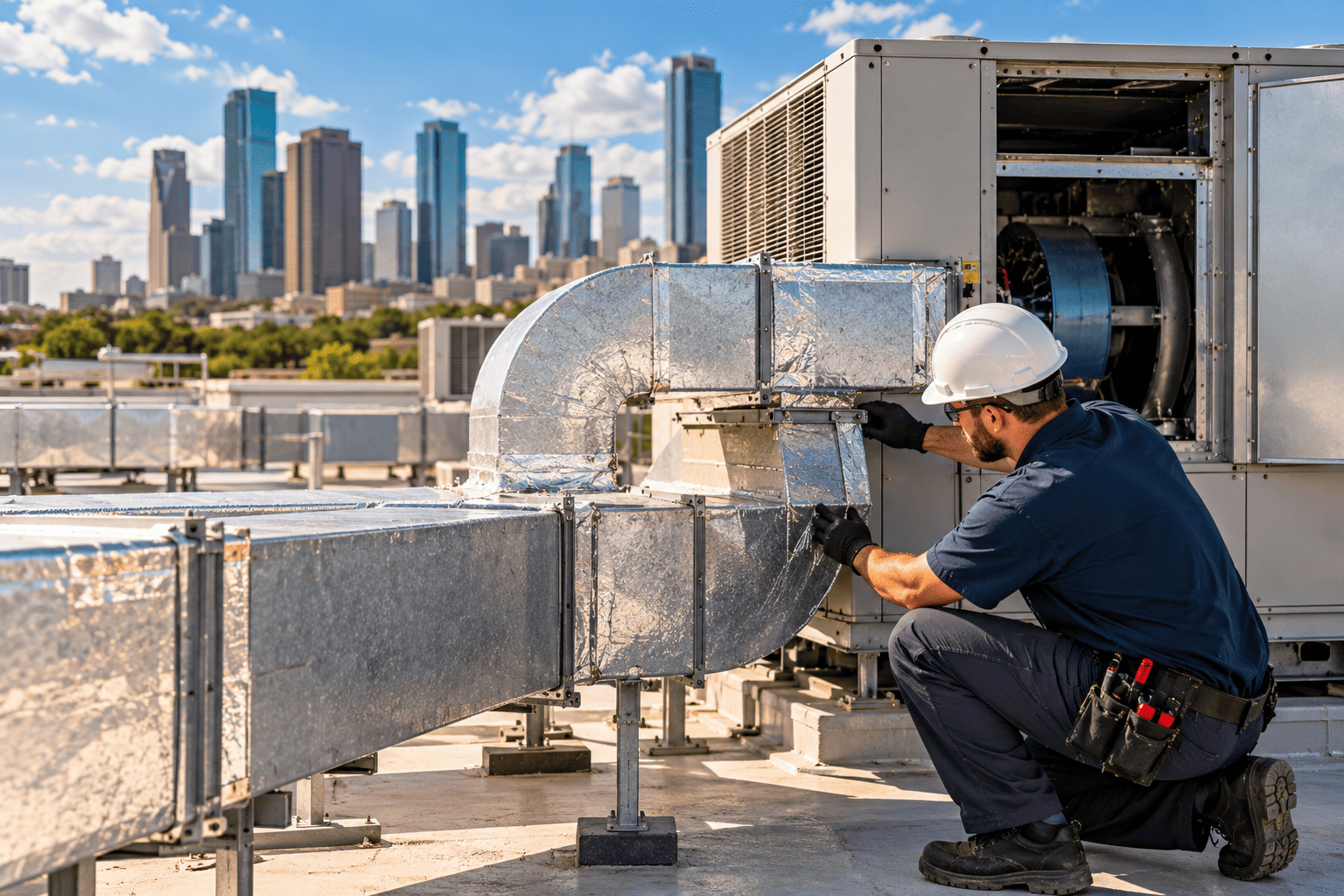
How Duct Leakage Affects Commercial HVAC Performance and Energy Costs in Houston
Commercial HVAC equipment may be operating normally at the unit while conditioned air is still being lost before it reaches the spaces it is supposed to cool. Leaking supply ducts, return-side air leaks, failed joints, damaged connections, and deteriorated ductwork can contribute to weak airflow, uneven temperatures, pressure problems, longer operating cycles, and unnecessary cooling demand. For Houston businesses searching for Commercial HVAC & Industrial Refrigeration Services in Houston TX, ACF Mechanical provides professional HVAC diagnostics, airflow evaluation, duct inspection, repair, and preventive maintenance for commercial buildings throughout Houston.
Duct leakage is only one possible cause of poor HVAC performance. Low airflow may also result from dirty filters, coil restrictions, blower problems, belt and pulley issues, motor problems, dampers, controls, or excessive system resistance. Correct diagnosis requires evaluating the HVAC unit and the air-distribution system together rather than assuming every hot zone or high utility bill is caused by leaking ductwork.
What Is Commercial HVAC Duct Leakage?
Commercial ductwork is designed to move conditioned air from HVAC equipment to occupied areas and return air back to the system.
Duct leakage occurs when air moves through unintended openings in the duct system.
Potential leakage points include:
- Duct seams
- Mechanical joints
- Connections
- Transitions
- Flexible connectors
- Access panels
- Damaged duct sections
- Supply connections
- Return connections
- Rooftop unit transitions
- Air-handler connections
The effect depends on where the leak is located, how large it is, the pressure at that point in the system, and the environment surrounding the duct.
A small leak in one location may have little noticeable effect, while significant leakage in another part of the system may contribute to major airflow and comfort problems.
Supply Duct Leakage vs. Return Duct Leakage
Supply and return duct leaks should not be treated as identical problems.
Supply Duct Leakage
Supply ducts carry conditioned air from the HVAC unit toward occupied spaces.
A Commercial HVAC supply duct leak Houston TX may allow part of that conditioned air to escape before reaching the intended zone.
Depending on where the duct is located, this can contribute to:
- Reduced airflow at diffusers
- Uneven cooling
- Hot zones
- Longer HVAC operation
- Wasted conditioned air
- Pressure imbalance
If supply ductwork passes through unconditioned areas, lost cooling may have a greater operational impact.
Return Duct Leakage
Return ducts carry air back toward the HVAC equipment.
A Commercial HVAC return duct leak Houston may allow unintended air to enter the return system.
The consequences depend heavily on where the return leak is located.
If return ductwork draws hot, humid, dusty, or contaminated air from an undesirable area, it can change the conditions entering the HVAC equipment and increase the load the system must handle.
This distinction is especially important in Houston’s hot and humid climate.
Common Signs of Commercial HVAC Duct Leakage
Duct leakage is not always visible from occupied areas.
Possible warning signs include:
- Weak supply airflow
- Uneven temperatures
- Persistent hot or cold zones
- Longer HVAC operating cycles
- Unexplained airflow changes
- Noise near duct joints
- Visible disconnected duct sections
- Damaged duct insulation
- Condensation near ductwork
- Building pressure complaints
- Increased cooling demand
- Reduced comfort despite HVAC operation
- Recurring airflow complaints from the same zones
These symptoms do not prove that duct leakage exists.
Professional Commercial HVAC airflow diagnostics Houston TX should determine whether the problem originates in the duct system, HVAC equipment, controls, building pressure, or another source.
What Causes Commercial Ductwork to Leak?
Commercial duct systems can develop leakage for several reasons.
Potential causes include:
- Failed seals
- Loose mechanical connections
- Damaged seams
- Aging materials
- Improperly secured duct sections
- Deteriorated flexible connections
- Equipment vibration
- Building movement
- Poor previous repairs
- Physical damage
- Corrosion
- Access-panel problems
- Damage during other building work
In some buildings, several small leakage points may exist throughout the duct system rather than one obvious opening.
This is why a complete Commercial HVAC duct inspection Houston can be more useful than repairing only the first visible problem.
How Duct Leakage Affects Commercial HVAC Airflow
An HVAC system is designed to move a specific amount of air through a network of equipment and ductwork.
When significant leakage develops, actual airflow reaching occupied spaces may differ from intended airflow.
Possible effects include:
- Reduced supply airflow
- Uneven air distribution
- Temperature differences between zones
- Increased fan operation
- Comfort complaints
- Difficulty balancing the system
However, low airflow does not automatically mean there is a duct leak.
Other causes can include:
- Dirty filters
- Dirty evaporator coils
- Dirty blower wheels
- Blower wheel imbalance
- Worn belts
- Pulley problems
- Bearing problems
- Motor problems
- Closed dampers
- VFD problems
- Incorrect fan speed
- Excessive duct resistance
Professional diagnosis should evaluate the complete airflow path.
Duct Leakage vs. Blower Problems
A duct leak and a blower problem can produce similar symptoms.
For example, both may contribute to weak airflow at supply diffusers.
A blower problem may involve:
- Dirty blower wheels
- Fan imbalance
- Bearing wear
- Belt slip
- Motor problems
- Incorrect fan speed
A duct problem may involve:
- Open seams
- Failed joints
- Disconnected duct sections
- Damaged transitions
- Leaking flexible connectors
Professional Commercial HVAC repair Houston TX should determine where the airflow is being lost before repairs are recommended.
Replacing blower components will not correct a major duct leak, and sealing ductwork will not repair an underperforming blower.
How Duct Leakage Affects Static Pressure
Static pressure is an important diagnostic measurement in commercial HVAC systems.
The duct system, filters, coils, dampers, grilles, diffusers, and other components all influence airflow and pressure relationships.
Duct leakage can change those relationships, but the effect is not identical in every system.
A leak does not simply mean static pressure will always increase or always decrease.
The actual result depends on:
- Whether the leak is on the supply or return side
- Location of the leak
- Fan characteristics
- Duct design
- System resistance
- Damper positions
- Fan speed
- Building pressure
For Commercial HVAC static pressure problems Houston TX, technicians may measure pressure at multiple locations to understand how the complete system is operating.
Duct Leakage and Building Pressure
Commercial buildings are affected by more than supply and return airflow.
Building pressure also depends on:
- Exhaust systems
- Outdoor ventilation air
- Makeup air
- Economizers
- Door openings
- Building envelope leakage
- Kitchen exhaust
- Restroom exhaust
- Process exhaust
Significant duct leakage can contribute to pressure imbalance, but it should not automatically be identified as the only cause.
Potential signs of pressure problems include:
- Doors that are difficult to open
- Air rushing through exterior doors
- Unwanted outdoor air infiltration
- Persistent humidity problems
- Drafts
- Odor movement between spaces
Restaurants and industrial facilities may have especially complex pressure relationships because of exhaust and makeup-air requirements.
Why Houston Humidity Makes Air Leakage Important
Houston’s climate creates a significant latent cooling load.
Commercial HVAC systems must remove both sensible heat and moisture from indoor air.
If return-side leakage or building pressure problems allow hot, humid outdoor air to enter the system or building, the HVAC equipment may need to handle additional moisture.
Potential consequences can include:
- Increased cooling demand
- Longer operating periods
- Indoor humidity complaints
- Comfort problems
- Condensation risk
This does not mean every humidity problem is caused by leaking ductwork.
Other possible causes include ventilation settings, oversized equipment, controls, drainage problems, building-envelope leakage, economizer issues, or insufficient dehumidification.
The correct cause should be identified through system-level diagnosis.
Duct Leakage and Energy Costs
One reason Houston businesses investigate duct leakage is concern about operating costs.
Significant supply-side leakage can allow conditioned air to escape before it reaches occupied spaces.
Return-side leakage may introduce unwanted air that the HVAC system must condition.
Depending on location and severity, leakage may contribute to:
- Wasted cooling
- Longer HVAC operating periods
- Increased cooling demand
- Poor space temperature control
- Reduced system performance
However, it would be inaccurate to promise a specific energy saving from duct sealing without measurements.
Commercial HVAC energy costs are influenced by many factors, including:
- Equipment efficiency
- Building load
- Thermostat settings
- Controls
- Operating schedule
- Outdoor conditions
- Airflow
- Refrigerant-side performance
- Ventilation
- Building envelope
- Duct condition
Duct leakage should therefore be evaluated as one part of overall HVAC performance.
Duct Leakage and Uneven Temperatures
Uneven temperatures are common complaints in commercial buildings.
Some zones may feel warm while others receive adequate cooling.
Duct leakage can contribute to these conditions when air is lost before reaching specific zones.
But other possible causes include:
- Incorrect balancing
- Closed dampers
- VAV problems
- Thermostat or sensor issues
- Duct restrictions
- Inadequate system capacity
- Changes in building load
- Blower problems
- Zoning controls
Professional diagnosis should determine whether the problem is caused by air loss, distribution, controls, load, or equipment performance.
Duct Insulation Problems vs. Duct Leakage
Duct leakage and insulation failure are related but different problems.
Duct leakage involves unintended air movement through openings.
Duct insulation problems involve unwanted heat transfer and possible surface-temperature issues.
Damaged insulation may contribute to:
- Heat gain into supply air
- Heat loss
- Condensation
- Wet insulation
- Reduced thermal performance
A duct can leak while its insulation remains intact.
A duct can also be properly sealed while its insulation is damaged.
In some systems, both problems occur at the same time.
Why Commercial HVAC Ducts Can Sweat
Condensation develops when a surface temperature falls below the dew point of the surrounding air.
Cold supply duct surfaces in humid environments can therefore develop condensation when insulation or vapor protection is inadequate.
Potential contributors to Commercial HVAC duct condensation Houston include:
- Missing insulation
- Damaged insulation
- Vapor barrier failure
- High surrounding humidity
- Air leakage
- Cold duct surfaces
Condensation should not automatically be treated as proof of duct leakage.
A technician should inspect insulation, vapor barriers, humidity conditions, duct temperature, and air leakage before determining the repair.
Rooftop Unit Duct Leakage
Rooftop units are common on commercial buildings in Houston.
The transition between the RTU and the building’s duct system is an important inspection area.
Potential rooftop unit duct leakage Houston locations may include:
- Supply transitions
- Return transitions
- Equipment connections
- Flexible connectors
- Seams
- Access panels
- Damaged duct sections
Because rooftop configurations vary, inspection should follow the actual equipment and duct arrangement.
Professional Commercial HVAC rooftop unit repair Houston may include evaluating the HVAC unit as well as the air-distribution components connected to it.
Commercial Air Handler Duct Leakage
Large commercial air handlers may serve extensive duct networks.
The basic airflow relationship is:
Air Handler → Supply Ductwork → Building Zones → Return Ductwork → Air Handler
Leakage anywhere in this path can alter actual system performance.
Potential Commercial air handler duct leakage Houston TX should be evaluated along with:
- Fan performance
- Filters
- Coils
- Dampers
- VFD operation
- Static pressure
- Supply airflow
- Return airflow
Professional Commercial air handler repair Houston TX should consider both the equipment and the duct system it serves.
Duct Leakage in Restaurants
Restaurants have unique HVAC pressure challenges.
Kitchen exhaust systems remove large amounts of air from the building. Makeup air and HVAC systems must operate correctly to maintain suitable building conditions.
Duct leakage may further complicate airflow and pressure relationships.
Possible symptoms include:
- Dining-room comfort complaints
- Excessive outdoor air infiltration
- Pressure differences
- Humidity issues
- Uneven temperatures
Restaurant airflow problems should therefore be evaluated as part of the complete ventilation, exhaust, makeup-air, and HVAC system.
Duct Leakage in Warehouses
Warehouses often contain large spaces and long duct runs.
Depending on the building, ductwork may be exposed and easier to inspect, or it may pass through difficult-to-access areas.
Potential warehouse problems include:
- Damaged duct sections
- Loose connections
- Air distribution problems
- Uneven temperatures
- High cooling demand
- Physical damage from facility operations
A warehouse HVAC duct leakage Houston inspection should consider both the duct condition and the large-volume airflow requirements of the building.
Duct Leakage in Offices and Retail Buildings
Office and retail properties often generate complaints when one area remains noticeably warmer than another.
Potential causes include duct leakage, but technicians should also evaluate:
- Zone controls
- Dampers
- Sensors
- Space usage
- Solar load
- Occupancy
- Air balancing
- Equipment performance
A system-level approach prevents unnecessary duct repairs when the actual cause is elsewhere.
Ductwork in Industrial Facilities
Industrial buildings may have more complex HVAC and ventilation requirements.
Process exhaust, outdoor air, dust, heat-generating equipment, and pressure relationships may all affect HVAC operation.
Damaged ductwork can create additional performance problems, but repairs should consider the operating requirements of the facility rather than treating the duct system in isolation.
How ACF Mechanical Diagnoses Commercial Duct Leakage
Effective diagnosis starts by understanding the complaint.
Is the customer experiencing weak airflow, uneven temperatures, humidity problems, long run times, unusual noise, or pressure imbalance?
Depending on the building and system, ACF Mechanical technicians may evaluate:
- Accessible ductwork
- Duct seams and joints
- Equipment connections
- Flexible connectors
- Supply airflow
- Return airflow
- Static pressure
- Filters
- Coils
- Blower performance
- Dampers
- Duct insulation
- Condensation
- Building pressure
- Temperature differences
Targeted leakage testing may also be appropriate depending on the system and the scope of the problem.
The goal is to identify where performance is being lost rather than assuming the ductwork is responsible.
Commercial Duct Leakage Symptoms and Possible Causes
| Symptom | Possible Cause |
|---|---|
| Weak airflow | Duct leak, filter, coil, blower, damper, belt, or motor problem |
| Uneven temperatures | Air distribution, zoning, duct leakage, load, or controls |
| High operating costs | Duct leakage may be one of several contributing factors |
| Duct condensation | Insulation, vapor barrier, humidity, temperature, or leakage |
| Building pressure problems | Supply/return imbalance, exhaust, ventilation, envelope, or duct leakage |
| Noise near a duct joint | Loose connection, air leakage, or vibration |
| Long HVAC cycles | Air loss, equipment condition, controls, building load, or airflow problem |
Accurate diagnosis should confirm the cause before repairs begin.
How Commercial Duct Leaks Are Repaired
The correct repair depends on the duct material, location, condition, and type of failure.
Possible Commercial HVAC duct leak repair Houston methods may include:
- Sealing failed joints
- Repairing seams
- Reconnecting separated sections
- Repairing flexible connections
- Replacing damaged duct sections
- Correcting access-panel leakage
- Restoring damaged insulation
- Repairing vapor barriers
- Correcting duct supports
The repair should address the actual defect rather than simply covering visible damage without investigating why it occurred.
When Ductwork Should Be Repaired or Replaced
Localized leakage can often be repaired.
More extensive replacement may be appropriate when duct sections are:
- Severely damaged
- Corroded
- Structurally compromised
- Improperly installed
- Repeatedly failing
- Difficult to seal reliably
The decision should consider the condition of the entire duct section and accessibility rather than automatically replacing large portions of the system.
Preventing Commercial HVAC Duct Problems
Routine Commercial HVAC maintenance Houston should include attention to the air-distribution system, especially when recurring airflow or comfort problems exist.
Preventive inspections may include:
- Inspecting accessible ductwork
- Checking seams and joints
- Inspecting flexible connectors
- Looking for disconnected sections
- Inspecting insulation
- Checking for condensation
- Inspecting duct supports
- Evaluating recurring airflow complaints
- Checking static pressure when appropriate
- Inspecting rooftop unit connections
- Evaluating air-handler connections
- Investigating persistent hot and cold zones
Early identification can help prevent minor duct defects from becoming larger operational problems.
Facility Manager Ductwork Checklist
Facility managers can watch for several warning signs without opening or modifying HVAC equipment.
Look for:
- New hot or cold zones
- Reduced airflow from diffusers
- Sudden airflow changes
- Visible duct damage
- Loose or separated duct sections
- Damaged insulation
- Water or condensation near ducts
- Unusual air noise
- Recurring humidity complaints
- Doors behaving differently because of pressure changes
- HVAC systems operating longer than expected
Recurring problems should be professionally investigated rather than repeatedly adjusting thermostat settings.
When Duct Problems Require Prompt HVAC Service
Prompt service may be appropriate when:
- A major duct section becomes disconnected
- Airflow drops significantly
- Condensation is causing water damage
- Building pressure changes suddenly
- A damaged duct affects a critical commercial area
- HVAC equipment cannot maintain temperature
- Duct damage is spreading
- A rooftop transition is visibly compromised
- Recurring repairs are not solving the problem
Professional inspection can determine whether the issue requires duct repair, HVAC equipment service, airflow balancing, or a combination of solutions.
Why Houston Businesses Choose ACF Mechanical
Commercial airflow problems require more than simply sealing visible openings. Effective diagnosis involves understanding how the HVAC equipment, blower, filters, coils, dampers, ductwork, controls, ventilation, and building pressure interact.
Houston businesses choose ACF Mechanical for:
- Experienced technicians
- Commercial HVAC expertise
- Industrial refrigeration knowledge
- Airflow diagnostics
- Rooftop unit service
- Air handler experience
- Preventive maintenance
- Fast response
- Reliable service
ACF Mechanical works with business owners, facility managers, restaurant owners, warehouses, industrial companies, commercial property owners, and other Texas businesses that depend on reliable HVAC performance.
Keep Conditioned Air Where Your Business Needs It
Commercial duct leakage can be difficult to identify because the HVAC unit may continue running while airflow is lost elsewhere in the building.
Weak airflow, uneven temperatures, long operating cycles, humidity complaints, pressure problems, or damaged insulation may indicate ductwork issues, but they can also result from equipment, controls, airflow restrictions, or building conditions.
For commercial buildings in Houston, proper diagnosis is particularly important because high cooling demand and humid outdoor conditions can make air-distribution problems more noticeable.
With professional Commercial HVAC & Industrial Refrigeration Services in Houston TX, ACF Mechanical can inspect HVAC equipment and ductwork, diagnose airflow and pressure problems, identify leakage, recommend appropriate repairs, and help Houston businesses maintain reliable commercial cooling performance.
If your building has weak airflow, hot zones, damaged ductwork, condensation, pressure problems, or suspected air loss, contact ACF Mechanical for professional commercial HVAC diagnostics and repair in Houston, TX.