
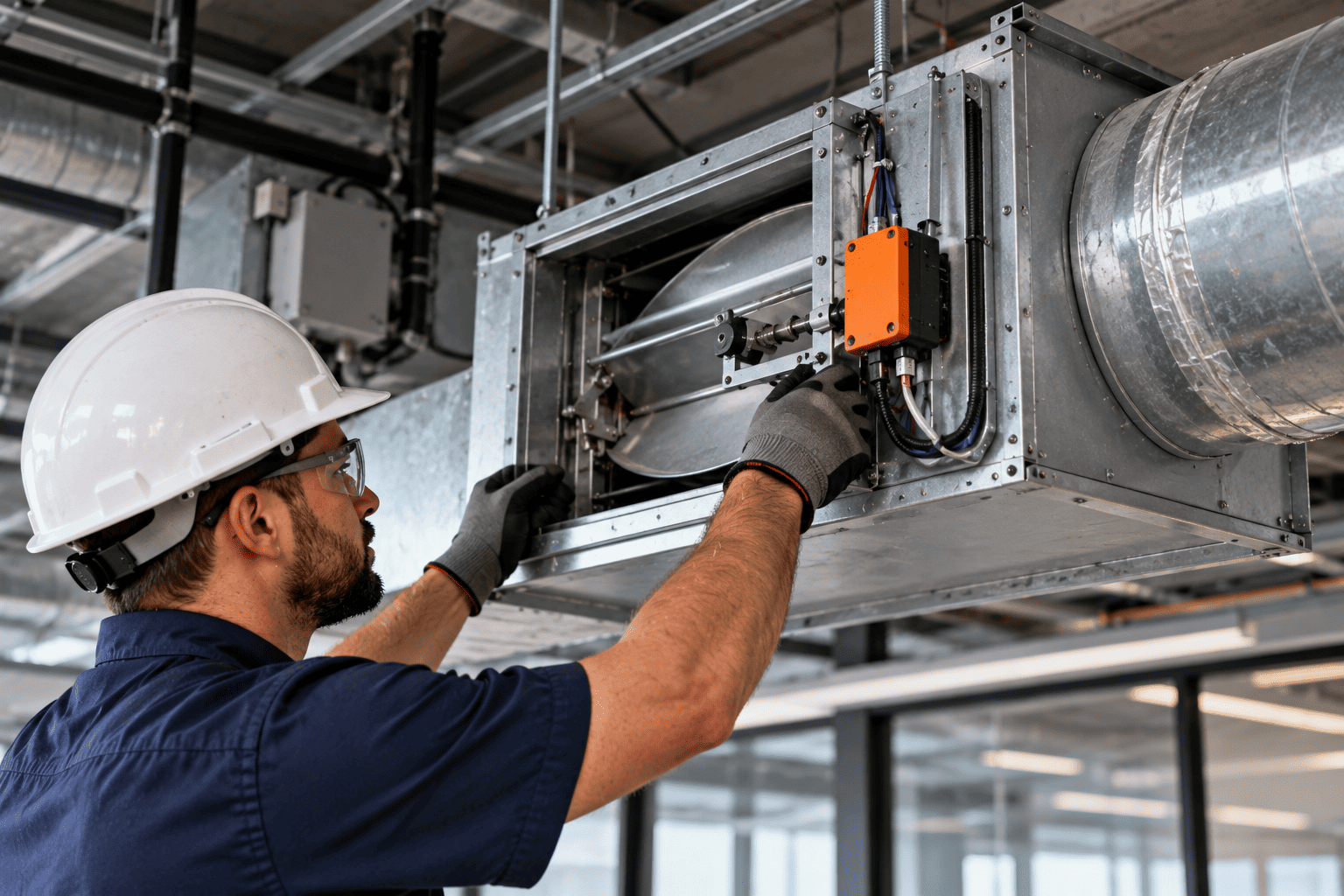
A commercial HVAC system may be operating while one office, conference room, tenant area, or other zone remains too hot, too cold, or receives the wrong amount of airflow. In multi-zone buildings, the problem may involve a Variable Air Volume (VAV) box rather than the central cooling equipment itself. For Houston businesses searching for Commercial HVAC & Industrial Refrigeration Services in Houston TX, ACF Mechanical provides professional airflow diagnostics, VAV troubleshooting, commercial HVAC controls service, air handler diagnostics, and HVAC repair to identify the actual cause of zone comfort problems.
VAV systems depend on several components working together. A damper, actuator, airflow sensor, controller, thermostat or zone sensor, duct system, supply fan, static pressure controls, and building automation system may all influence how much conditioned air reaches a particular space. Because of these interactions, replacing a VAV actuator or adjusting a damper without proper testing may fail to solve the underlying problem.
What Is a VAV Box in a Commercial HVAC System?
A Variable Air Volume box is a terminal device used to regulate the amount of supply air delivered to a specific HVAC zone.
Instead of producing conditioned air itself, the VAV box receives air from a central system and controls how much of that air enters the zone.
A typical VAV terminal may include:
- Damper assembly
- Damper actuator
- Airflow sensor
- Differential pressure pickup
- Controller
- Thermostat or zone sensor input
- Duct connections
- Communication connection to a BAS
Some VAV boxes also include reheat components.
The exact design varies by building and HVAC system.
This distinction is important: a VAV box does not create cooling. It regulates airflow supplied by central equipment such as an air handler or other commercial HVAC system.
How a VAV Box Controls Zone Airflow
The zone thermostat or temperature sensor communicates the current space condition to the control system.
When more cooling is required, the VAV controller may command the damper to open farther, increasing airflow.
As the zone approaches its temperature target, the controller may reduce airflow while maintaining the minimum required by the system’s design and control strategy.
Proper operation depends on several things happening correctly:
- The zone sensor must provide accurate information.
- The controller must calculate the correct airflow demand.
- The airflow sensor must measure airflow correctly.
- The actuator must respond to the command.
- The damper must physically move.
- Adequate supply air must be available upstream.
A problem anywhere in this sequence can create Commercial HVAC VAV box problems Houston TX.
Common Signs of VAV Box Problems
VAV problems often appear as localized comfort complaints rather than complete HVAC failure.
Common symptoms include:
- One zone remains too hot
- One zone becomes excessively cold
- Weak airflow from specific diffusers
- Excessive airflow
- Drafts
- Unusual air noise
- VAV damper remains open
- VAV damper remains closed
- Actual airflow does not match the airflow setpoint
- Zone temperature changes slowly
- Recurring comfort complaints from the same area
- BAS alarms or abnormal readings
These symptoms do not automatically confirm a failed VAV box.
Similar problems may result from duct restrictions, central fan problems, insufficient static pressure, sensor errors, thermostat problems, or changing building loads.
Professional Commercial HVAC airflow diagnostics Houston should identify the actual cause before components are replaced.
What Happens When a VAV Damper Is Stuck Closed?
A VAV damper that remains closed or cannot open sufficiently may restrict supply airflow to the zone.
Possible symptoms include:
- Low airflow
- No airflow
- Hot zone during cooling
- Inability to satisfy the thermostat
- Persistent cooling demand
- Temperature imbalance
- Occupant complaints
Potential causes include:
- Failed actuator
- Seized damper
- Broken linkage
- Controller problem
- Incorrect control signal
- Mechanical obstruction
- Incorrect damper setup
A VAV box stuck closed Houston TX should therefore be inspected mechanically and electrically rather than diagnosed from room temperature alone.
What Happens When a VAV Damper Is Stuck Open?
A damper stuck open may allow more airflow than the zone requires.
Possible consequences include:
- Overcooling
- Cold rooms
- Excessive airflow
- Drafts
- Air noise
- Difficulty maintaining zone temperature
- Unnecessary conditioning
The controller may appear to command a lower airflow rate while the mechanical damper remains open because of actuator, linkage, or blade problems.
This is why actual damper position should be confirmed during VAV box troubleshooting Houston TX.
VAV Actuator Problems
The actuator moves the VAV damper according to the controller’s command.
Potential VAV damper actuator problems Houston include:
- Failed actuator motor
- Damaged internal gears
- Loss of electrical power
- Incorrect control signal
- Loose actuator mounting
- Damaged linkage
- Incorrect actuator setup
- Mechanical binding
One important diagnostic principle is that an actuator command does not guarantee actual damper movement.
A controller may command 100% open while a damaged linkage prevents the blade from reaching the required position.
Likewise, visible actuator movement does not necessarily prove that the damper itself is moving through its complete range.
VAV Airflow Sensor Problems
Airflow measurement is critical in many VAV systems.
The controller may use differential pressure information from the VAV box to estimate airflow and regulate the damper.
Potential VAV airflow sensor problems Houston include:
- Blocked sensing ports
- Damaged tubing
- Disconnected tubing
- Cracked tubing
- Incorrect tubing connections
- Sensor failure
- Calibration problems
- Incorrect controller configuration
An inaccurate airflow reading can cause the controller to make incorrect decisions.
For example, if the controller believes airflow is lower than it actually is, it may continue opening the damper.
If it believes airflow is higher than reality, it may close the damper too far.
This can create comfort problems even when the mechanical damper and actuator are functional.
Actual Airflow vs. Airflow Setpoint
Two important values in VAV diagnostics are airflow setpoint and actual airflow.
Airflow setpoint represents the airflow the control system is requesting.
Actual airflow represents the airflow being measured or calculated by the VAV system.
When these values differ significantly, technicians need to determine why.
Potential causes include:
- Damper problems
- Actuator problems
- Airflow sensor errors
- Damaged pressure tubing
- Duct restrictions
- Insufficient upstream static pressure
- Central supply fan problems
- VFD problems
- Controller issues
- Incorrect configuration
Simply replacing the VAV controller because the values do not match can result in unnecessary repairs.
The complete airflow path should be evaluated.
VAV Minimum Airflow Problems
Many VAV systems maintain a minimum airflow setting.
The correct minimum depends on the system design, zone requirements, ventilation strategy, occupancy, equipment configuration, and applicable requirements.
An incorrect minimum airflow setting may contribute to:
- Insufficient airflow
- Excessive airflow
- Overcooling
- Comfort complaints
- Air-distribution problems
- Control instability
There is no universal minimum airflow value that is correct for every commercial building.
Professional VAV airflow calibration Houston TX should consider the design and intended operation of the specific system.
VAV Maximum Airflow Problems
Maximum airflow settings are also important.
If maximum airflow is set too low, a zone may not receive enough conditioned air during periods of high cooling demand.
If maximum airflow is excessive, the zone may experience:
- Drafts
- Noise
- Excessive cooling
- Poor system balancing
Technicians should compare the configured airflow limits with actual building requirements and system capability.
VAV Box Problems vs. Thermostat Problems
A hot room does not automatically indicate a failed VAV box.
The thermostat or zone sensor may be reporting an incorrect temperature.
Professional diagnosis may compare:
- Actual room temperature
- Zone sensor reading
- Temperature setpoint
- Cooling demand
- VAV airflow setpoint
- Actual airflow
- Damper command
- Actual damper position
If the temperature input is incorrect, the VAV controller may respond correctly to incorrect information.
Replacing the VAV box would not solve that problem.
VAV Box Problems vs. Central HVAC Problems
One of the most important diagnostic questions is whether the problem affects one zone or multiple zones.
If one zone has poor airflow while nearby zones operate normally, technicians may focus on:
- Local VAV box
- Actuator
- Damper
- Airflow sensor
- Branch ductwork
- Zone sensor
- Local controls
If multiple zones simultaneously experience low airflow, the problem may be farther upstream.
Potential causes include:
- Supply fan problems
- Dirty filters
- Dirty coils
- VFD problems
- Air handler problems
- Static pressure control problems
- Central control issues
- Duct restrictions
This is not an absolute rule, but it provides an important starting point for diagnosis.
Professional Commercial air handler repair Houston should evaluate the central equipment when zone problems indicate a broader airflow issue.
How Static Pressure Affects VAV Box Performance
A VAV box cannot deliver the required airflow if adequate upstream conditions are unavailable.
For example, the controller may command the VAV damper fully open, yet actual airflow may remain below the requested setpoint.
This does not automatically mean the VAV box has failed.
Possible causes include:
- Insufficient supply static pressure
- Duct restriction
- Dirty filter
- Dirty coil
- Fan problem
- VFD problem
- Closed upstream damper
- Duct leakage
- Incorrect static pressure control
This leads to another important diagnostic principle:
A Fully Open VAV Damper Does Not Automatically Mean the VAV Box Is Faulty
The terminal can only regulate the air available to it.
Professional diagnosis should evaluate both the terminal and the central air-distribution system.
How VAV Systems Interact With VFD-Controlled Fans
Many commercial VAV systems use variable-frequency drives to control supply fan speed.
As VAV dampers open and close throughout the building, system airflow demand changes.
Static pressure controls may then signal the VFD to increase or decrease fan speed.
This creates an interaction between:
- VAV boxes
- Dampers
- Static pressure sensors
- Supply fans
- VFDs
- Building automation controls
A problem in one part of this sequence can affect other areas.
For example, insufficient fan speed may leave several VAV boxes fully open but unable to reach their airflow setpoints.
Conversely, incorrect pressure control may create excessive airflow or noise.
Professional Commercial HVAC controls Houston TX service should evaluate the complete control sequence rather than individual components in isolation.
VAV Reheat Problems
Some VAV terminals include reheat capability.
Depending on the system, reheat may use hot water or electric heat.
Potential problems can involve:
- Reheat valves
- Electric heating components
- Control signals
- Hot-water flow
- Temperature sensors
- Incorrect sequences
A zone may receive the correct airflow but still have a temperature problem if the reheat system is malfunctioning.
In other situations, simultaneous cooling and unnecessary reheat may increase energy consumption.
The exact sequence should be verified according to system design.
Building Automation and VAV Problems
Building Automation Systems can provide valuable diagnostic information.
Depending on the system, BAS data may show:
- Zone temperature
- Temperature setpoint
- Airflow setpoint
- Actual airflow
- Damper command
- Occupancy mode
- Controller status
- Alarms
However, BAS data should not be treated as proof that mechanical components are operating correctly.
For example, the BAS may indicate that a damper has been commanded open without confirming that a damaged linkage actually moved the blade.
Professional Commercial HVAC BAS troubleshooting Houston should combine control-system information with physical equipment inspection and field measurements.
VAV Problems in Houston Office Buildings
Office buildings are common applications for VAV zoning.
Individual zones may serve:
- Conference rooms
- Private offices
- Open office areas
- Perimeter spaces
- Interior spaces
- Tenant suites
- Shared areas
These spaces can have very different cooling loads.
A conference room may experience rapid occupancy changes, while perimeter zones may be affected by solar heat gain.
When a VAV box does not respond correctly, one part of the building can become uncomfortable even though the central HVAC equipment continues operating.
For facility managers, repeated complaints from the same zone are an important reason to investigate the terminal unit and associated controls.
Houston Heat and VAV Performance
Houston’s hot climate creates extended periods of high cooling demand.
Heat itself does not automatically cause VAV box failure, but it can expose an existing airflow problem.
During mild conditions, a zone may remain comfortable even if maximum airflow is lower than intended.
During peak Texas heat, the same zone may require substantially more cooling.
If the VAV box cannot deliver its requested airflow because of a damper, sensor, static pressure, duct, or central HVAC problem, the zone may no longer maintain temperature.
This is why airflow problems often become more noticeable during periods of high cooling demand.
Houston Humidity and VAV Systems
Houston businesses also operate in a humid climate.
VAV boxes primarily regulate zone airflow; they are not automatically responsible for controlling building humidity.
Humidity performance depends on factors such as:
- Central cooling equipment
- Coil performance
- Ventilation
- Outdoor-air control
- Building envelope
- System design
- Operating sequences
- Occupancy
Incorrect VAV airflow may affect comfort and sensible cooling, but high indoor humidity should not automatically be blamed on the VAV box.
Professional diagnosis should evaluate the entire HVAC system.
VAV Systems and Commercial Rooftop Equipment
Some commercial buildings use rooftop HVAC equipment together with zoning or variable-air-volume controls.
When commercial rooftop unit airflow problems Houston affect the amount of air available to downstream zones, individual VAV terminals may not reach their airflow targets.
Technicians may need to evaluate:
- Rooftop supply fan
- Filters
- Coils
- VFD
- Ductwork
- Static pressure
- Controls
- Downstream VAV boxes
Professional Commercial HVAC repair Houston TX should distinguish between a terminal problem and a central equipment problem before repairs are recommended.
VAV Systems and Commercial Air Handlers
Large commercial air handlers frequently serve multiple zones through VAV systems.
The air handler may include:
- Supply fan
- VFD
- Filters
- Cooling coils
- Heating components
- Outdoor-air controls
- Static pressure sensors
- BAS controls
A central air handler problem can affect many VAV boxes at the same time.
For this reason, Commercial air handler airflow problems Houston TX should be evaluated when multiple zones experience similar symptoms.
VAV Systems, Chillers, and Central Cooling
In chilled-water commercial HVAC systems, chillers provide chilled water to cooling coils, while air handlers distribute conditioned air to occupied zones.
The VAV box is part of the air-distribution side of the system.
A zone airflow problem therefore should not automatically be diagnosed as a chiller problem.
Technicians may need to determine whether the issue originates with:
- Chilled-water temperature
- Cooling coil performance
- Air handler
- Supply fan
- Ductwork
- Static pressure
- VAV terminal
- Zone controls
Understanding these relationships helps avoid unnecessary repairs to equipment that is operating correctly.
VAV Systems in Other Commercial Facilities
VAV systems can also be used in larger retail properties, mixed-use buildings, institutional facilities, and some industrial or warehouse applications.
Not every restaurant, warehouse, or industrial facility uses VAV zoning, so the diagnostic approach should always reflect the actual HVAC design.
For Texas businesses with multi-zone HVAC systems, recurring temperature complaints should be investigated based on equipment configuration rather than assumptions.
Common VAV Symptoms and Possible Causes
| Symptom | Possible Cause |
|---|---|
| No airflow | Closed damper, actuator, controls, duct, or upstream problem |
| Low airflow | Sensor error, restriction, insufficient static pressure, or damper problem |
| Excessive airflow | Damper stuck open, sensor error, or incorrect setpoint |
| Zone too hot | Low airflow, controls, high load, or central HVAC problem |
| Zone too cold | Excessive airflow, sensor error, controls, or reheat problem |
| Damper fully open but airflow remains low | Insufficient upstream pressure, restriction, duct leakage, or sensor problem |
| Actual airflow differs from setpoint | Sensor, damper, actuator, static pressure, or control problem |
| VAV repeatedly opens and closes | Sensor, control tuning, pressure, or communication issue |
| BAS command changes but airflow does not | Mechanical damper, actuator, linkage, sensor, or upstream problem |
These symptoms provide diagnostic clues, but measurements and equipment inspection are necessary to confirm the cause.
How ACF Mechanical Diagnoses VAV Box Problems
Professional Commercial HVAC VAV troubleshooting Houston requires more than checking whether the damper moves.
Depending on the system, ACF Mechanical technicians may:
- Verify actual zone temperature
- Check thermostat or zone sensor readings
- Review temperature setpoint
- Check airflow setpoint
- Check actual airflow
- Inspect VAV damper operation
- Test actuator response
- Inspect linkage
- Inspect airflow sensor
- Inspect differential pressure tubing
- Verify controller signals
- Check upstream static pressure
- Inspect branch ductwork
- Evaluate supply fan operation
- Check VFD operation
- Review BAS information where available
The objective is to identify whether the VAV box itself is faulty or whether it is responding to another system problem.
How VAV Box Problems Are Repaired
The appropriate Commercial HVAC VAV box repair Houston depends on the confirmed cause.
Potential repairs may include:
- Actuator replacement
- Damper repair
- Linkage repair
- Sensor replacement
- Pressure tubing repair
- Airflow sensor calibration
- Controller correction
- Control programming correction
- Zone sensor replacement
- VAV balancing
- Duct repair
- Static pressure correction
- Central HVAC repair
- Complete VAV box replacement
Replacing multiple components without diagnosis can increase repair costs without correcting the root problem.
Repair vs. Replace a Commercial VAV Box
Many VAV problems can be repaired without replacing the complete terminal.
Repair may be appropriate when the problem involves:
- Actuator
- Linkage
- Sensor
- Pressure tubing
- Controller
- Calibration
- Control configuration
Complete VAV box replacement Houston TX may be considered when:
- The damper assembly is severely damaged
- The terminal is mechanically deteriorated
- Components are obsolete or unsupported
- Repairs are no longer reliable
- The terminal has repeated mechanical failures
- Replacement better supports the building’s HVAC requirements
The decision should be based on equipment condition, compatibility, accessibility, and long-term reliability.
Preventing VAV Box and Zone Airflow Problems
Routine Commercial HVAC maintenance Houston can help identify VAV problems before they result in repeated comfort complaints.
Preventive inspection may include:
- Checking actuator operation
- Verifying damper movement
- Comparing airflow setpoint with actual airflow
- Inspecting sensing tubing
- Checking sensor readings
- Reviewing recurring zone complaints
- Checking static pressure
- Reviewing BAS alarms
- Inspecting duct connections
- Checking unusual air noise
- Evaluating airflow balance
Facility teams should also pay attention to building changes.
New walls, tenant improvements, occupancy changes, equipment additions, and space-use changes can alter zone loads and airflow requirements.
Facility Manager VAV Checklist
Facility managers should consider professional inspection when they notice:
- One area is consistently hotter than surrounding zones
- A zone is consistently overcooled
- Airflow suddenly decreases
- Airflow becomes unusually strong
- A VAV zone no longer responds to thermostat changes
- BAS shows airflow far from the requested setpoint
- The damper remains fully open for extended periods
- Comfort complaints repeatedly come from the same area
- Several zones begin experiencing low airflow
- Problems become significantly worse during peak summer conditions
Recording which zones are affected and when symptoms occur can help technicians diagnose the system more efficiently.
When VAV Problems Need Prompt Commercial HVAC Service
Prompt service may be appropriate when:
- A critical business area loses airflow
- Multiple zones suddenly become uncomfortable
- A VAV damper stops responding
- Actual airflow remains far below the setpoint
- An actuator repeatedly fails
- Static pressure becomes abnormal
- BAS generates recurring VAV alarms
- Airflow changes significantly without an operational reason
- The central HVAC system can no longer maintain building conditions
Professional Commercial HVAC service Houston can determine whether the problem is localized to the VAV terminal or part of a larger system issue.
Why Houston Businesses Choose ACF Mechanical
VAV problems often involve more than one component. Effective troubleshooting requires understanding airflow, dampers, actuators, sensors, controls, static pressure, air handlers, VFDs, ductwork, and building automation.
Houston businesses choose ACF Mechanical for:
- Experienced technicians
- Commercial HVAC expertise
- Industrial refrigeration knowledge
- Professional airflow diagnostics
- VAV and control troubleshooting
- Air handler expertise
- Rooftop HVAC experience
- Preventive maintenance
- Fast response
- Reliable service
ACF Mechanical serves business owners, facility managers, commercial property owners, restaurants, warehouses, industrial facilities, and other Texas businesses that depend on reliable HVAC and refrigeration equipment.
Restore Proper VAV Airflow and Zone Comfort
A VAV box problem can affect a single office or an entire group of zones without causing the central HVAC system to shut down.
Failed actuators, damaged dampers, inaccurate airflow sensors, incorrect setpoints, controller problems, insufficient static pressure, duct restrictions, and central air-handler problems can all produce similar symptoms.
The most important step is determining where the airflow problem actually originates.
For commercial buildings in Houston, this becomes especially important during periods of high cooling demand, when an existing airflow limitation can make it difficult for affected zones to maintain comfortable temperatures.
With professional Commercial HVAC & Industrial Refrigeration Services in Houston TX, ACF Mechanical can diagnose VAV boxes, test airflow, inspect actuators and sensors, evaluate static pressure, troubleshoot air handlers and controls, and recommend the appropriate repair.
If your building has hot or cold zones, weak airflow, excessive airflow, VAV alarms, or recurring comfort complaints, contact ACF Mechanical for professional commercial HVAC diagnostics and service in Houston, TX.