
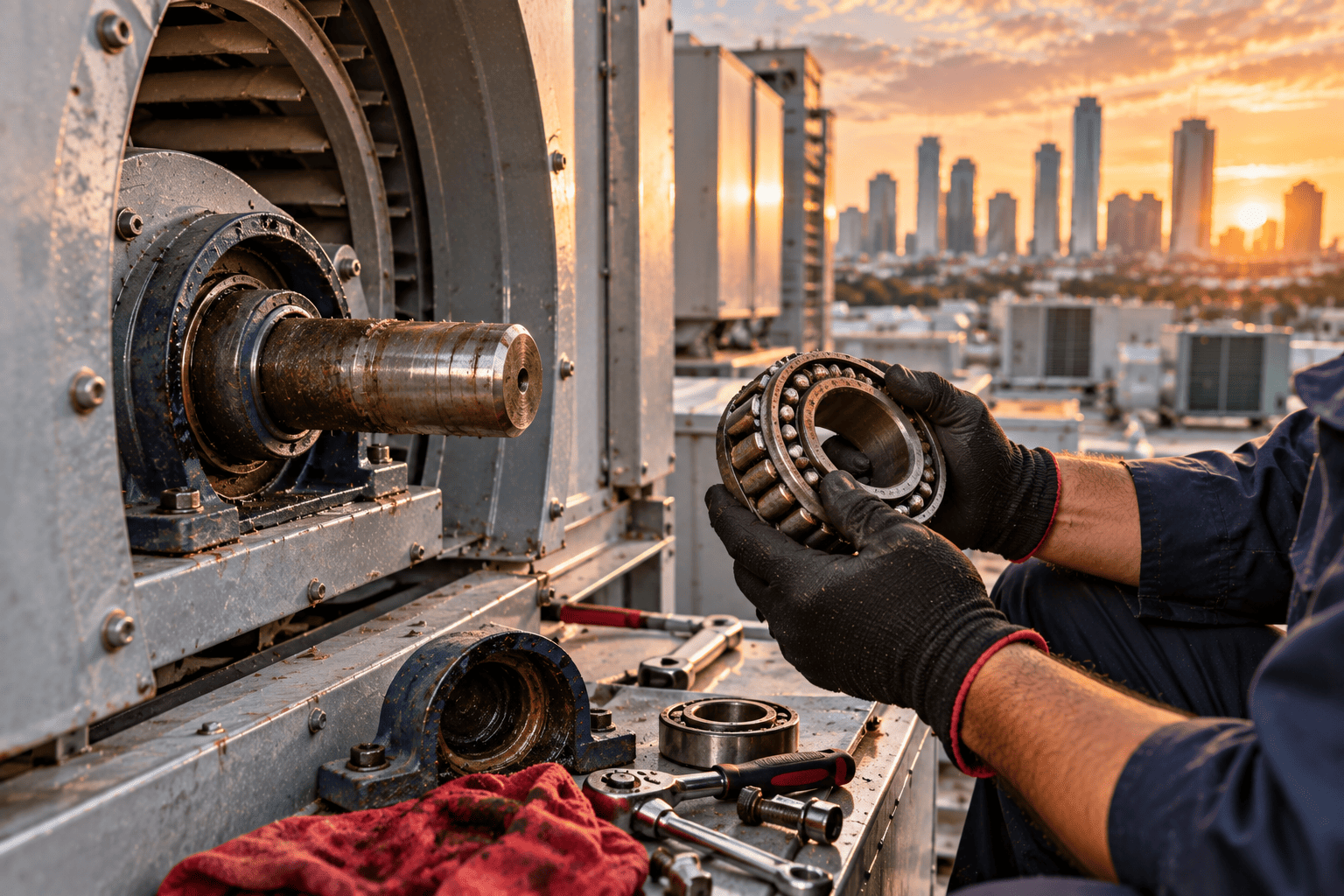
Commercial HVAC and refrigeration equipment relies on rotating components that must operate smoothly for thousands of hours. When bearings begin to wear, lose proper lubrication, become contaminated, or operate under excessive mechanical load, the result may be noise, vibration, overheating, shaft movement, and eventually equipment failure. For Houston businesses searching for Commercial HVAC & Industrial Refrigeration Services in Houston TX, ACF Mechanical provides professional diagnostics, repair, and preventive maintenance for rooftop units, air handlers, commercial AC systems, refrigeration equipment, condenser and evaporator fans, motors, blowers, and other rotating components.
Bearing problems should not be diagnosed from noise alone. A grinding or rumbling sound may indicate bearing wear, but similar symptoms can result from blower imbalance, belt problems, loose components, motor issues, or mechanical damage. Correct diagnosis requires evaluating the complete rotating assembly and the conditions that may have caused the bearing problem.
What Do Bearings Do in HVAC and Refrigeration Equipment?
Bearings support rotating shafts and allow mechanical components to turn with controlled friction.
Depending on the equipment design, bearings may be used in:
- Blower assemblies
- Fan motors
- Air handlers
- Rooftop units
- Condenser fans
- Evaporator fans
- Pumps
- Cooling equipment
- Refrigeration systems
- Other rotating machinery
A properly operating bearing helps maintain shaft position while allowing the component to rotate smoothly.
When a bearing deteriorates, shaft movement and friction may increase. This can affect the fan, blower, motor, belt drive, or other components connected to the rotating assembly.
Common Signs of Commercial HVAC Bearing Problems
The symptoms of Commercial HVAC bearing problems Houston TX can vary considerably depending on bearing type, equipment design, speed, load, lubrication, and severity of wear.
Common warning signs include:
- Grinding or rumbling sounds
- Squealing or unusual mechanical noise
- Increasing vibration
- Excessive shaft movement
- Bearing housing heat
- Changing fan noise
- Fan or blower speed problems
- Motor overheating
- Repeated belt problems
- Visible lubricant leakage on serviceable assemblies
- Fan wheel movement or instability
- Rotating components becoming difficult to turn
- Unexpected equipment shutdowns
One symptom alone does not confirm bearing failure. A professional inspection should determine whether the bearing itself is damaged and why the problem developed.
What Causes HVAC Bearings to Fail Prematurely?
Bearings are wear components, but premature failure can result from operating conditions or problems elsewhere in the equipment.
Potential causes include:
- Incorrect lubrication
- Insufficient lubrication
- Excessive lubrication on applicable bearing types
- Contamination
- Moisture
- Misalignment
- Excessive belt tension
- Shaft problems
- Fan imbalance
- Mechanical vibration
- Improper installation
- Excessive load
- Damaged mounting
- Normal wear after extended service
Finding the root cause is important. Installing a new bearing without correcting the condition that damaged the original one can lead to another failure.
Bearing Noise: What Grinding, Rumbling, and Squealing May Mean
Changes in equipment sound are often among the first warning signs noticed by facility personnel.
Grinding Noise
An HVAC bearing grinding noise Houston complaint may indicate bearing or rotating-component damage, but grinding can also originate from mechanical contact elsewhere in the assembly.
Rumbling Noise
Rumbling may be associated with bearing wear, shaft problems, or another rotating component.
Squealing Noise
Squealing is not automatically a bearing problem. Belt slip, pulley problems, mechanical friction, and some motor conditions can produce similar sounds.
Humming
Humming may involve the motor or electrical system rather than the bearing itself.
For this reason, technicians should locate the actual source of the sound before recommending replacement.
Bearing Vibration and Why It Matters
Bearings help maintain the position of rotating shafts. As wear increases, shaft movement can increase and vibration may become more noticeable.
However, the relationship works in both directions.
A damaged bearing can create vibration, but vibration from another source can also damage a bearing.
Potential vibration sources include:
- Blower wheel imbalance
- Fan imbalance
- Pulley misalignment
- Belt problems
- Bent shafts
- Loose mounting
- Damaged fan blades
- Motor problems
This creates an important diagnostic relationship:
Imbalance → Vibration → Bearing Stress
and:
Bearing Wear → Shaft Movement → Vibration
Professional Commercial HVAC bearing vibration Houston diagnosis should therefore include the complete rotating assembly.
Bearing Problems vs. Blower Wheel Imbalance
A dirty or unbalanced blower wheel can create symptoms that resemble bearing problems.
An unbalanced wheel may cause:
- Repetitive vibration
- Noise
- Bearing stress
- Shaft movement
- Premature mechanical wear
At the same time, worn blower bearings can allow the shaft and wheel to move excessively.
This means replacing bearings without inspecting the blower wheel may leave the original vibration source unresolved.
Likewise, cleaning or balancing a blower wheel will not repair a bearing that has already sustained significant damage.
Bearing Problems vs. Belt and Pulley Problems
Belt-driven commercial HVAC systems contain several mechanical components that interact with each other.
A slipping or misaligned belt may produce:
- Squealing
- Reduced fan speed
- Belt dust
- Uneven wear
- Vibration
Bearing problems may produce:
- Rumbling
- Grinding
- Heat
- Shaft play
- Mechanical resistance
- Vibration
The symptoms can overlap.
Professional Commercial HVAC repair Houston TX should inspect the belt, pulleys, bearings, shaft, motor, and fan assembly rather than diagnosing the problem from sound alone.
How Belt Tension Can Affect Bearing Life
Belt tension is important for both power transmission and bearing life.
A belt that is too loose may slip. A belt that is excessively tight may increase radial load on the shafts and bearings connected to the drive.
Depending on equipment design, excessive tension can place unnecessary stress on:
- Motor bearings
- Blower bearings
- Fan bearings
- Shafts
- Pulleys
Correct belt tension should follow equipment and belt-drive specifications.
Tightening a belt beyond the required tension is not a proper solution for recurring belt slip.
Bearing Lubrication Problems
Lubrication is one of the most important—and frequently misunderstood—aspects of bearing maintenance.
The correct lubricant reduces friction, helps control wear, and supports proper bearing operation.
However, lubrication requirements vary significantly between equipment and bearing designs.
Under-Lubrication
Insufficient lubrication can contribute to increased friction, heat, and wear in bearings designed to be periodically lubricated.
Over-Lubrication
More grease is not always better.
For applicable bearing arrangements, excessive grease can create operating problems and additional heat.
Incorrect Lubricant
Using an inappropriate lubricant or mixing incompatible products can create additional problems.
Sealed Bearings
Not all HVAC bearings are designed for field lubrication.
Some motors, fans, and other equipment use sealed or permanently lubricated bearings. Maintenance should follow manufacturer requirements rather than assuming every bearing needs additional grease.
Professional Commercial HVAC bearing lubrication Houston should always consider the actual bearing and equipment design.
Bearing Contamination
Contamination can shorten bearing life.
Possible contaminants include:
- Dust
- Dirt
- Moisture
- Metal particles
- Process debris
- Improper lubricant
- Foreign material introduced during service
Contaminants can affect lubricant condition and bearing surfaces.
Commercial and industrial facilities with dusty or demanding operating environments may require closer attention to rotating equipment condition.
Misalignment and Bearing Wear
Misalignment can create abnormal forces on rotating components.
Potential sources include:
- Shaft misalignment
- Pulley misalignment
- Improper motor position
- Damaged mounts
- Installation errors
- Structural movement
The result may include vibration, uneven loading, and accelerated mechanical wear.
When bearings repeatedly fail, technicians should investigate alignment rather than assuming the replacement bearing was defective.
Commercial HVAC Blower Bearing Problems
Blower assemblies are a common location for bearing-related issues in belt-driven HVAC equipment.
Potential Commercial HVAC blower bearing problems Houston TX include:
- Bearing wear
- Lubrication problems
- Shaft movement
- Excessive vibration
- Mechanical noise
- Overheating
- Misalignment
A blower bearing problem can affect more than the bearing itself.
If the shaft no longer remains properly supported, the blower wheel, belts, pulleys, and other drive components may also be affected.
Professional diagnosis should include the entire blower assembly.
Motor Bearing Problems
Electric motors contain bearings that support the rotor and shaft.
Potential Commercial HVAC motor bearing problems Houston TX may produce:
- Increased noise
- Vibration
- Shaft movement
- Heat
- Mechanical resistance
- Changes in motor operation
However, motor overheating should not automatically be attributed to bearings.
Electrical problems, excessive load, voltage conditions, airflow around the motor, fan problems, and other causes may also need to be evaluated.
Technicians may check motor amperage and operating conditions along with the mechanical condition of the motor.
Commercial Air Handler Bearing Problems
Large air handlers can operate for extended periods while moving substantial volumes of air through commercial buildings.
Potential Commercial HVAC air handler bearing problems Houston TX may involve:
- Blower shaft bearings
- Fan bearings
- Motor bearings
- Belt-drive components
- Misalignment
- Lubrication
- Vibration
Professional Commercial air handler bearing repair Houston should not focus on the bearing alone.
Technicians may also inspect:
- Blower wheel condition
- Shaft condition
- Belts
- Pulleys
- Motor
- Fan speed
- Static pressure
- Vibration
- Mounting hardware
This system-level approach helps identify the reason the bearing developed a problem.
Rooftop Unit Bearing Problems in Houston
Commercial rooftop units are widely used on offices, restaurants, retail properties, warehouses, and other commercial buildings in Houston.
Depending on the RTU design, bearings may be present in blower assemblies, motors, or fan systems.
Potential rooftop unit bearing problems Houston TX can produce noise, vibration, fan performance issues, and mechanical wear.
Professional rooftop HVAC bearing repair should include inspection of related components rather than replacing a bearing without determining the cause.
Houston’s long cooling season can result in substantial runtime for rooftop equipment, making preventive inspection especially valuable.
Condenser Fan Bearing Problems
Commercial HVAC and refrigeration condensers depend on fans to move air across heat-transfer surfaces when air-cooled designs are used.
A condenser fan bearing problem may contribute to:
- Fan noise
- Vibration
- Reduced fan speed
- Fan instability
- Motor problems
- Complete fan failure
Reduced condenser airflow can affect heat rejection.
However, technicians should determine whether poor fan performance is caused by bearings, the motor, electrical controls, fan blades, capacitors where applicable, VFD controls, or another component.
Evaporator Fan Bearing Problems
Evaporator fans are particularly important in refrigeration applications because they circulate air across the evaporator coil and throughout the refrigerated space.
Potential refrigeration evaporator fan bearing problems Houston may cause:
- Noise
- Vibration
- Reduced fan operation
- Uneven airflow
- Fan failure
These problems can affect walk-in coolers, walk-in freezers, commercial refrigeration systems, and industrial refrigeration equipment.
A noisy evaporator fan should be inspected before assuming that the bearing is the only failed component.
Industrial Refrigeration Bearing Problems
Industrial refrigeration systems can contain numerous rotating components, including fans, motors, pumps, and other equipment depending on system design.
Potential industrial refrigeration bearing problems Houston TX should be evaluated according to the specific equipment involved.
Technicians may inspect:
- Fan bearings
- Motor bearings
- Pump bearings
- Shafts
- Couplings
- Belt drives
- Alignment
- Lubrication
- Vibration
Professional industrial refrigeration repair Houston TX requires understanding the relationship between the mechanical component and the refrigeration system it supports.
Commercial Refrigeration Bearing Problems
Commercial refrigeration systems in restaurants, food-service facilities, grocery operations, cold-storage areas, and other businesses depend on reliable fans and motors.
Bearing problems can affect:
- Condenser fans
- Evaporator fans
- Fan motors
- Other rotating equipment
Possible symptoms include noise, vibration, overheating, and fan performance problems.
Professional commercial refrigeration repair Houston should identify whether the issue is mechanical, electrical, airflow-related, or a combination of conditions.
Walk-In Cooler Fan Bearing Problems
Walk-in coolers depend on evaporator fans to circulate cold air through the refrigerated space.
Potential walk-in cooler fan bearing problems Houston TX may create:
- Fan noise
- Vibration
- Reduced airflow
- Intermittent fan operation
- Fan motor problems
Reduced evaporator airflow can affect temperature distribution, but bearing failure is only one possible cause.
Other possibilities include:
- Ice accumulation
- Fan blade damage
- Motor failure
- Electrical problems
- Control problems
- Evaporator coil restrictions
Professional walk-in cooler repair Houston TX should identify the actual cause before components are replaced.
Walk-In Freezer Fan Bearing Problems
Walk-in freezers also depend on reliable evaporator fan operation.
Potential walk-in freezer fan bearing problems Houston can become noticeable through noise, vibration, or fan failure.
Freezer environments introduce additional diagnostic considerations, including:
- Ice accumulation
- Defrost problems
- Fan blade obstruction
- Motor condition
- Electrical controls
A technician should evaluate the entire evaporator fan assembly and surrounding operating conditions.
A Note About Compressor Bearing Problems
Compressors contain internal mechanical components, but compressor diagnosis is different from external fan or blower bearing service.
Noise or vibration from a refrigeration compressor should not automatically be labeled an internal bearing problem.
Depending on compressor design, internal mechanical repair may not be a practical field procedure.
Compressor-specific diagnostics may involve evaluating:
- Refrigerant pressures
- Electrical measurements
- Operating temperatures
- Oil condition where applicable
- Vibration
- Sound
- System operating conditions
The correct repair depends on compressor design, condition, and manufacturer requirements.
How Bearing Problems Can Affect Equipment Performance
Bearing deterioration can increase mechanical resistance and alter shaft stability.
Depending on the component affected, consequences may include:
- Increased vibration
- Fan speed problems
- Reduced airflow
- Motor stress
- Mechanical noise
- Belt wear
- Shaft damage
- Fan failure
- Equipment shutdown
The impact depends on where the bearing is located and what equipment it supports.
A blower bearing problem may affect HVAC airflow, while a refrigeration condenser fan bearing problem may affect condenser airflow and heat rejection.
Houston Heat and Bearing Wear
Houston’s hot climate creates long periods of high HVAC and refrigeration demand.
Texas heat does not directly prove that a bearing will fail.
However, longer equipment runtime means rotating components accumulate operating hours more quickly.
Existing lubrication problems, contamination, misalignment, vibration, or wear may become more significant during periods of sustained operation.
This makes preventive maintenance particularly important for Houston businesses that depend on HVAC and refrigeration equipment every day.
Houston Humidity and Bearing Condition
Houston humidity can also affect exposed equipment conditions.
Depending on the equipment location and protection, moisture may contribute to corrosion or contamination around mechanical components.
However, humidity should not be treated as the universal cause of bearing failure.
Technicians should evaluate:
- Lubrication
- Alignment
- Load
- Contamination
- Equipment age
- Vibration
- Installation
- Operating hours
The cause should be established through inspection rather than assumed from climate alone.
Diagnosing Bearing Problems Correctly
Professional bearing diagnosis involves more than listening for noise.
Depending on the equipment, technicians may evaluate:
- Bearing noise
- Vibration
- Shaft movement
- Bearing temperature
- Lubrication condition
- Alignment
- Belt tension
- Pulley condition
- Blower or fan balance
- Motor amperage
- Fan speed
- Mounting hardware
- Equipment operating conditions
The objective is to identify both the failed component and the reason it failed.
Bearing Symptoms and Possible Causes
| Symptom | Possible Cause |
|---|---|
| Grinding noise | Bearing or rotating-component damage |
| Rumbling | Bearing wear or shaft problem |
| Squealing | Bearing, belt, or other mechanical issue |
| Excessive vibration | Bearing, alignment, belt, fan, or blower problem |
| Shaft movement | Bearing wear, mounting, or shaft problem |
| Bearing overheating | Lubrication, load, alignment, or bearing problem |
| Fan slows or stops | Bearing, motor, drive, control, or electrical problem |
| Repeated bearing failure | Underlying root cause has not been corrected |
This table should be used as a diagnostic guide, not as a substitute for equipment inspection.
When Does a Bearing Need Replacement?
Not every unusual sound requires bearing replacement.
Replacement may be appropriate when inspection confirms:
- Significant bearing wear
- Excessive shaft play
- Damaged bearing surfaces
- Seizure
- Persistent bearing-related vibration
- Mechanical damage
- Bearing failure
The service procedure depends on the equipment design.
In some assemblies, bearings are individually serviceable. In others, replacing a motor, fan assembly, or another complete component may be the appropriate repair.
Why Repeated Bearing Failure Requires Root-Cause Diagnosis
A bearing that repeatedly fails is often a sign of another unresolved problem.
Potential causes include:
- Misalignment
- Excessive belt tension
- Fan imbalance
- Incorrect lubrication
- Contamination
- Shaft damage
- Improper installation
- Excessive load
Repeatedly installing bearings without correcting the root cause can increase repair costs and equipment downtime.
Preventing Commercial HVAC and Refrigeration Bearing Problems
Routine Commercial HVAC maintenance Houston can help identify mechanical wear before it becomes a major failure.
Preventive maintenance may include:
- Listening for abnormal bearing noise
- Checking vibration
- Inspecting shaft movement
- Inspecting belts
- Verifying belt tension
- Checking pulley alignment
- Inspecting blower and fan condition
- Checking mounting hardware
- Inspecting lubrication where applicable
- Using the specified lubricant
- Avoiding unnecessary over-lubrication
- Inspecting for contamination
- Checking motor condition
- Monitoring bearing temperature where appropriate
Refrigeration maintenance should similarly include inspection of condenser fans, evaporator fans, motors, pumps, and other applicable rotating equipment.
Maintenance requirements should always follow equipment and manufacturer specifications.
Facility Manager Bearing Problem Checklist
Facility managers can help identify developing mechanical problems without disassembling equipment.
Watch for:
- New grinding or rumbling sounds
- Increasing vibration
- Repeated belt failures
- Fan wobble
- Unusual motor heat
- Reduced airflow
- Fan speed changes
- Repeated fan shutdowns
- Scraping sounds
- Sudden changes in equipment noise
If these symptoms appear, schedule professional inspection.
Guards, fan compartments, and rotating machinery should not be opened or adjusted while operating by unqualified personnel.
When Bearing Problems Require Prompt Service
Prompt professional service may be appropriate when:
- Grinding becomes severe
- Vibration increases rapidly
- A shaft has excessive movement
- A fan becomes unstable
- A bearing appears seized
- The motor repeatedly overheats
- The fan or blower stops
- Mechanical components begin contacting each other
- Refrigeration airflow is significantly reduced
- HVAC airflow drops substantially
Continuing to operate equipment with severe rotating-component problems can allow damage to spread beyond the original bearing.
Why Houston Businesses Choose ACF Mechanical
Bearing problems require technicians who understand more than the bearing itself. Reliable diagnosis involves the motor, shaft, fan, blower, belts, pulleys, alignment, lubrication, vibration, airflow, electrical conditions, and overall equipment operation.
Houston businesses choose ACF Mechanical for:
- Experienced technicians
- Commercial HVAC expertise
- Industrial refrigeration knowledge
- Rooftop unit diagnostics
- Air handler service
- Commercial refrigeration experience
- Preventive maintenance
- Fast response
- Reliable service
ACF Mechanical works with business owners, facility managers, restaurant owners, warehouses, industrial companies, commercial property owners, and other Texas businesses that depend on reliable HVAC and refrigeration equipment.
Protect Rotating Equipment Before Bearing Problems Cause Failure
Bearings are relatively small components, but their condition can affect much larger HVAC and refrigeration assemblies.
Grinding, vibration, overheating, shaft movement, repeated belt problems, or abnormal fan noise should not be ignored. These symptoms may indicate bearing wear, but they may also reveal misalignment, imbalance, lubrication problems, damaged shafts, belt-drive issues, or other mechanical conditions.
For commercial buildings in Houston, preventive inspection is especially valuable because HVAC and refrigeration equipment can accumulate substantial operating hours throughout the long Texas cooling season.
With professional Commercial HVAC & Industrial Refrigeration Services in Houston TX, ACF Mechanical can diagnose bearing and rotating-equipment problems, identify underlying causes, perform appropriate repairs, and help reduce the risk of unexpected HVAC or refrigeration downtime.
If your commercial HVAC or refrigeration equipment is producing grinding noises, excessive vibration, unusual heat, shaft movement, or recurring bearing failures, contact ACF Mechanical for professional diagnostics and repair in Houston, TX.