
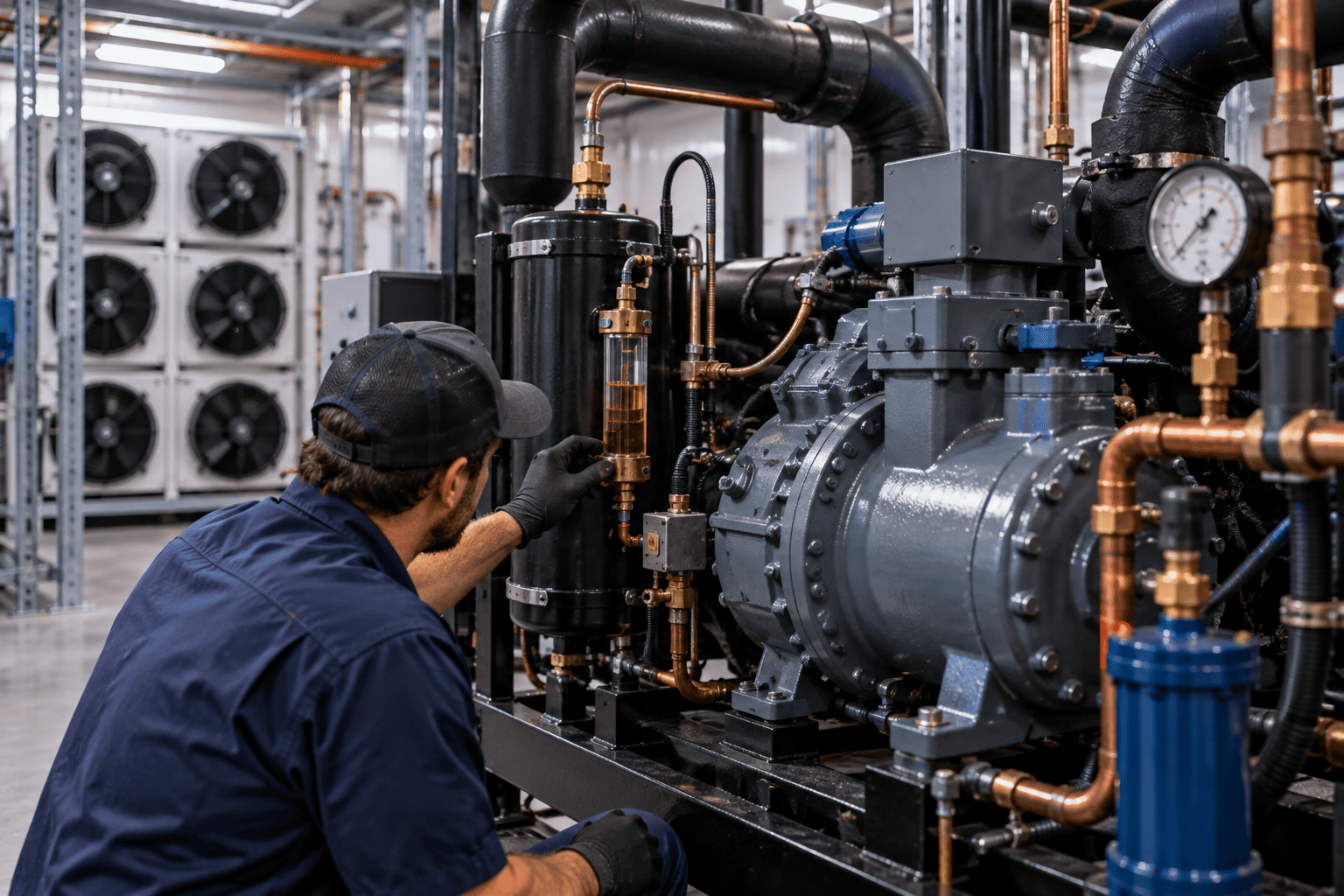
Houston businesses depend on commercial and industrial refrigeration equipment to maintain temperatures, protect products, and support continuous operations. When oil does not circulate or return correctly, compressors can experience lubrication problems, repeated oil-safety shutdowns, abnormal wear, and eventually serious mechanical damage. For facilities searching for Commercial HVAC & Industrial Refrigeration Services in Houston TX, ACF Mechanical provides professional refrigeration diagnostics to identify oil return, oil pressure, separator, piping, refrigerant, and compressor problems before they develop into larger failures.
Oil management is particularly important because adding oil does not necessarily correct a low oil level. If oil has become trapped elsewhere in the refrigeration circuit, adding more oil without identifying the cause can create additional problems. Proper diagnosis requires understanding the entire refrigeration system.
What Is Oil Management in a Refrigeration System?
Refrigeration compressors require lubricant to reduce friction, protect moving components, help seal internal surfaces, and support reliable operation.
However, compressor oil does not always remain entirely inside the compressor. Depending on compressor design, refrigerant, lubricant, piping, and operating conditions, some oil can leave the compressor with the discharge gas and circulate through the refrigeration system.
That oil must be properly managed and, in many systems, returned to the compressor.
Oil management can involve:
- Compressor oil level
- Oil pressure
- Oil separators
- Oil reservoirs
- Oil level regulators
- Refrigerant piping
- Suction-line design
- Refrigerant velocity
- System load
- Compressor staging
- Oil safety controls
The exact oil-management strategy depends on equipment design. A small commercial refrigeration system may operate very differently from a multi-compressor refrigeration rack or a large industrial refrigeration plant.
Why Proper Oil Return Matters
A compressor depends on adequate lubrication during operation.
When excessive oil leaves the compressor and does not return properly, the compressor oil level may fall. At the same time, oil can accumulate elsewhere in the refrigeration system.
Poor oil return can potentially contribute to:
- Low compressor oil level
- Lubrication problems
- Oil safety trips
- Abnormal compressor noise
- Reduced heat-transfer efficiency
- Oil logging in evaporators
- Compressor wear
- Unexpected system shutdowns
- Reduced refrigeration reliability
An industrial refrigeration oil return problem Houston should therefore be investigated as a system condition rather than simply corrected by adding lubricant.
Common Signs of Refrigeration Oil Management Problems
Oil-management problems can develop gradually or appear as repeated shutdowns.
Possible warning signs include:
- Low oil level in the compressor
- Repeated oil safety trips
- Abnormal oil differential pressure
- Oil level that changes significantly during operation
- Compressor noise
- Oil visible where it should not accumulate
- Excessive oil carryover
- Oil separator problems
- Refrigeration capacity problems
- Compressor overheating
- Repeated compressor shutdowns
- Evidence of oil logging in evaporators
- Compressor lubrication alarms
These symptoms do not automatically prove that the refrigeration system has an oil-return problem. Professional industrial refrigeration oil system diagnostics Houston TX should evaluate compressor operation, oil controls, refrigerant conditions, piping, load, and system design.
What Causes Poor Oil Return?
Oil return depends on several interacting factors.
Common contributors include:
- Incorrect refrigeration piping design
- Low refrigerant velocity
- Oversized suction piping
- Improper vertical riser design
- Incorrect or missing traps where required
- Extended operation at reduced capacity
- Oil separator problems
- Oil reservoir problems
- Oil level regulator malfunction
- Refrigerant charge problems
- Refrigerant migration
- Incorrect lubricant
- Contamination
- Compressor wear
- System modifications
- Improper installation
Because several conditions can exist at the same time, correcting one symptom without evaluating the full system may not solve the underlying problem.
Understanding Low Oil Pressure in Refrigeration Compressors
Low oil pressure is a serious diagnostic condition, but the meaning of an oil-pressure reading depends on compressor design.
For compressors using pressure lubrication, technicians may need to consider both oil pump pressure and crankcase or suction pressure.
The important measurement may be the net oil differential pressure rather than a single pressure reading.
Depending on the equipment, low effective oil pressure can result from:
- Low oil level
- Oil pump problems
- Worn compressor components
- Refrigerant dilution
- Excessive oil foaming
- Restricted oil passages
- Incorrect oil viscosity or lubricant
- High crankcase pressure
- Oil control problems
There is no single universal oil-pressure value that applies to every refrigeration compressor.
Technicians should follow compressor and equipment manufacturer specifications when evaluating industrial refrigeration low oil pressure Houston TX.
Why Oil Safety Controls Trip
Many refrigeration compressors use an oil safety control or electronic protection system to help prevent operation under inadequate lubrication conditions.
If the required oil pressure differential is not established or maintained for the permitted period, the safety system may shut down the compressor.
Possible causes of an industrial refrigeration oil safety trip Houston include:
- Low oil level
- Poor oil return
- Failed oil pump
- Oil foaming
- Refrigerant dilution
- Worn compressor
- Faulty oil pressure sensor
- Oil pressure control problem
- Wiring or electrical fault
- Incorrect control settings
Repeatedly resetting an oil safety without determining why it tripped can allow a serious lubrication problem to continue.
A safety trip should be treated as a warning that requires diagnosis.
Oil Separator Problems
An oil separator is installed in the compressor discharge line on many refrigeration systems to separate lubricant from discharge gas and return or route the oil appropriately.
Oil separators can help reduce the amount of lubricant circulating through the rest of the refrigeration system.
Potential industrial refrigeration oil separator problems Houston include:
- Internal float problems
- Restricted oil return
- Damaged internal components
- Improper separator sizing
- Excessive oil carryover
- Contamination
- Return-line problems
- Pressure-related issues
A malfunctioning separator may allow excessive oil to enter the refrigeration circuit or may fail to return separated oil correctly.
Signs an Oil Separator May Not Be Working Correctly
Possible indicators include:
- Compressor continually losing oil
- Excessive oil in downstream components
- Unstable oil level
- Oil reservoir problems
- Oil accumulation in evaporators
- Repeated need to add oil
However, these symptoms can also be caused by piping or operating conditions.
Professional refrigeration oil separator troubleshooting Houston TX should determine whether the separator itself is defective or whether another system problem is interfering with oil management.
Oil Reservoir and Oil Level Regulator Problems
Multi-compressor refrigeration systems may use an oil reservoir and individual oil-level regulators to distribute lubricant among compressors.
A typical system may include:
- Oil separator
- Oil reservoir
- Pressure controls
- Oil level regulators
- Float or electronic controls
- Oil return lines
If a regulator fails, one compressor may receive insufficient oil while another experiences an incorrect oil level.
Potential problems include:
- Stuck float mechanisms
- Restricted oil lines
- Incorrect reservoir pressure
- Electronic regulator failure
- Contamination
- Improper adjustment
- Incorrect installation
Diagnosing industrial refrigeration oil reservoir problems Houston TX requires understanding how oil is intended to move through the entire compressor rack.
What Is Oil Logging?
Oil logging occurs when significant lubricant accumulates in parts of the refrigeration circuit instead of returning properly to the compressor.
Oil may accumulate in:
- Evaporators
- Suction lines
- Vertical risers
- Low points in piping
- Heat exchangers
- Other system components
Oil logging can create two simultaneous problems: the compressor may have insufficient oil while other parts of the system contain too much.
Oil Trapped in the Evaporator
Excessive oil accumulation in an evaporator can interfere with heat transfer.
A layer of oil on heat-transfer surfaces may reduce the efficiency of heat exchange between the refrigerant and the air or product being cooled.
Possible consequences include:
- Reduced evaporator performance
- Lower refrigeration capacity
- Longer equipment run times
- Poor oil return
- Compressor oil-level problems
An industrial refrigeration oil trapped in evaporator Houston TX condition should prompt investigation into refrigerant velocity, piping design, operating load, and oil separation.
Oil Trapped in Suction Lines
The suction line must return refrigerant vapor to the compressor while also supporting oil return under the conditions for which the system was designed.
Oil can become difficult to return when gas velocity is insufficient.
Potential contributing factors include:
- Oversized suction piping
- Long horizontal piping runs
- Improper pitch
- Vertical risers
- Low-load operation
- Capacity control
- Incorrect piping modifications
Refrigeration piping should be evaluated according to equipment capacity, refrigerant, operating temperatures, load range, and manufacturer or engineering requirements.
Refrigerant Velocity and Oil Return
Oil return depends partly on refrigerant velocity.
If vapor velocity is too low in certain portions of the suction piping, the refrigerant may not effectively carry oil back toward the compressor.
This can become particularly important in systems with:
- Long refrigerant lines
- Vertical suction risers
- Variable refrigeration loads
- Multiple compressors
- Compressor unloading
- Capacity control
- Multiple evaporators
At the same time, piping should not simply be made smaller to increase velocity. Excessive pressure drop can reduce system performance.
Proper refrigeration piping design balances pressure drop, capacity, velocity, and oil return.
Vertical Risers and Oil Return
Vertical suction risers can present additional oil-return challenges.
Depending on system design and operating range, properly engineered traps, double risers, or other piping strategies may be required.
For example, a system that operates over a wide capacity range may have enough gas velocity for oil return at full load but insufficient velocity at minimum load.
This is why refrigeration riser oil return problems Houston often require evaluation of both piping design and actual operating capacity.
Refrigeration Oil Traps
Oil traps are sometimes used in refrigeration piping to assist oil movement in specific applications, particularly around vertical suction risers.
However, more traps are not automatically better.
Incorrectly designed or unnecessary traps can increase pressure drop or create additional places for oil to collect.
Their use should follow proper refrigeration piping design and manufacturer recommendations.
Refrigerant Migration and Oil Dilution
During off cycles, refrigerant can migrate toward cooler areas of a system, including the compressor crankcase under certain conditions.
If refrigerant mixes with compressor oil, it can dilute the lubricant.
When the compressor starts, a rapid pressure reduction may cause refrigerant dissolved in the oil to vaporize.
This can contribute to:
- Oil foaming
- Reduced effective lubrication
- Oil being carried out of the compressor
- Unstable oil level
Some systems use crankcase heaters or other design strategies to reduce refrigerant migration, but not every compressor or refrigeration system uses the same method.
Why Refrigeration Compressor Oil Foams
Oil foaming can occur when refrigerant dissolved in the lubricant rapidly boils out during a pressure change.
Possible contributing factors include:
- Refrigerant migration
- Liquid refrigerant in the crankcase
- Startup conditions
- Refrigerant dilution
- System operating problems
Foaming does not by itself prove that a compressor has failed.
Technicians need to evaluate oil condition, refrigerant migration, superheat, system controls, and operating conditions before determining the cause.
Refrigeration Oil Contamination
Lubricant condition can affect compressor reliability.
Refrigeration oil may become contaminated by:
- Moisture
- Acid
- Debris
- Compressor wear products
- Improper service procedures
- Incorrect lubricant
- Chemical contamination following compressor failure
Moisture and acid contamination are particularly important because they can contribute to chemical reactions and deterioration within the sealed refrigeration circuit.
After certain compressor failures, technicians may need to evaluate oil and refrigerant-system contamination rather than replacing only the failed compressor.
Why the Correct Refrigeration Oil Matters
Refrigeration lubricants are selected based on compressor design, refrigerant, temperature, application, and manufacturer requirements.
Depending on the equipment, lubricants may include:
- POE oils
- Mineral oils
- Alkylbenzene lubricants
- Other manufacturer-specified oils
Lubricants are not interchangeable simply because they look similar or have comparable viscosity.
Using an incorrect lubricant can affect:
- Oil return
- Refrigerant compatibility
- Lubrication
- Compressor reliability
- System performance
Technicians should follow equipment and compressor specifications when selecting or adding refrigeration oil.
Oil Problems vs. Refrigerant Charge Problems
Oil-management symptoms can overlap with other refrigeration problems.
For example, reduced system capacity may be caused by:
- Incorrect refrigerant charge
- TXV problems
- Filter-drier restriction
- Solenoid valve problems
- Dirty heat-transfer surfaces
- Compressor problems
- Oil logging
A technician should not assume that reduced refrigeration capacity means the system is low on refrigerant.
Similarly, a low compressor oil level does not automatically mean more oil should be added.
Correct diagnosis requires determining where both the refrigerant and lubricant are moving within the system.
Why Simply Adding Oil Can Create More Problems
A compressor showing a low oil level may tempt someone to add lubricant immediately.
But if the missing oil is trapped in the evaporator or piping, that oil may eventually return.
If additional oil has already been added, the compressor or oil-management system could then contain excessive lubricant.
Too much oil may contribute to:
- Excessive oil circulation
- Reduced system performance
- Separator or reservoir issues
- Oil-level control problems
Before adding oil, technicians should determine why the compressor oil level is low.
Walk-In Cooler Oil Return Problems
Walk-in coolers with remote condensing units can have refrigerant piping that travels significant distances between the evaporator and compressor.
Oil-return performance can be influenced by:
- Line length
- Suction-line size
- Vertical elevation
- Refrigerant velocity
- Load variation
- Piping layout
A walk-in cooler oil return problem Houston may show up as compressor oil-level changes, repeated shutdowns, or declining refrigeration reliability.
The complete piping and refrigeration circuit should be evaluated before assuming the compressor itself is defective.
Walk-In Freezer Oil Return Problems
Low-temperature refrigeration systems can present demanding oil-return conditions.
Walk-in freezer performance may be affected by:
- Low evaporating temperatures
- Long suction lines
- Vertical risers
- Varying refrigeration load
- Compressor cycling or capacity control
- Lubricant characteristics
A walk-in freezer oil return problem Houston TX requires careful evaluation of the equipment, refrigerant, oil, piping, and operating conditions.
Restaurant Refrigeration Oil Problems
Restaurant refrigeration systems often operate for long periods while responding to frequent door openings and changing product loads.
Potential oil-management issues can affect:
- Walk-in coolers
- Walk-in freezers
- Remote condensing units
- Multi-compressor systems
Restaurant operators may first notice temperature instability or repeated compressor shutdowns rather than an obvious oil problem.
Professional refrigeration diagnostics can determine whether the problem originates from oil return, refrigerant flow, electrical controls, or another component.
Cold Storage Refrigeration Oil Problems
Cold-storage systems may include multiple evaporators, long piping runs, and larger refrigeration equipment.
These configurations make proper oil management especially important.
Technicians evaluating cold storage refrigeration oil problems Houston TX may inspect:
- Compressor oil levels
- Oil separators
- Oil reservoirs
- Regulators
- Refrigeration piping
- Suction risers
- System load
- Refrigerant conditions
- Compressor staging
Oil distribution should remain reliable throughout the expected operating range.
Warehouse Refrigeration Oil Return
Large refrigerated warehouses may operate multiple compressors and evaporators under continuously changing loads.
Oil management may become more complex as compressors stage on and off.
A warehouse refrigeration oil return Houston problem may be related to:
- Refrigeration rack operation
- Low-load velocity
- Oil separator performance
- Reservoir pressure
- Oil regulators
- Long suction lines
- Vertical risers
- Compressor staging
System-level troubleshooting is particularly important in these applications.
Industrial Refrigeration Oil Management
Industrial refrigeration systems vary significantly in design.
Depending on the application, they may use:
- Reciprocating compressors
- Screw compressors
- Scroll compressors in certain applications
- Oil separators
- Oil coolers
- Oil pumps
- Reservoirs
- Float controls
- Electronic oil controls
- Specialized oil-return systems
The appropriate oil-management strategy depends on the refrigerant, compressor type, operating temperature, capacity, and system configuration.
This is why industrial refrigeration oil system troubleshooting Houston requires equipment-specific knowledge rather than a single generic procedure.
Oil Management in Screw Compressors
Some screw compressor systems use oil not only for bearing lubrication but also for sealing, cooling, and other compressor functions.
Their oil systems can include:
- Oil separators
- Oil filters
- Oil pumps
- Oil coolers
- Differential pressure controls
- Temperature controls
These systems should be serviced according to compressor and equipment manufacturer requirements.
Oil-management recommendations intended for a small reciprocating refrigeration compressor should not automatically be applied to a screw compressor package.
Houston Heat and Refrigeration Oil Management
Houston’s long periods of high outdoor temperatures can increase refrigeration load, particularly for systems rejecting heat through outdoor air-cooled condensers.
Higher loads can result in longer compressor operating periods.
Texas heat does not directly cause poor oil return, but demanding operating conditions can expose existing weaknesses in:
- Oil management
- Compressor lubrication
- Refrigeration piping
- Condenser performance
- Refrigerant charge
- Capacity control
Houston businesses should address repeated oil alarms or oil-level changes before peak operating conditions turn a developing problem into a shutdown.
Houston Humidity and Refrigeration Systems
Houston humidity is important when sealed refrigeration systems are opened for service.
Moisture should be kept out of refrigeration circuits because it can contribute to contamination and chemical reactions depending on the refrigerant and lubricant.
Proper service procedures may include:
- Keeping components sealed until installation
- Appropriate nitrogen practices during brazing where required
- Replacing filter-driers when appropriate
- Proper evacuation
- Moisture control
- Leak testing
Humidity alone does not enter an intact sealed refrigeration system.
Can Oil Management Problems Damage a Compressor?
Yes, inadequate lubrication can contribute to compressor wear and mechanical damage.
However, an oil safety trip does not automatically mean that the compressor has already been damaged.
The cause should be identified quickly.
Potential compressor risks associated with inadequate lubrication include:
- Bearing wear
- Internal component wear
- Increased friction
- Excessive heat
- Mechanical failure
The actual effect depends on compressor design, severity of the oil problem, and how long the equipment operated under abnormal conditions.
When Oil Problems Require Prompt Refrigeration Service
Professional service should be considered promptly when:
- Oil safety repeatedly trips
- Compressor oil level continues falling
- Oil pressure is below manufacturer requirements
- Compressor makes unusual mechanical noise
- Oil level changes rapidly
- Compressor shuts down unexpectedly
- Oil separator appears to malfunction
- Refrigeration temperatures begin rising
- Multiple compressors show oil-distribution problems
Continuing to reset safety controls without determining the cause can increase the risk of a more expensive failure.
Preventing Refrigeration Oil Management Problems
Preventive maintenance should evaluate both the compressor and the surrounding refrigeration system.
Depending on equipment, maintenance may include:
- Checking compressor oil level
- Verifying oil pressure
- Checking oil differential pressure
- Inspecting oil separators
- Checking oil reservoirs
- Testing oil-level regulators
- Inspecting oil return lines
- Evaluating compressor operating conditions
- Reviewing refrigeration pressures
- Checking refrigerant charge
- Inspecting for leaks
- Evaluating suction piping
- Reviewing compressor staging
- Checking safety controls
- Investigating unusual oil consumption
Professional industrial refrigeration maintenance Houston can identify changes before they result in compressor shutdown or loss of refrigeration.
Refrigeration Oil Management Checklist for Facility Managers
Facility managers can monitor several warning signs without opening the sealed refrigeration circuit.
Watch for Compressor Changes
- New or unusual compressor noise
- Repeated shutdowns
- Oil-related alarms
- Longer run times
- Changes in compressor cycling
Monitor Refrigeration Performance
- Rising space temperature
- Slow temperature recovery
- Uneven cooling between zones
- Reduced system capacity
- Frequent alarms
Track Service History
- How often has oil been added?
- Has the compressor been replaced?
- Were refrigerant lines recently modified?
- Has an oil separator or regulator been serviced?
- Did problems begin after a system modification?
Repeated oil addition should be documented because it can provide an important clue during diagnosis.
Why Houston Businesses Choose ACF Mechanical
Oil-management problems require more than checking a compressor sight glass.
The technician must understand compressor lubrication, refrigerant movement, piping design, pressure relationships, oil separation, controls, and the operating characteristics of the entire refrigeration system.
Houston businesses choose ACF Mechanical for:
- Experienced technicians
- Commercial HVAC expertise
- Commercial refrigeration knowledge
- Industrial refrigeration expertise
- Compressor diagnostics
- Oil-management troubleshooting
- Refrigerant-system diagnostics
- Preventive maintenance
- Fast response
- Reliable service
ACF Mechanical works with business owners, facility managers, restaurant owners, warehouse managers, industrial companies, and commercial property owners throughout Houston, TX.
Protect Your Refrigeration Equipment with Proper Oil Management
Oil is essential to compressor reliability, but effective refrigeration oil management involves much more than maintaining a visible oil level.
Poor oil return, oil separator failures, low oil pressure, refrigerant migration, oil logging, piping problems, and incorrect lubricants can all affect refrigeration reliability.
The correct solution starts with identifying why the oil-management problem developed.
With professional Commercial HVAC & Industrial Refrigeration Services in Houston TX, ACF Mechanical can evaluate compressor oil levels, oil pressure, separators, reservoirs, oil controls, refrigeration piping, refrigerant conditions, and system operation.
If your commercial or industrial refrigeration equipment is experiencing repeated oil safety trips, low oil pressure, unstable oil levels, compressor problems, or poor refrigeration performance, contact ACF Mechanical for professional refrigeration diagnostics and service in Houston, TX.