
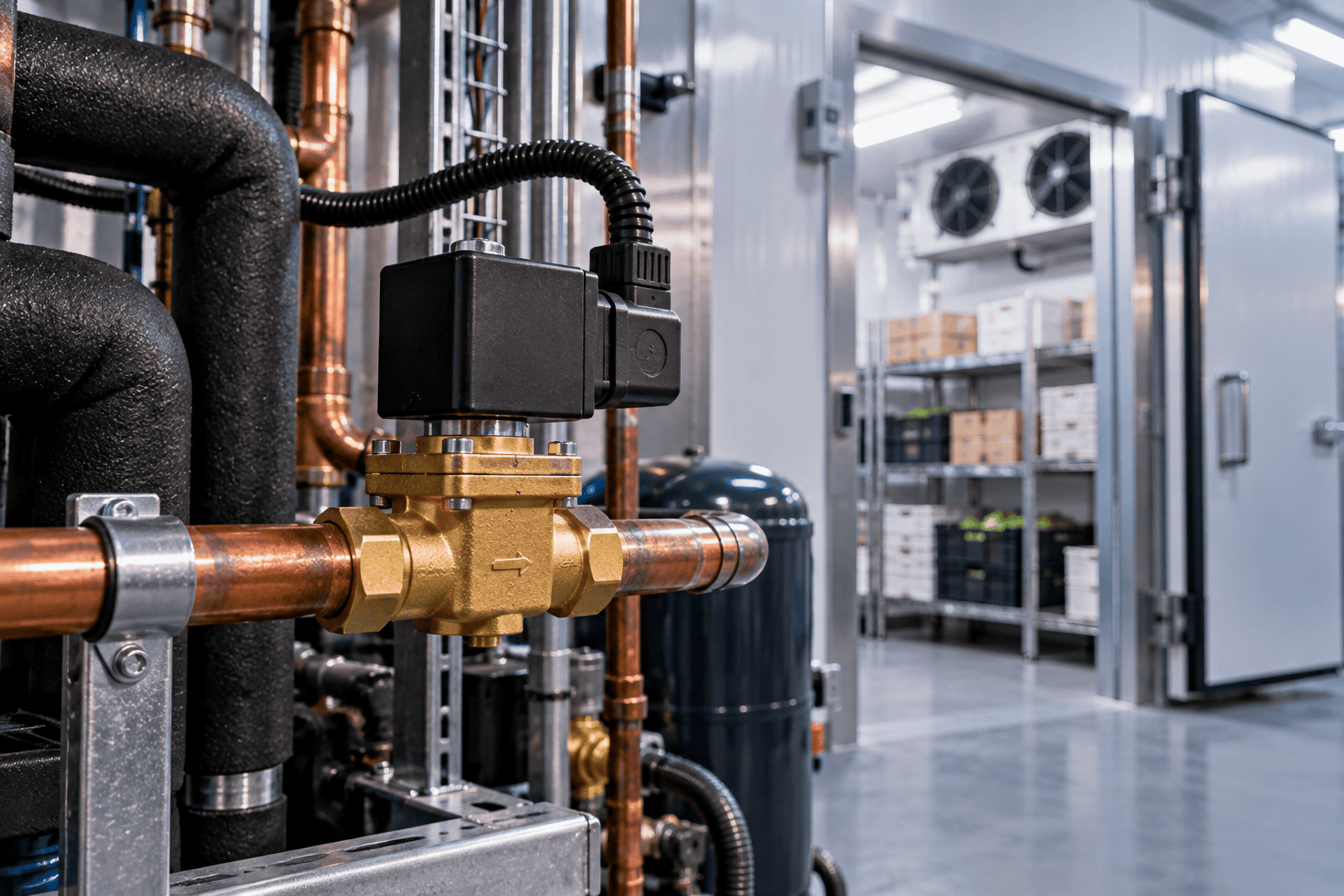
Houston businesses depend on commercial and industrial refrigeration equipment to maintain stable temperatures, protect temperature-sensitive products, and keep daily operations moving. A malfunctioning solenoid valve can interrupt refrigerant flow, prevent a system from completing a normal pump-down cycle, cause temperature instability, or make a walk-in cooler or freezer stop cooling correctly. For businesses looking for Commercial HVAC & Industrial Refrigeration Services in Houston TX, accurate diagnosis matters because solenoid valve symptoms can resemble TXV problems, refrigerant restrictions, low refrigerant charge, or electrical control failures. ACF Mechanical evaluates the complete refrigeration system to determine what is actually causing the problem before recommending repair or replacement.
What Does a Refrigeration Solenoid Valve Do?
A refrigeration solenoid valve is an electrically controlled valve used to start or stop refrigerant flow.
In many commercial refrigeration applications, a temperature controller or thermostat sends an electrical signal to the solenoid coil. When energized or de-energized, depending on valve design, the coil creates a magnetic field that changes the position of the internal plunger or pilot mechanism.
This allows the refrigeration controls to manage refrigerant flow without requiring manual valve operation.
Solenoid valves may be found in:
- Walk-in coolers
- Walk-in freezers
- Restaurant refrigeration
- Cold-storage equipment
- Refrigerated warehouses
- Multi-evaporator systems
- Commercial refrigeration equipment
- Certain industrial refrigeration systems
Not every refrigeration system uses the same valve arrangement. Larger industrial systems may use pilot-operated valves, regulators, electronic valves, or more complex refrigerant-control assemblies.
Why Solenoid Valve Problems Matter
A small control valve can have a major effect on refrigeration performance.
If a liquid-line solenoid valve fails to open when cooling is required, refrigerant may not reach the evaporator correctly. If the valve fails to close, refrigerant flow may continue when the refrigeration controls are attempting to stop it.
Possible consequences include:
- Loss of cooling
- Rising product-space temperature
- Refrigerant-flow problems
- Evaporator starvation
- Pump-down problems
- Abnormal compressor cycling
- Extended equipment operation
- Temperature fluctuations
- Unexpected refrigeration shutdowns
- Increased stress on system components
For restaurants, warehouses, cold-storage facilities, and industrial operations in Houston, these problems can quickly become operational concerns.
Common Signs of Commercial Refrigeration Solenoid Valve Problems
A failing solenoid valve does not always produce the same symptoms.
Warning signs may include:
- Walk-in cooler is not reaching setpoint
- Walk-in freezer temperature is rising
- Refrigerant does not appear to reach the evaporator
- Cooling starts and stops unexpectedly
- System fails to pump down correctly
- Compressor cycles abnormally
- Valve does not respond to the control signal
- Solenoid coil becomes unusually hot
- Valve makes unusual noise
- Cooling continues when the controller should be satisfied
- Refrigeration performance becomes intermittent
These symptoms require professional commercial refrigeration solenoid valve troubleshooting Houston because many other refrigeration faults can produce similar operating conditions.
What Causes a Refrigeration Solenoid Valve to Fail?
Solenoid valve problems may be mechanical, electrical, or related to refrigeration-system conditions.
Common causes include:
- Failed solenoid coil
- Incorrect supply voltage
- Damaged wiring
- Loose electrical connections
- Failed controller or thermostat signal
- Dirt or debris inside the valve
- Internal plunger problems
- Damaged valve seat
- Refrigerant contamination
- Excessive or insufficient pressure differential
- Improper installation
- Incorrect valve selection
- Normal component wear
- Heat-related coil deterioration
- Moisture or corrosion affecting electrical components
Correct diagnosis requires identifying which part of the control chain has failed.
Replacing the valve body will not correct a failed control signal, and replacing a coil will not solve a mechanically damaged valve.
Solenoid Valve Stuck Closed
A solenoid valve that remains closed when refrigeration is required can restrict or completely stop refrigerant flow.
Depending on system design, symptoms may include:
- Evaporator starvation
- Loss of refrigeration capacity
- High superheat
- Low suction pressure
- Walk-in cooler not cooling
- Walk-in freezer temperature rise
- Compressor cycling through pressure controls
- Refrigeration system shutting down
A refrigeration solenoid valve stuck closed Houston TX problem can sometimes look similar to a clogged filter-drier, closed manual valve, TXV restriction, or low refrigerant condition.
Technicians therefore need to determine whether the solenoid is receiving the correct control signal and whether the valve itself is actually opening.
Solenoid Valve Stuck Open
A valve that fails to close creates a different set of problems.
When refrigeration controls are satisfied, the liquid-line solenoid may be expected to stop refrigerant flow. If the valve remains open or leaks significantly through the seat, refrigerant may continue entering the low side.
Depending on system configuration, this can cause:
- Pump-down problems
- Compressor cycling issues
- Continued refrigerant migration
- Temperature-control problems
- Failure to complete the intended shutdown sequence
- Intermittent operation
A commercial refrigeration solenoid valve not closing Houston service call should include evaluation of the valve as well as the controls commanding it.
Solenoid Coil Failure
The solenoid coil provides the magnetic force needed to operate the valve mechanism.
A failed coil may prevent the valve from changing position even when the refrigeration controller is sending the correct command.
Possible causes include:
- Coil deterioration
- Incorrect voltage
- Voltage outside acceptable range
- Electrical short
- Open winding
- Overheating
- Loose wiring
- Moisture damage
- Physical damage
Technicians can verify whether the coil is receiving the expected voltage and whether the electrical circuit is functioning correctly.
A commercial refrigeration solenoid coil failure Houston TX does not necessarily mean the entire valve body needs replacement.
If the valve body is in good condition and the problem is isolated to the coil, the appropriate repair may be different from a complete valve replacement.
Why Solenoid Valve Voltage Matters
Solenoid valves are designed to operate at specific electrical ratings.
Supplying the wrong voltage can result in:
- Valve failing to open
- Weak magnetic force
- Coil overheating
- Premature coil failure
- Intermittent operation
A voltage measurement should be interpreted along with the control sequence.
Technicians may need to determine whether a voltage problem originates from:
- Temperature controller
- Relay
- Wiring
- Electrical connection
- Transformer
- Control board
- Power supply
- Safety circuit
This is why a refrigeration solenoid valve not energizing Houston problem should not automatically be diagnosed as a defective valve.
Mechanical Valve Problems and Refrigerant Contamination
Electrical operation is only one part of solenoid valve performance.
The coil may energize correctly while the internal valve mechanism remains restricted by:
- Debris
- Contamination
- Damaged internal components
- Wear
- Deposits
- Mechanical sticking
Contamination elsewhere in the refrigeration system should also be investigated.
Replacing a contaminated valve without determining where the debris came from may result in another failure.
Solenoid Valve vs. TXV: What Is the Difference?
Solenoid valves and thermostatic expansion valves perform different functions.
| Component | Primary Function |
|---|---|
| Solenoid valve | Starts or stops refrigerant flow |
| TXV | Meters refrigerant entering the evaporator |
| Filter-drier | Helps remove contaminants and limited moisture |
| Compressor | Circulates refrigerant and creates pressure difference |
In a typical application, a liquid-line solenoid valve may control whether refrigerant is allowed to flow toward the evaporator, while the TXV regulates the amount of refrigerant entering the evaporator.
A malfunction in either component may cause poor cooling, but the diagnostic process and repair are different.
This distinction is important when investigating refrigeration solenoid valve vs TXV Houston TX problems.
Solenoid Valve Problems vs. Filter-Drier Restrictions
A closed or restricted solenoid valve can produce symptoms similar to a restricted filter-drier.
Both may result in:
- Reduced refrigerant flow
- Starved evaporator
- High superheat
- Low suction pressure under applicable conditions
- Reduced refrigeration capacity
Technicians can differentiate the conditions by evaluating:
- Temperature and pressure conditions
- Valve command
- Coil voltage
- Valve operation
- Filter-drier temperature difference
- Refrigerant charge
- TXV performance
- System configuration
Changing components without confirming the location of the restriction can increase repair costs without solving the problem.
Solenoid Valve Problems vs. Low Refrigerant Charge
When a walk-in cooler stops cooling, adding refrigerant should not be the automatic response.
Low refrigerant charge and a closed solenoid valve can both reduce evaporator feeding.
A professional diagnostic process may evaluate:
- Suction pressure
- Discharge or head pressure
- Superheat
- Subcooling where applicable
- Refrigerant leaks
- Solenoid valve operation
- Control voltage
- Filter-drier condition
- TXV operation
- Sight glass condition where applicable
- Overall system load
A refrigerant charge should be corrected based on system requirements and verified operating conditions, not one symptom.
How Pump-Down Refrigeration Systems Work
Pump-down control is common in many commercial refrigeration applications.
Although exact designs vary, a typical sequence may operate as follows:
- The temperature controller calls for cooling.
- The liquid-line solenoid valve opens.
- Refrigerant flows toward the evaporator.
- Compressor operation maintains refrigeration.
- When the controller is satisfied, the liquid-line solenoid closes.
- The compressor continues operating temporarily and removes refrigerant from the low side.
- Suction pressure decreases.
- A low-pressure control stops the compressor.
This sequence helps manage refrigerant during the off cycle.
How Solenoid Valve Problems Affect Pump-Down
A malfunctioning liquid-line solenoid valve can disrupt the pump-down sequence.
Valve Does Not Close
If the solenoid remains open when the temperature controller is satisfied, refrigerant may continue entering the low side.
The compressor may have difficulty reaching the intended cutout pressure, potentially causing:
- Extended compressor operation
- Failure to pump down
- Abnormal cycling
- Control problems
Valve Does Not Open
If the solenoid remains closed when cooling is required, refrigerant flow toward the evaporator may be interrupted.
Depending on system design, the compressor may start briefly and then shut down on the low-pressure control, or cooling may not begin normally.
Professional diagnosis of commercial refrigeration pump down problems Houston TX should therefore include both refrigerant and electrical controls.
Why a Refrigeration System May Not Pump Down
The solenoid valve is important, but it is not the only possible cause of a pump-down problem.
Technicians may also investigate:
- Low-pressure control
- Temperature controller
- Refrigerant migration
- Valve leakage
- Incorrect pressure settings
- Electrical controls
- Compressor condition
- Refrigerant charge
- System configuration
A system that does not pump down correctly should be diagnosed as a complete control sequence rather than by replacing the solenoid valve immediately.
Walk-In Cooler Solenoid Valve Problems
Walk-in coolers are common in Houston restaurants, grocery operations, food-service facilities, and other commercial buildings.
A walk-in cooler solenoid valve problem Houston TX may cause:
- Cooler not reaching setpoint
- Temperature fluctuations
- Intermittent cooling
- Starved evaporator
- Pump-down problems
- Compressor cycling issues
- Refrigerant-flow interruption
The first step should be determining whether the controller is calling for refrigeration.
From there, technicians can evaluate the electrical signal, solenoid coil, valve mechanism, refrigeration pressures, and related components.
Professional walk-in cooler solenoid valve repair Houston should correct the underlying fault rather than simply replacing parts based on symptoms.
Walk-In Freezer Solenoid Valve Problems
Walk-in freezers require reliable refrigerant flow to maintain low temperatures under varying loads.
A malfunctioning solenoid valve may result in:
- Freezer temperature rise
- Loss of cooling
- Intermittent refrigeration
- Pump-down failure
- Abnormal compressor cycling
- Evaporator starvation
However, a freezer that is not cooling may also have:
- Defrost problems
- TXV problems
- Filter-drier restrictions
- Refrigerant leaks
- Evaporator fan problems
- Compressor faults
- Door or air-infiltration issues
Professional walk-in freezer solenoid valve repair Houston should therefore begin with system diagnostics.
Restaurant Refrigeration Solenoid Valve Problems
Restaurants depend on refrigeration equipment throughout daily operations.
Walk-in coolers and freezers may operate under frequent door openings, changing product loads, and long operating hours.
A solenoid valve problem can interfere with the system’s ability to respond correctly to temperature controls.
Warning signs restaurant operators may notice include:
- Cooler temperature increasing
- Freezer not recovering normally
- Refrigeration running unexpectedly
- Compressor cycling differently than usual
- Cooling becoming intermittent
Prompt restaurant refrigeration solenoid valve repair Houston can help restore proper refrigeration control before the problem develops into a more disruptive failure.
Cold Storage Solenoid Valve Problems
Cold-storage facilities may use multiple evaporators and refrigerant-control valves to maintain different temperature zones.
A valve problem affecting one circuit may cause localized temperature instability even while other areas continue operating normally.
Technicians servicing cold storage solenoid valve problems Houston may evaluate:
- Individual evaporator operation
- Valve control signals
- Refrigerant distribution
- Temperature controls
- Pressure conditions
- Valve response
- System sequencing
Accurate zone-by-zone diagnosis can be especially important in larger refrigeration systems.
Warehouse Refrigeration Valve Problems
Refrigerated warehouses can depend on refrigeration equipment to maintain large spaces under substantial cooling loads.
Possible symptoms of warehouse refrigeration solenoid valve problems Houston include:
- One evaporator not cooling
- Uneven temperature across zones
- Intermittent refrigeration
- Unusual compressor operation
- Refrigerant-flow problems
- Control-system alarms
Because warehouse systems can be more complex than individual walk-in coolers, technicians should evaluate the complete refrigeration-control strategy.
Industrial Refrigeration Solenoid Valve Problems
Industrial refrigeration systems may use a wide range of valve technologies.
Depending on system design, these can include:
- Direct-acting solenoid valves
- Pilot-operated solenoid valves
- Pressure regulators
- Electronic control valves
- Check valves
- Specialized refrigerant control assemblies
For this reason, industrial refrigeration solenoid valve troubleshooting Houston should never assume that every system follows the same control sequence as a standard walk-in cooler.
Technicians need to understand:
- Refrigerant type
- Valve design
- Pressure differential
- Control strategy
- Electrical requirements
- Refrigeration load
- Compressor configuration
- Evaporator configuration
- Manufacturer requirements
Industrial refrigeration diagnostics require a system-level approach.
Pressure Differential and Solenoid Valve Operation
Some solenoid valves depend on a minimum pressure differential to open or close correctly.
This is particularly important with certain pilot-operated designs.
A valve may have a functional coil and receive correct voltage yet still fail to operate normally if system pressure conditions are outside the valve’s operating requirements.
Technicians may therefore evaluate:
- Upstream pressure
- Downstream pressure
- Refrigerant condition
- Valve orientation
- Valve design
- Pressure differential requirements
This prevents an operating-condition problem from being mistaken for an electrical failure.
Can a Solenoid Valve Leak Internally?
Yes. A solenoid valve may appear closed but still allow refrigerant to leak past the valve seat.
Possible causes include:
- Debris on the seat
- Internal wear
- Damaged sealing surfaces
- Mechanical damage
- Contamination
Internal leakage can interfere with pump-down operation and may contribute to unexpected compressor cycling depending on the system.
A commercial refrigeration solenoid valve leaking Houston TX problem requires confirmation because other components can also contribute to pressure changes during the off cycle.
Houston Heat and Commercial Refrigeration Valve Problems
Houston’s climate creates demanding conditions for commercial refrigeration equipment.
High outdoor temperatures can increase heat rejection requirements and overall refrigeration load, particularly for systems with air-cooled condensers.
Long operating periods may make an existing solenoid valve, refrigerant-flow, or control problem more noticeable.
However, Texas heat does not directly mean that a solenoid valve will fail.
Instead, high load can expose a marginal component or control problem because refrigeration equipment has less available capacity to compensate for reduced performance.
Houston businesses should therefore investigate refrigeration problems early rather than waiting for peak cooling conditions to turn a minor issue into a loss of temperature control.
Does Houston Humidity Affect Solenoid Valves?
Humidity can be relevant primarily to exposed electrical components, connections, corrosion conditions, and service environments.
A properly sealed refrigerant circuit is not normally contaminated simply because outdoor humidity is high.
However, when refrigeration equipment is opened for service, technicians must use appropriate procedures to limit moisture contamination.
This is especially important in Houston’s humid climate.
Can a Bad Solenoid Valve Damage a Compressor?
A malfunctioning solenoid valve does not automatically damage a compressor.
However, depending on system design, improper refrigerant control may contribute to unfavorable operating conditions.
Possible effects can include:
- Repeated abnormal cycling
- Extended compressor operation
- Improper pump-down
- Reduced refrigerant flow
- Loss of refrigeration capacity
Whether these conditions create meaningful compressor stress depends on the specific system and the nature of the failure.
Early diagnosis is preferable to allowing abnormal operation to continue.
Solenoid Valve Repair vs. Replacement
Not every solenoid valve problem requires complete valve replacement.
Technicians first need to determine whether the fault is in:
- Solenoid coil
- Electrical wiring
- Controller
- Valve body
- Plunger or pilot mechanism
- Valve seat
- Refrigeration system pressure
- Refrigerant contamination
When Coil Replacement May Be Appropriate
A coil may be replaced when testing confirms an electrical coil failure and the valve body remains suitable for continued service.
When Valve Replacement May Be Required
Complete valve replacement may be appropriate when:
- Valve body is damaged
- Internal mechanism is worn
- Valve seat is damaged
- Valve repeatedly sticks
- Internal leakage is confirmed
- Valve is incompatible with the application
- Repair is not practical
- Manufacturer procedures require replacement
The replacement valve must be compatible with refrigerant, pressure, line size, capacity, electrical requirements, and system design.
Why Replacing a Solenoid Valve Without Diagnostics Can Waste Money
Solenoid valve symptoms overlap with several other refrigeration problems.
For example, a walk-in cooler that is not cooling may actually have:
- Failed temperature controller
- Wiring problem
- Filter-drier restriction
- TXV malfunction
- Refrigerant leak
- Incorrect refrigerant charge
- Compressor problem
- Evaporator fan failure
Replacing the solenoid valve without verifying the cause can leave the original problem unresolved.
A professional refrigeration solenoid valve diagnosis Houston should determine whether the valve is receiving the correct command and whether refrigerant flow changes as expected.
Preventing Commercial Refrigeration Solenoid Valve Problems
Preventive maintenance can identify valve and control problems before they cause complete refrigeration failure.
Maintenance may include:
- Inspecting electrical connections
- Checking wiring condition
- Verifying control voltage
- Confirming valve response
- Monitoring refrigerant pressures
- Evaluating pump-down operation
- Checking temperature-controller operation
- Inspecting refrigerant-system condition
- Investigating abnormal compressor cycling
- Checking for refrigerant restrictions
- Reviewing unusual temperature trends
Routine commercial refrigeration maintenance Houston also provides an opportunity to identify problems with TXVs, filter-driers, fans, coils, compressors, sensors, and defrost systems.
When Solenoid Valve Problems Require Prompt Refrigeration Service
Houston businesses should consider prompt professional service when:
- Walk-in cooler temperature is rising
- Walk-in freezer cannot maintain temperature
- Refrigeration stops completely
- Compressor repeatedly short-cycles
- System cannot complete pump-down
- One refrigeration zone stops cooling
- Solenoid valve repeatedly fails to respond
- Refrigeration operation becomes intermittent
- Industrial process refrigeration loses capacity
Facilities that depend on refrigeration for products or operations should avoid waiting until the system fails completely.
Refrigeration Troubleshooting Checklist for Facility Managers
Facility managers should not open sealed refrigeration systems or perform electrical repairs unless properly qualified, but they can collect useful operating information.
Temperature
- Is the equipment maintaining setpoint?
- Is the temperature rising steadily or intermittently?
- Does only one zone have a problem?
- Does cooling return temporarily?
Compressor Operation
- Is the compressor running?
- Is it cycling more frequently than normal?
- Does it continue running after the temperature controller is satisfied?
- Is the system repeatedly shutting down?
Recent Changes
- Was the solenoid valve recently replaced?
- Was refrigerant-system work performed?
- Were electrical controls changed?
- Did the problem begin after maintenance?
- Has the equipment experienced previous refrigerant restrictions?
This information can help refrigeration technicians diagnose the problem more efficiently.
Why Houston Businesses Choose ACF Mechanical
Solenoid valve problems require knowledge of refrigeration, electrical controls, pressure relationships, and system sequencing.
ACF Mechanical evaluates the complete refrigeration system rather than assuming that a single component is responsible for every cooling problem.
Houston businesses choose ACF Mechanical for:
- Experienced technicians
- Commercial HVAC expertise
- Commercial refrigeration expertise
- Industrial refrigeration knowledge
- Walk-in cooler and freezer diagnostics
- Refrigerant-flow troubleshooting
- Electrical and refrigeration control diagnostics
- Preventive maintenance
- Fast response
- Reliable service
ACF Mechanical works with business owners, facility managers, restaurant owners, warehouse managers, industrial companies, and commercial property owners throughout Houston, TX.
Restore Reliable Refrigeration Control
A solenoid valve is a relatively small component, but it can play a critical role in controlling refrigerant flow.
A valve that does not open may prevent an evaporator from receiving refrigerant. A valve that does not close may interfere with pump-down and temperature control. Electrical coil problems, damaged wiring, contamination, pressure conditions, and mechanical valve failures can all create similar symptoms.
Accurate diagnosis is therefore essential.
With professional Commercial HVAC & Industrial Refrigeration Services in Houston TX, ACF Mechanical can evaluate solenoid valves, pump-down controls, refrigerant flow, TXVs, filter-driers, electrical controls, compressors, and related refrigeration components.
If your walk-in cooler, walk-in freezer, restaurant refrigeration equipment, cold-storage system, warehouse refrigeration, or industrial refrigeration system is experiencing temperature problems, abnormal cycling, pump-down failure, or interrupted refrigerant flow, contact ACF Mechanical for professional refrigeration diagnostics and repair in Houston, TX.