
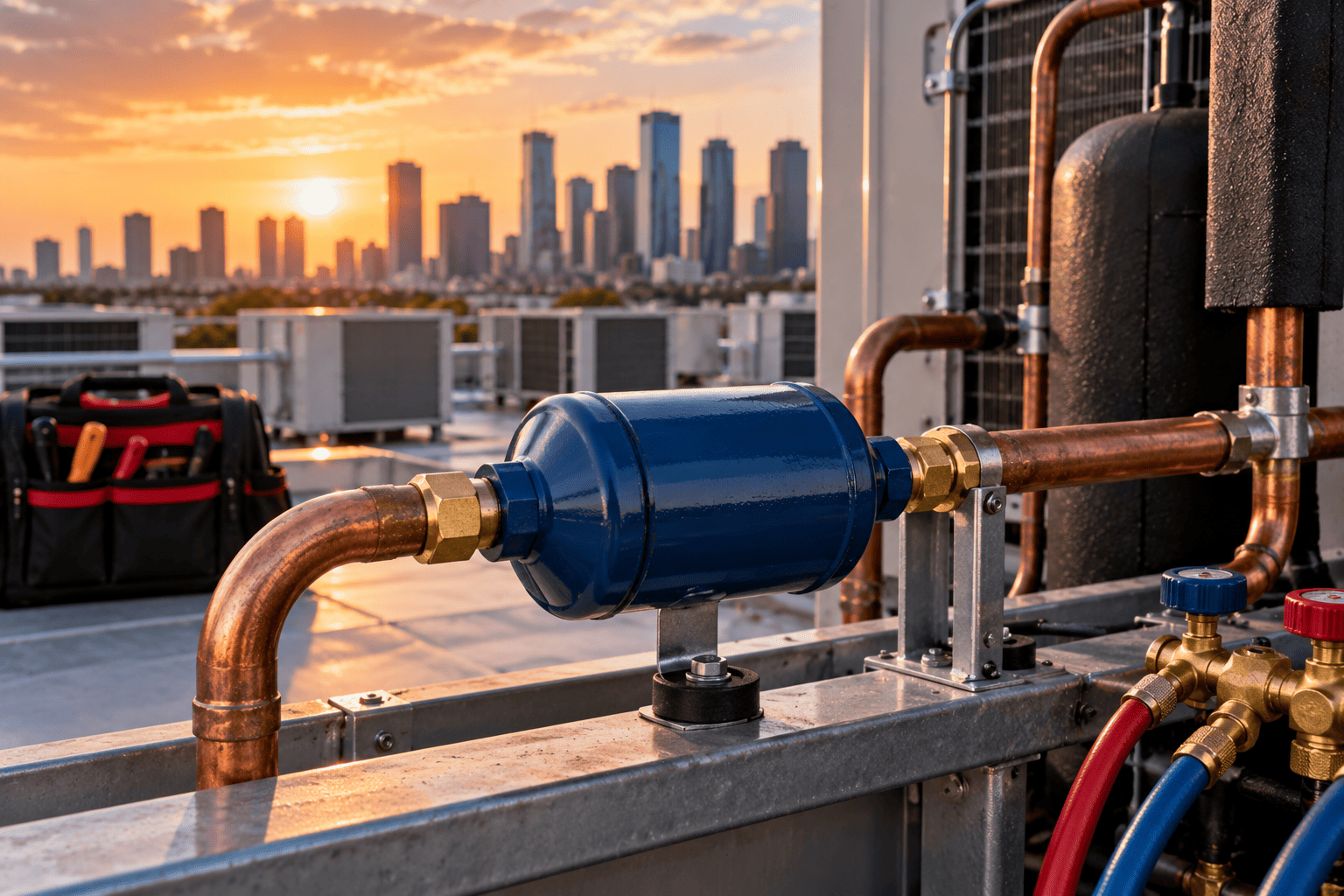
Commercial HVAC and refrigeration equipment depends on a clean, dry refrigerant circuit and unrestricted refrigerant flow. When a filter-drier becomes restricted or moisture enters the system, cooling capacity can fall, evaporator feeding can become unstable, and compressors may operate under unfavorable conditions. For Houston businesses searching for Commercial HVAC & Industrial Refrigeration Services in Houston TX, correctly diagnosing these problems is important because a filter-drier restriction can resemble a refrigerant-charge problem, TXV malfunction, or other system fault. ACF Mechanical evaluates refrigerant pressures and temperatures, superheat, subcooling where applicable, airflow, filter-drier condition, and overall system performance to identify the actual cause.
What Does a Filter-Drier Do in an HVAC or Refrigeration System?
A filter-drier is a protective component installed in the refrigerant circuit. Its primary functions are to capture certain contaminants and remove limited amounts of moisture from the system.
A typical filter-drier contains desiccant material designed to absorb moisture as refrigerant passes through the component. It also helps capture particles that could otherwise travel through the refrigeration circuit and interfere with valves, compressors, or metering devices.
Filter-driers may be used in:
- Commercial rooftop HVAC units
- Split commercial AC systems
- Certain chiller applications
- Walk-in coolers
- Walk-in freezers
- Restaurant refrigeration systems
- Cold-storage equipment
- Refrigerated warehouses
- Industrial refrigeration systems
The exact type, location, and application of a filter-drier depend on equipment and refrigerant-system design.
A filter-drier is not an unlimited cleaning device. If a refrigeration system contains excessive moisture, acid, debris, or contamination, replacing one component without addressing the source may not solve the underlying problem.
Why Filter-Drier Restrictions Matter
Refrigerant must move through the system at the correct rate for the evaporator to absorb heat effectively.
When a filter-drier becomes significantly restricted, it can create an unwanted pressure drop in the refrigerant circuit. Depending on where the restriction occurs and the system design, the evaporator may receive insufficient refrigerant.
Potential consequences include:
- Reduced cooling capacity
- Starved evaporator
- High superheat
- Low suction pressure under certain conditions
- Extended compressor runtime
- Difficulty reaching thermostat setpoint
- Walk-in cooler temperature problems
- Freezer temperature instability
- Increased stress on system components
- Unexpected equipment shutdowns
A commercial HVAC filter drier restriction Houston facility experiences should be diagnosed before assuming that refrigerant simply needs to be added.
Common Signs of a Restricted or Clogged Filter-Drier
Filter-drier restrictions can range from minor to severe.
Possible warning signs include:
- Commercial AC cannot maintain building temperature
- Walk-in cooler takes too long to pull down
- Freezer temperature begins rising
- Refrigeration equipment runs for extended periods
- Evaporator appears underfed
- Superheat is higher than expected
- Suction pressure is abnormal
- A temperature difference develops across the filter-drier
- Frost or condensation appears around a restriction under certain conditions
- System capacity decreases
These symptoms are not exclusive to filter-drier problems.
Low refrigerant charge, a TXV problem, restricted piping, airflow problems, or compressor performance issues may produce similar symptoms.
Professional commercial HVAC filter drier diagnostics Houston should evaluate the entire refrigeration circuit.
What Causes a Filter-Drier to Become Restricted?
A filter-drier can become restricted when it captures enough contamination or when internal conditions interfere with refrigerant flow.
Possible contributing factors include:
- Debris inside the refrigeration circuit
- Moisture contamination
- Material generated after component failure
- Contamination introduced during improper service
- System deterioration
- Compressor failure
- Refrigeration circuit left exposed to ambient air
- Internal desiccant or filter-related problems
- Contaminants remaining after previous repairs
The cause matters because simply replacing a restricted filter-drier without correcting contamination may lead to another restriction.
Filter-Drier Restriction vs. TXV Problem
A filter-drier restriction and a thermostatic expansion valve problem can produce similar operating symptoms.
This can make diagnosis difficult without proper measurements.
| Symptom | Filter-Drier Restriction | TXV Problem |
|---|---|---|
| Reduced cooling capacity | Possible | Possible |
| Starved evaporator | Possible | Possible |
| High superheat | Possible | Possible |
| Low suction pressure | Possible | Possible |
| Long runtime | Possible | Possible |
| Localized temperature change at filter-drier | May occur | Not caused by filter-drier |
| Unstable refrigerant feeding | Possible indirectly | Possible |
| Poor evaporator performance | Possible | Possible |
The location of the restriction and measured operating conditions help technicians determine which component requires attention.
Replacing a TXV without checking for a commercial HVAC liquid line restriction Houston TX businesses may have can result in unnecessary repair costs.
Filter-Drier Restriction vs. Low Refrigerant Charge
A refrigerant restriction can also resemble a system that is low on refrigerant.
Both conditions may produce:
- Poor cooling
- High superheat
- Low suction pressure
- Long compressor runtime
- Reduced evaporator capacity
However, the corrective actions are completely different.
Adding refrigerant to a system with a restriction does not remove the restriction and may create additional operating problems.
A professional diagnostic process may evaluate:
- Refrigerant pressures
- Line temperatures
- Superheat
- Subcooling where applicable
- Temperature difference across suspected restrictions
- Refrigerant charge
- Leak indications
- Evaporator condition
- Condenser condition
- Metering-device performance
These measurements should be interpreted together rather than relying on one pressure reading.
Understanding Temperature Drop Across a Filter-Drier
Temperature measurements can provide useful information when diagnosing a suspected filter-drier restriction.
A significant pressure drop through a restriction can be accompanied by a measurable temperature change.
Technicians may compare temperatures at the inlet and outlet of the filter-drier while considering:
- System load
- Refrigerant type
- Equipment design
- Operating pressures
- Ambient conditions
- Refrigerant state at that location
There is no single temperature difference that should be applied universally to every HVAC and refrigeration system.
Professional commercial HVAC filter drier troubleshooting Houston TX should combine temperature measurements with other operating data.
Why a Filter-Drier May Frost or Become Cold
Frost or an unusually cold area around a filter-drier can sometimes indicate a significant pressure drop.
As refrigerant passes through a severe restriction, pressure conditions may change enough to produce localized cooling.
However, visible frost alone does not prove that the filter-drier is defective.
Technicians should verify:
- Refrigerant pressures
- Temperature difference
- System charge
- Refrigerant state
- Superheat
- Subcooling where applicable
- Other possible restrictions
Correct diagnosis prevents unnecessary component replacement.
What Is Moisture Contamination?
A refrigeration circuit is designed to operate as a sealed system.
Moisture contamination occurs when unwanted water vapor or moisture enters the refrigerant circuit.
This may happen when:
- A system is opened for service
- Components are replaced
- Refrigerant piping is installed
- A circuit remains exposed to humid ambient air
- Proper evacuation is not completed
- Moisture remains after improper repair procedures
- A leak allows system conditions that contribute to contamination concerns
Houston’s humidity makes proper refrigeration service procedures especially important whenever a sealed refrigerant circuit is opened.
Humidity does not pass normally through intact copper tubing and directly contaminate a sealed system. The concern is exposure to humid ambient air during installation, service, component replacement, or other situations where the refrigerant circuit is open.
Why Moisture Is Harmful to HVAC and Refrigeration Systems
Moisture can create several problems inside a refrigeration circuit.
Depending on refrigerant, lubricant, temperature, and system conditions, moisture may contribute to:
- Ice formation
- Refrigerant-flow restrictions
- Chemical reactions
- Acid formation
- Oil degradation
- Internal corrosion
- Damage to system components
- Reduced equipment reliability
For Houston commercial buildings, restaurants, warehouses, and industrial facilities, these problems may eventually result in reduced cooling or unexpected downtime.
Professional commercial HVAC moisture contamination Houston service should focus on both removing the contamination and determining how it entered the system.
How Moisture Can Affect Expansion Valves
Moisture-related problems can sometimes appear near refrigerant metering devices.
Because expansion valves create a pressure reduction, temperatures in and around the metering process can become very low.
Under certain conditions, moisture inside the refrigerant circuit may freeze and interfere with refrigerant flow.
This can create an intermittent restriction that resembles a defective TXV.
Possible symptoms include:
- Cooling performance that changes over time
- High superheat
- Low suction pressure
- Starved evaporator
- Reduced refrigeration capacity
- Intermittent refrigerant-flow problems
This is one reason professional diagnosis should evaluate contamination as well as the TXV itself.
Liquid-Line Filter-Driers vs. Suction-Line Filter-Driers
Filter-driers can serve different purposes depending on where and why they are installed.
Liquid-Line Filter-Driers
Liquid-line filter-driers are commonly used to protect refrigeration circuits by capturing contaminants and removing limited amounts of moisture.
They are generally installed in the liquid line before the refrigerant reaches the metering device, although exact placement depends on system design.
A commercial HVAC liquid line filter drier Houston TX application should use a component correctly sized and approved for the refrigerant, system capacity, and operating conditions.
Suction-Line Filter-Driers
Suction-line filter-driers may be used in certain cleanup applications, particularly following specific compressor failures or contamination events.
Because a suction-line filter-drier can create an undesirable pressure drop if left in an inappropriate application, installation and removal should follow the equipment, component, and service-procedure requirements.
Not every system requires a permanent suction-line filter-drier.
Compressor Burnout and Refrigeration-System Contamination
A severe compressor electrical burnout can contaminate a refrigeration circuit.
Depending on the type and extent of failure, the system may contain:
- Acidic byproducts
- Damaged oil
- Carbonized material
- Debris
- Other contaminants
Installing a new compressor without addressing contamination can expose the replacement component to the same contaminated circuit.
Professional commercial HVAC compressor burnout cleanup Houston TX may involve assessing:
- Compressor failure type
- Refrigerant condition
- Oil condition
- Acid contamination
- Filter-drier requirements
- System cleanliness
- Refrigerant circuit condition
- Manufacturer procedures
Cleanup requirements vary by equipment, refrigerant, lubricant, and severity of failure.
Why Acid Contamination Requires Attention
Acid inside a refrigeration circuit can contribute to deterioration of internal components and electrical insulation.
Acid formation may be associated with severe compressor failure and chemical reactions involving heat, refrigerant, lubricant, moisture, and contamination.
When acid contamination is suspected, technicians may use appropriate testing methods and follow system-specific cleanup procedures.
Simply replacing the failed compressor without evaluating the circuit may leave harmful contaminants behind.
Professional commercial HVAC acid contamination Houston diagnostics should therefore be part of the repair strategy when system conditions indicate a contamination risk.
Why Proper Evacuation and Dehydration Matter
Whenever a sealed refrigerant circuit is opened, proper evacuation is an important part of returning the system to service.
Evacuation helps remove non-condensable gases and moisture from the system before the refrigerant circuit resumes normal operation.
Proper commercial HVAC evacuation and dehydration Houston TX service becomes particularly important in humid environments.
Effective evacuation depends on factors including:
- System size
- Piping configuration
- Moisture level
- Service equipment
- Hose and connection setup
- System condition
- Required service procedures
Evacuation should be verified with appropriate instruments rather than based only on how long a vacuum pump has been operating.
Filter-Drier Problems in Commercial Rooftop Units
Rooftop HVAC equipment in Houston often operates for long periods during high outdoor temperatures.
A refrigerant restriction that is less noticeable during moderate weather may significantly reduce capacity when cooling demand increases.
Possible rooftop unit filter drier problems Houston TX include:
- Reduced cooling
- Extended compressor runtime
- High superheat
- Low suction conditions
- Poor evaporator feeding
- Difficulty maintaining indoor temperature
Technicians should also evaluate condenser cleanliness, evaporator airflow, refrigerant charge, compressor performance, and TXV operation.
Filter-Drier Problems in Commercial Air-Conditioning Systems
Commercial AC systems may use filter-driers to protect the refrigerant circuit from moisture and contaminants.
When a filter-drier becomes restricted, a commercial AC system may continue running while producing less cooling.
For facility managers, warning signs may include:
- Longer cooling cycles
- Warm areas in the building
- Difficulty maintaining thermostat settings
- Compressor running longer
- Increasing cooling complaints
- Unusual refrigeration readings during service
These symptoms should be investigated before the system experiences a more serious loss of capacity.
Commercial Chiller Refrigerant Contamination
Chillers vary significantly in design, refrigerant circuit configuration, compressor type, and refrigerant-control strategy.
Some chiller systems use replaceable filter-driers or similar filtration and moisture-control components, while others use different arrangements.
Professional commercial chiller refrigerant contamination Houston TX service must therefore follow the actual chiller design.
Depending on the equipment, technicians may evaluate:
- Refrigerant condition
- Moisture indicators
- Oil condition
- Filter or drier condition
- Refrigerant pressures and temperatures
- Compressor operation
- Manufacturer service requirements
A generic filter-drier replacement approach should not be applied to every chiller.
Industrial Refrigeration Filter-Drier Problems
Industrial refrigeration systems can have larger refrigerant charges, multiple evaporators, specialized controls, and more complex piping than standard commercial AC equipment.
Where filter-driers are used, a restriction may affect refrigerant flow and refrigeration capacity.
Possible industrial refrigeration filter drier problems Houston TX include:
- Reduced evaporator feeding
- Capacity loss
- Abnormal pressure conditions
- High superheat in applicable systems
- Longer equipment runtime
- Temperature instability
Industrial refrigeration systems may also use different filtration, moisture-control, or refrigerant-treatment strategies depending on system design.
Technicians must understand the specific equipment rather than assume all industrial systems use the same filter-drier configuration.
Walk-In Cooler Filter-Drier Problems
Restaurants, grocery operations, food-service businesses, and other facilities rely on walk-in coolers to maintain stable temperatures.
A walk-in cooler filter drier problem Houston may contribute to:
- Cooler not reaching setpoint
- Extended compressor runtime
- High superheat
- Low suction pressure
- Starved evaporator
- Temperature fluctuations
- Reduced refrigeration capacity
However, these symptoms may also come from a refrigerant leak, dirty condenser, TXV problem, compressor issue, fan failure, or other fault.
Professional walk-in cooler filter drier replacement Houston TX should therefore follow a confirmed diagnosis.
Walk-In Freezer Filter-Drier Problems
Walk-in freezer refrigeration systems may also experience filter-drier restrictions and contamination.
Possible symptoms include:
- Rising freezer temperature
- Extended runtime
- Reduced evaporator capacity
- High superheat
- Low suction conditions
- Abnormal frost patterns
- Inadequate refrigerant flow
Technicians should distinguish these symptoms from defrost problems.
A heavily iced evaporator may be caused by a defrost heater, control, sensor, fan, drainage, or air-infiltration issue rather than a walk-in freezer refrigerant restriction Houston problem.
Restaurant Refrigeration and Moisture Contamination
Restaurant refrigeration systems often operate continuously and directly support food storage.
When these systems require compressor replacement, refrigerant-circuit repair, or other invasive service, controlling contamination is important.
Proper service practices can help reduce the risk of:
- Moisture remaining inside the circuit
- Debris entering refrigerant piping
- Repeat restrictions
- Metering-device problems
- Compressor reliability problems
A restaurant refrigeration filter drier replacement Houston service should be treated as part of a complete refrigeration repair rather than simply changing a small component.
Cold Storage and Warehouse Refrigeration Restrictions
Cold-storage facilities and refrigerated warehouses may depend on large refrigeration systems to protect significant quantities of temperature-sensitive products.
A refrigerant restriction can reduce system capacity and affect the ability to maintain stable space temperatures.
Possible signs of warehouse refrigeration restriction Houston facilities may experience include:
- Longer refrigeration cycles
- Temperature instability
- Reduced evaporator performance
- Abnormal refrigerant conditions
- Increased compressor runtime
- Difficulty maintaining product-space temperature
Early diagnosis is especially valuable where refrigeration downtime could disrupt business operations.
Houston Heat, Humidity, and Refrigeration-System Service
Houston’s climate creates two separate considerations for HVAC and refrigeration systems.
First, high outdoor temperatures increase cooling demand. Commercial HVAC systems may operate for extended periods, making an existing refrigerant restriction more noticeable.
Second, Houston’s humid air matters whenever a refrigeration circuit is opened for installation or service.
If refrigerant piping or components remain exposed to humid ambient air, moisture can enter the open circuit. Proper service practices, system sealing, filter-drier selection, and evacuation help reduce contamination risk.
Texas heat and humidity therefore increase the importance of professional refrigeration service, even though ambient humidity does not normally enter a properly sealed refrigerant circuit.
Can a Restricted Filter-Drier Damage a Compressor?
A restricted filter-drier does not automatically cause compressor failure.
However, a significant restriction can create abnormal system operating conditions.
Depending on system design and severity, these conditions may include:
- Reduced refrigerant mass flow
- High superheat
- Extended compressor runtime
- Reduced cooling capacity
- Elevated compressor operating temperatures in some applications
- Insufficient compressor cooling in refrigerant-cooled designs
If these conditions continue, compressor stress may increase.
The correct response is to identify the restriction and its cause before more expensive components are affected.
When Should a Filter-Drier Be Replaced?
Filter-drier replacement may be appropriate when:
- A restriction has been confirmed
- The refrigerant circuit has been opened for certain repairs
- A compressor has been replaced
- A compressor burnout requires cleanup
- Contamination is suspected or confirmed
- Moisture exposure has occurred
- Manufacturer service procedures require replacement
- A filter-drier is no longer suitable for continued service
The correct replacement must be selected for:
- Refrigerant type
- System capacity
- Operating pressure
- Flow requirements
- Connection size
- Installation location
- Application
Installing an undersized or incorrect filter-drier can create new operating problems.
Why Replacing Only the Filter-Drier May Not Solve the Problem
A restricted filter-drier is often a symptom of contamination elsewhere in the system.
If technicians replace the drier but fail to determine why it became restricted, the replacement component may eventually experience the same problem.
The diagnostic process should ask:
- Is debris present?
- Has a compressor failed?
- Was the refrigeration circuit exposed to moisture?
- Is acid contamination possible?
- Is another restriction present?
- Was previous service completed correctly?
- Is the refrigerant charge correct?
- Is the TXV functioning properly?
The objective is not simply to restore flow temporarily. It is to correct the condition that caused the restriction.
Preventing Refrigerant-System Contamination
Preventive practices can reduce the risk of moisture and contamination problems.
Important measures include:
- Keeping refrigerant circuits sealed whenever possible
- Using proper installation procedures
- Minimizing exposure to ambient air during service
- Performing correct evacuation and dehydration
- Installing appropriate filter-driers when required
- Repairing refrigerant leaks correctly
- Using clean service equipment
- Following proper refrigerant handling procedures
- Inspecting system performance during maintenance
- Diagnosing compressor failures before replacement
- Following equipment manufacturer requirements
Professional commercial HVAC maintenance Houston can identify changing system conditions before they develop into major performance problems.
Commercial Refrigeration and Industrial Refrigeration Maintenance
Preventive refrigeration maintenance should evaluate more than temperatures alone.
A professional inspection may include:
- Refrigerant pressures
- Superheat and subcooling where applicable
- Compressor operation
- Condenser condition
- Evaporator condition
- Fan operation
- Refrigerant leaks
- Temperature controls
- Filter-drier condition
- Signs of refrigerant restriction
- Unusual temperature differences
- Overall refrigeration capacity
For Houston businesses operating walk-in coolers, freezers, cold storage, or industrial refrigeration equipment, routine maintenance can reduce the likelihood of unexpected cooling loss.
Professional industrial refrigeration maintenance Houston is particularly important for facilities where refrigeration failure could interrupt production or product storage.
When Refrigerant Restrictions Require Prompt Service
A suspected restriction should be investigated promptly when it causes:
- Complete loss of cooling
- Rapid walk-in cooler temperature increase
- Freezer temperature rise
- Cold-storage temperature instability
- Repeated compressor trips
- Severe capacity loss
- Critical process refrigeration problems
- Extended compressor operation without reaching setpoint
Restaurant owners, facility managers, warehouse operators, and industrial companies should not wait for a minor refrigeration problem to become a complete equipment shutdown.
Filter-Drier Troubleshooting Checklist for Facility Managers
Facility personnel should leave sealed-system repairs to qualified technicians, but they can monitor operating symptoms.
Cooling Performance
- Is the commercial space taking longer to cool?
- Is refrigeration equipment maintaining setpoint?
- Has equipment runtime increased?
- Is cooling capacity lower during high outdoor temperatures?
Refrigeration Equipment
- Is unusual frost visible?
- Are evaporator fans operating?
- Is the condenser visibly dirty?
- Has compressor operation changed?
- Are there repeated equipment trips?
Recent Service History
- Was the refrigerant circuit recently opened?
- Was a compressor replaced?
- Was a refrigerant leak repaired?
- Did the problem begin after major refrigeration service?
- Has the same restriction occurred before?
This information can help technicians narrow down possible causes more efficiently.
Why Houston Businesses Choose ACF Mechanical
Filter-drier restrictions and moisture contamination require accurate refrigerant-system diagnostics. Replacing parts without identifying the underlying cause can lead to repeated failures and unnecessary costs.
ACF Mechanical evaluates the complete HVAC or refrigeration system rather than relying on a single symptom.
Houston businesses choose ACF Mechanical for:
- Experienced technicians
- Commercial HVAC expertise
- Industrial refrigeration knowledge
- Refrigerant-system diagnostics
- Filter-drier and restriction troubleshooting
- Walk-in cooler and freezer service
- Preventive maintenance
- Fast response
- Reliable service
- Experience with rooftop units, commercial AC equipment, refrigeration systems, cold storage, and industrial applications
ACF Mechanical works with business owners, facility managers, restaurant owners, warehouse managers, industrial companies, and commercial property owners throughout Houston, TX.
Protect Your HVAC and Refrigeration System from Restrictions and Contamination
A filter-drier is a relatively small component, but it plays an important role in protecting commercial HVAC and refrigeration systems from moisture and contaminants.
When a filter-drier becomes restricted, refrigerant flow can decrease, evaporator capacity can fall, and equipment may run longer without maintaining the required temperature.
Moisture contamination can create additional problems, including intermittent restrictions, chemical deterioration, acid formation under certain conditions, and reduced system reliability.
The symptoms can resemble a TXV problem, low refrigerant charge, compressor issue, or airflow fault, which makes professional diagnosis essential.
With professional Commercial HVAC & Industrial Refrigeration Services in Houston TX, ACF Mechanical can evaluate refrigerant restrictions, filter-drier condition, moisture concerns, system contamination, and related performance problems.
If your rooftop unit, commercial AC system, walk-in cooler, walk-in freezer, cold-storage equipment, or industrial refrigeration system is experiencing poor cooling, high superheat, low suction pressure, unusual icing, long runtime, or suspected refrigerant contamination, contact ACF Mechanical for professional diagnostics and service in Houston, TX.