
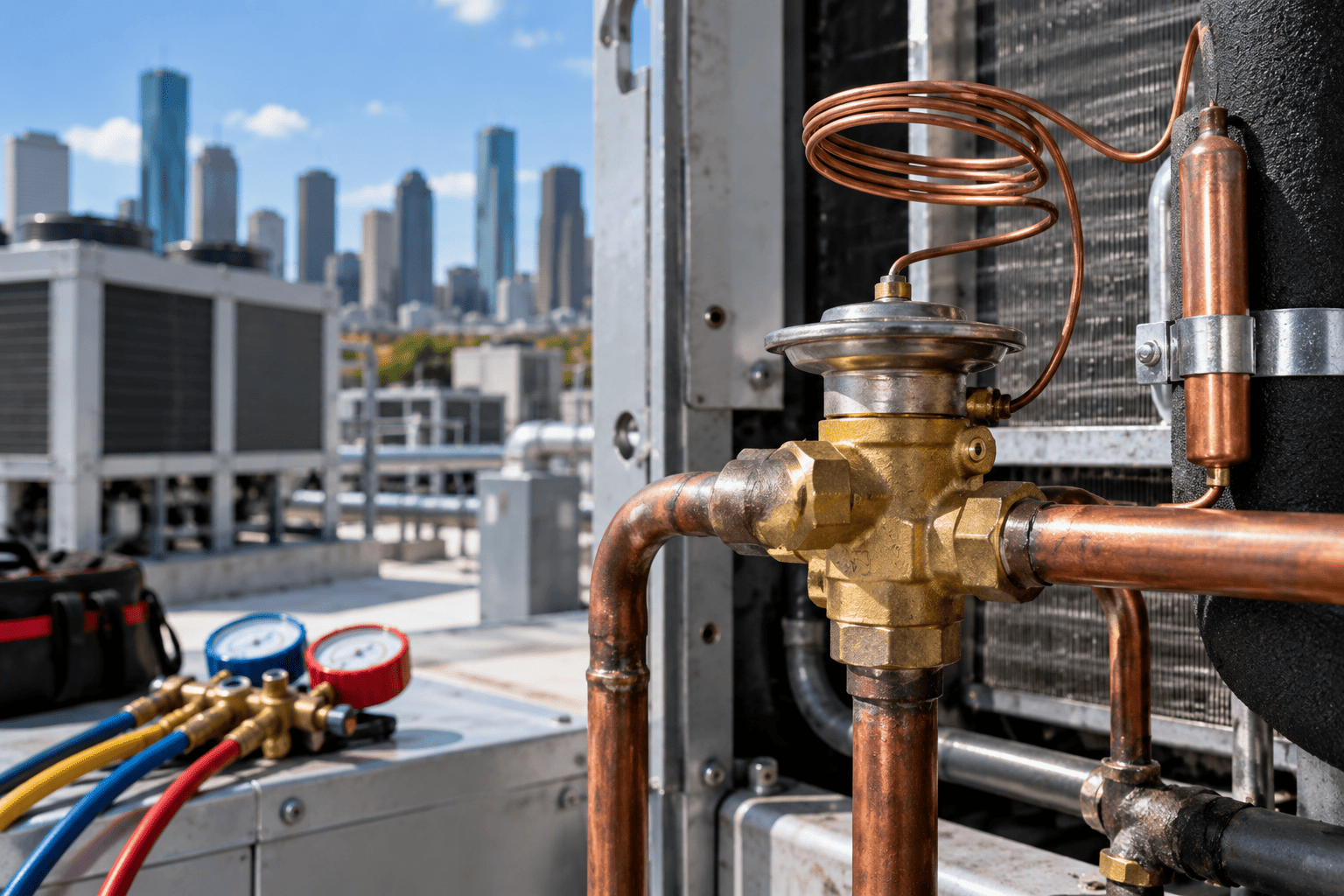
When a thermostatic expansion valve does not meter refrigerant correctly, a commercial HVAC or refrigeration system may lose cooling capacity, develop evaporator icing, run for extended periods, or operate with abnormal refrigerant conditions. For Houston businesses, these problems can become especially noticeable when cooling equipment operates under heavy loads during Texas heat. Businesses looking for Commercial HVAC & Industrial Refrigeration Services in Houston TX need more than a quick assumption that the TXV has failed. ACF Mechanical evaluates refrigerant pressures and temperatures, airflow, superheat, system load, evaporator condition, refrigerant charge, and other factors to identify the actual cause of poor system performance.
What Does a TXV Do in Commercial HVAC and Refrigeration Systems?
A thermostatic expansion valve, commonly called a TXV, is a refrigerant metering device used in many HVAC and refrigeration systems.
Its job is to regulate the amount of refrigerant entering the evaporator according to operating conditions. The valve responds to conditions at the evaporator outlet and helps maintain appropriate superheat.
A properly operating TXV allows the evaporator to receive enough refrigerant to absorb heat effectively while helping prevent excessive liquid refrigerant from leaving the evaporator.
Depending on equipment design, TXVs may be found in:
- Commercial air-conditioning systems
- Rooftop units
- Air-handler and evaporator assemblies
- Certain commercial chillers
- Commercial refrigeration equipment
- Walk-in coolers
- Walk-in freezers
- Restaurant refrigeration
- Cold-storage systems
- Industrial refrigeration equipment
Not every HVAC or refrigeration system uses a thermostatic expansion valve. Different equipment may use electronic expansion valves, fixed metering devices, float controls, or other refrigerant-feed arrangements.
Why TXV Problems Affect System Performance
The evaporator depends on controlled refrigerant flow.
If too little refrigerant enters the evaporator, part of the coil may not be used effectively for heat absorption. If refrigerant feeding is excessive or unstable, the system may operate outside its intended conditions.
Potential consequences of commercial HVAC TXV problems Houston businesses may experience include:
- Reduced cooling capacity
- Long equipment runtimes
- Temperature-control problems
- Evaporator icing
- Abnormal suction pressure
- High or low superheat
- Unstable refrigeration operation
- Increased compressor stress
- Higher operating costs
- Unexpected equipment shutdowns
These symptoms can also be caused by other system problems, which is why accurate diagnostics are essential before replacing an expansion valve.
Common Signs of a Bad or Malfunctioning TXV
A TXV problem does not always cause a complete system shutdown. In many cases, equipment continues operating while cooling performance gradually deteriorates.
Possible warning signs include:
- Commercial space is not reaching the thermostat setpoint
- Walk-in cooler struggles to maintain temperature
- Walk-in freezer temperature rises
- Evaporator develops unusual icing
- Suction pressure is outside expected operating conditions
- Superheat is excessively high or low
- Compressor runs longer than normal
- Refrigeration capacity changes unexpectedly
- Evaporator appears starved
- System performance becomes unstable
Professional commercial HVAC TXV diagnostics Houston TX should evaluate these symptoms as part of the entire refrigeration circuit.
Restricted or Clogged Expansion Valve Problems
A restricted TXV can reduce refrigerant flow into the evaporator.
Possible causes of restriction can include contamination, debris, moisture-related issues, or internal valve problems. The exact cause depends on the refrigeration system and its condition.
A commercial HVAC restricted TXV Houston facility may experience can contribute to a starved evaporator.
Potential symptoms include:
- Reduced cooling
- Low suction pressure under certain conditions
- High superheat
- Longer compressor runtime
- Insufficient evaporator capacity
- Temperature-control problems
However, these symptoms do not prove that the TXV is restricted.
Low refrigerant charge, filter-drier restrictions, airflow problems, or other refrigerant-circuit issues can produce similar operating conditions.
TXV Stuck Closed vs. TXV Stuck Open
The effect of a TXV problem depends partly on how the valve is failing.
| TXV Condition | Refrigerant Flow | Possible Effect |
|---|---|---|
| Restricted TXV | Reduced | Starved evaporator and reduced capacity |
| TXV stuck closed | Very low or no flow | Severe loss of cooling |
| TXV stuck open | Excessive feeding may occur | Low superheat and potential floodback risk |
| Unstable TXV control | Flow fluctuates | Hunting and unstable performance |
| Sensing problem | Incorrect valve response | Improper evaporator feeding |
A technician should verify actual system conditions rather than diagnosing the valve from one symptom alone.
What Is a Starved Evaporator?
A starved evaporator is not receiving enough refrigerant to use its available heat-transfer surface effectively.
When refrigerant feeding is insufficient, refrigerant may completely evaporate too early in the coil. The remaining portion of the evaporator then contributes less effectively to cooling.
Possible signs include:
- High superheat
- Reduced capacity
- Long runtimes
- Temperature problems
- Abnormal suction conditions
A commercial HVAC evaporator starving Houston problem can result from several causes—not only a TXV.
Potential causes include:
- Low refrigerant charge
- Restricted TXV
- Filter-drier restriction
- Refrigerant-line restriction
- Incorrect TXV adjustment where adjustment is applicable
- Sensing bulb problems
- Insufficient pressure differential
- Other refrigerant-system conditions
Correct diagnosis requires measurements rather than assumptions.
TXV Problems vs. Low Refrigerant Charge
This is one of the most important distinctions when diagnosing expansion valve problems.
Low refrigerant charge and restricted refrigerant flow can sometimes produce similar symptoms.
Both conditions may contribute to:
- Reduced cooling capacity
- High superheat
- Low suction pressure
- Long equipment runtime
- Inadequate evaporator feeding
Adding refrigerant without determining the actual cause is not an appropriate solution.
A professional diagnosis may include evaluating:
- Suction and discharge conditions
- Superheat
- Subcooling where applicable
- Refrigerant-line temperatures
- Refrigerant charge
- Airflow
- Evaporator condition
- Condenser condition
- Metering-device operation
If the refrigerant charge is low because of a leak, the leak should be identified rather than assuming that the TXV is responsible for poor cooling.
TXV Problems vs. Dirty Evaporator Coils
Airflow problems can also create misleading symptoms.
A dirty evaporator coil reduces airflow and heat transfer. This changes the load on the evaporator and can affect refrigerant pressures and temperatures.
A technician who looks only at refrigerant pressure may misinterpret an airflow problem as a refrigerant metering problem.
Before recommending commercial HVAC expansion valve repair Houston, technicians should consider:
- Evaporator cleanliness
- Air filter condition
- Blower or fan operation
- Duct airflow
- Fan speed
- System load
- Refrigerant conditions
Correcting the airflow problem may change the refrigeration readings significantly.
TXV Sensing Bulb Problems
The sensing bulb is an important part of a conventional thermostatic expansion valve system.
It monitors suction-line temperature at the evaporator outlet and influences valve operation.
Problems may occur when the sensing bulb is:
- Loose
- Incorrectly positioned
- Poorly secured to the suction line
- Improperly insulated where insulation is required
- Installed on an inappropriate section of piping
- Damaged
- Affected by a failed power element
A commercial HVAC TXV sensing bulb problem Houston can cause the valve to respond incorrectly even if the valve body itself is not mechanically restricted.
Sensing bulb position and installation should follow equipment and valve manufacturer requirements.
TXV Power Element Problems
The TXV power element responds to sensing bulb conditions and helps move the valve mechanism.
If the power element loses its ability to respond correctly, refrigerant flow may become inadequate or otherwise incorrect.
Possible symptoms can resemble:
- Restricted TXV
- Starved evaporator
- High superheat
- Poor cooling
- Unstable operation
Because these symptoms overlap with other refrigerant problems, the complete system should be evaluated before the valve is replaced.
External Equalizer Problems
Some thermostatic expansion valves use an external equalizer to account for evaporator pressure at a specific location.
Problems with an equalizer line can interfere with proper valve operation.
Possible issues include:
- Restriction
- Damage
- Incorrect connection
- Pressure-sensing problems
Whether an external equalizer is used depends on system and valve design.
Professional commercial HVAC TXV troubleshooting Houston should take the specific equipment configuration into account.
Understanding TXV Superheat Problems
Superheat is one of the important measurements used when evaluating evaporator and TXV operation.
However, a single superheat reading should not be used by itself to condemn a TXV.
High Superheat
High superheat may indicate that the evaporator is being underfed.
Potential causes can include:
- Restricted TXV
- Low refrigerant charge
- Filter-drier restriction
- Sensing bulb problem
- Incorrect valve operation
- Refrigerant-line restriction
- Other system conditions
Low Superheat
Low superheat may indicate excessive refrigerant feeding or insufficient heat load at the evaporator.
Possible causes may include:
- TXV overfeeding
- Incorrect sensing conditions
- Airflow problems
- Load changes
- Valve control problems
- Other refrigeration conditions
Technicians should interpret superheat together with the rest of the system data.
TXV Hunting and Unstable Operation
TXV hunting refers to repeated changes in refrigerant feeding as the valve attempts to maintain control.
Some variation in valve position is normal, but excessive or persistent hunting may produce unstable superheat and system performance.
Possible contributing factors can include:
- Improper valve sizing
- Incorrect bulb installation
- Changing evaporator load
- Refrigerant distribution issues
- Valve adjustment problems
- Other system-control conditions
A commercial HVAC TXV hunting Houston TX diagnosis should focus on why the valve cannot maintain stable control rather than simply replacing components.
Can TXV Problems Cause Evaporator Icing?
Yes, refrigerant metering problems can contribute to evaporator icing under certain operating conditions, but ice on an evaporator does not automatically mean the TXV is defective.
Evaporator icing may also result from:
- Low airflow
- Dirty air filters
- Dirty evaporator coils
- Fan or blower problems
- Low refrigerant charge
- Control problems
- Low load conditions
- Defrost problems in refrigeration applications
For this reason, commercial HVAC evaporator icing TXV Houston TX problems require broader system diagnostics.
Rooftop Unit TXV Problems
Commercial rooftop units operate under demanding conditions in Houston.
During periods of high Texas heat, rooftop equipment may run for extended periods at substantial cooling loads. A refrigerant-feed problem that produces only minor symptoms during moderate weather may become much more noticeable as cooling demand increases.
Possible rooftop unit TXV problems Houston include:
- Poor cooling
- High superheat
- Evaporator icing
- Low capacity
- Long compressor runtime
- Abnormal refrigerant conditions
Rooftop HVAC TXV diagnostics should also include airflow, coil condition, condenser performance, compressor operation, and refrigerant charge.
Commercial Air Handler and Evaporator TXV Problems
In split commercial systems, the expansion valve may be located near the evaporator associated with the air handler.
A commercial air handler expansion valve repair Houston TX diagnosis should not ignore the air side of the equipment.
Important factors include:
- Supply airflow
- Fan operation
- Filter condition
- Evaporator cleanliness
- Temperature entering the coil
- System load
- Refrigerant conditions
A perfectly functional TXV cannot compensate for severe airflow problems.
Commercial Chiller Expansion Valve Problems
Depending on chiller design, refrigerant flow may be controlled by different types of metering devices or electronic controls.
Some equipment may use thermostatic expansion valves, while other chillers use different refrigerant-control arrangements.
When applicable, commercial chiller expansion valve problems Houston may affect:
- Evaporator feeding
- Refrigeration capacity
- Superheat
- Compressor operation
- System stability
Chiller diagnostics should always be based on the actual equipment design and manufacturer specifications rather than assuming every chiller uses the same expansion-valve configuration.
Industrial Refrigeration Expansion Valve Problems
Industrial refrigeration systems depend on controlled refrigerant feeding to maintain capacity and stable operating conditions.
Depending on the application, refrigerant control may involve thermostatic valves, electronic expansion valves, float controls, or other devices.
Where TXVs are used, industrial refrigeration TXV problems Houston can affect:
- Evaporator feeding
- Refrigeration capacity
- Superheat
- Temperature stability
- Compressor operating conditions
- Equipment runtime
Industrial refrigeration diagnostics should account for the system design, refrigerant, load conditions, evaporator configuration, and control strategy.
Walk-In Cooler TXV Problems
Walk-in coolers are critical for restaurants, food-service businesses, retail operations, and other Houston businesses that depend on temperature-controlled storage.
A walk-in cooler TXV problem Houston may contribute to:
- Cooler not reaching setpoint
- Long compressor runtime
- High superheat
- Low suction conditions
- Evaporator feeding problems
- Temperature fluctuations
- Reduced refrigeration capacity
However, walk-in cooler performance can also be affected by:
- Dirty condenser
- Dirty evaporator
- Refrigerant leaks
- Fan problems
- Door infiltration
- Control problems
- Compressor issues
Professional walk-in cooler TXV repair Houston TX should therefore begin with complete refrigeration diagnostics.
Walk-In Freezer TXV Problems
Expansion-valve problems can also affect walk-in freezers.
Possible signs include:
- Freezer temperature rising
- Reduced refrigeration capacity
- High superheat
- Evaporator feeding problems
- Long runtime
- Abnormal frost patterns
Technicians should distinguish a TXV-related refrigerant problem from a defrost-system problem.
A heavily iced freezer evaporator may have a failed heater, timer, sensor, termination control, fan issue, drainage problem, or moisture-infiltration problem rather than a defective expansion valve.
Correct diagnosis prevents unnecessary walk-in freezer expansion valve replacement Houston TX.
Restaurant Refrigeration TXV Problems
Restaurants rely on stable refrigeration for food storage and daily operations.
When a walk-in cooler or freezer cannot maintain temperature, a TXV may be one possible cause—but it should not be the first component replaced without testing.
Restaurant refrigeration diagnostics may include:
- Temperature measurements
- Refrigerant pressures
- Superheat
- Subcooling where applicable
- Evaporator airflow
- Coil condition
- Condenser condition
- Refrigerant charge
- Compressor operation
- TXV response
Professional restaurant refrigeration expansion valve repair Houston should focus on restoring correct system operation, not simply changing parts.
Cold Storage and Warehouse Refrigeration TXV Problems
Cold-storage and refrigerated warehouse facilities can have significant refrigeration loads.
When a refrigerant metering problem develops, the system may lose capacity and struggle to maintain product-space temperatures.
Potential signs of cold storage TXV problems Houston TX include:
- Temperature instability
- Extended equipment runtime
- Evaporator starvation
- Abnormal superheat
- Reduced refrigeration capacity
- Compressor operating concerns
Because large refrigeration systems can use different refrigerant-feed strategies, technicians must identify the specific metering device and system configuration before determining the repair.
How Houston Heat Can Expose Refrigerant Metering Problems
Houston’s climate creates demanding conditions for commercial cooling equipment.
High outdoor temperatures increase heat-rejection requirements and can keep commercial HVAC systems operating for long periods. High humidity also increases latent cooling demands in many commercial buildings in Houston.
Heat does not automatically cause a TXV to fail.
However, high system load can make an existing refrigerant-feed problem more noticeable.
A rooftop unit that appears to provide acceptable cooling under moderate conditions may struggle during high outdoor temperatures if the evaporator is being underfed.
For Texas businesses, maintaining the entire refrigeration circuit is important before peak cooling demand exposes developing problems.
Can a Bad TXV Damage a Compressor?
A TXV problem does not automatically cause compressor failure.
However, prolonged abnormal refrigerant feeding can contribute to operating conditions that are unfavorable for compressor reliability.
A severely starved evaporator may produce excessive superheat and reduce system capacity. Under certain overfeeding conditions, inadequate evaporation can increase the risk of liquid refrigerant returning toward the compressor.
Actual compressor risk depends on:
- System design
- Refrigerant
- Load
- Compressor type
- Accumulator configuration where applicable
- Degree of TXV malfunction
- Other system conditions
This is another reason TXV problems should be diagnosed rather than ignored.
Should a TXV Be Repaired or Replaced?
The appropriate solution depends on the actual fault.
In some cases, the valve itself may not need replacement.
Service may involve correcting:
- Sensing bulb installation
- Insulation around the bulb where required
- Equalizer problems
- Refrigerant charge
- Airflow
- System contamination
- Other refrigerant restrictions
When the valve or power element has failed, commercial HVAC TXV replacement Houston TX may be required.
Replacement involves more than installing a physically similar valve.
Technicians must consider:
- Refrigerant type
- Equipment capacity
- Valve capacity
- Evaporator requirements
- Equalization method
- Connection type
- Manufacturer specifications
- Proper installation
- Refrigerant-system cleanliness
The new valve must be appropriate for the application.
Why Replacing the TXV Without Diagnostics Can Waste Money
Many symptoms associated with TXV failure are not unique to the expansion valve.
Replacing the TXV will not solve a problem caused by:
- Refrigerant leak
- Incorrect refrigerant charge
- Dirty evaporator
- Poor airflow
- Failed blower
- Dirty condenser
- Filter-drier restriction
- Compressor problem
- Sensor or control issue
Professional commercial HVAC expansion valve repair Houston should begin by identifying the root cause.
This approach can reduce unnecessary parts replacement and repeat service calls.
Preventive Maintenance for TXV-Controlled Systems
Expansion valves are part of a larger refrigeration circuit. Preventive maintenance should therefore focus on conditions that allow the complete system to operate correctly.
A professional maintenance program may include:
- Checking system temperatures
- Evaluating refrigerant pressures
- Checking superheat
- Checking subcooling where applicable
- Inspecting evaporator coils
- Inspecting condenser coils
- Checking airflow
- Inspecting fans and blowers
- Checking refrigerant charge when appropriate
- Looking for refrigerant leaks
- Inspecting filter-drier condition when indicated
- Evaluating temperature controls
- Checking compressor operation
Professional commercial HVAC maintenance Houston can identify performance changes before they become major cooling failures.
Commercial Refrigeration Maintenance in Houston
Restaurants, warehouses, food-service facilities, and other commercial operations cannot afford repeated refrigeration temperature problems.
Professional commercial refrigeration maintenance Houston TX should include attention to:
- Refrigerant circuit performance
- Evaporator condition
- Condenser condition
- Fan operation
- Controls
- Defrost systems
- Refrigerant leaks
- Metering-device performance
For industrial facilities, industrial refrigeration maintenance Houston can help identify changing system conditions before they contribute to unexpected downtime.
When Expansion Valve Problems Require Urgent Service
Not every suspected TXV problem is an emergency.
However, prompt service may be appropriate when the problem results in:
- Complete loss of commercial cooling
- Walk-in cooler temperature rise
- Walk-in freezer temperature rise
- Cold-storage temperature instability
- Critical refrigeration capacity loss
- Severe evaporator icing
- Compressor protection trips
- Business-critical equipment shutdown
For restaurants, cold-storage operations, warehouses, and industrial facilities, refrigeration temperature problems can quickly affect normal business operations.
TXV Troubleshooting Checklist for Facility Managers
Facility managers should not open the refrigeration circuit or attempt refrigerant repairs without appropriate qualifications, but they can watch for operating changes.
Cooling Performance
- Is the building taking longer to cool?
- Is the walk-in cooler reaching its setpoint?
- Is the freezer temperature stable?
- Has equipment runtime increased?
Evaporator Condition
- Is unusual ice developing?
- Is airflow reduced?
- Are fans operating normally?
- Is the coil visibly dirty?
System Operation
- Are there repeated equipment trips?
- Has compressor operation changed?
- Are temperatures fluctuating?
- Did the problem become worse during high outdoor temperatures?
These observations can help a technician understand how the problem develops under actual operating conditions.
Why Houston Businesses Choose ACF Mechanical
Diagnosing a TXV problem requires more than checking one pressure reading or replacing a valve based on symptoms.
ACF Mechanical evaluates the complete HVAC or refrigeration system to identify conditions affecting refrigerant flow and cooling performance.
Houston businesses choose ACF Mechanical for:
- Experienced technicians
- Commercial HVAC expertise
- Industrial refrigeration knowledge
- Refrigerant-system diagnostics
- Walk-in cooler and freezer service
- Preventive maintenance
- Fast response
- Reliable service
- Experience with rooftop units, air handlers, commercial AC equipment, refrigeration systems, and cold-storage applications
ACF Mechanical serves business owners, facility managers, restaurant owners, warehouse managers, industrial companies, and commercial property owners throughout Houston, TX.
Restore Proper Refrigerant Flow and Cooling Performance
A thermostatic expansion valve is a relatively small component, but its operation can have a major effect on evaporator performance and refrigeration capacity.
Restricted refrigerant flow, incorrect valve response, sensing bulb problems, unstable superheat, or a failed power element can contribute to poor cooling and abnormal system operation.
At the same time, symptoms that appear to indicate TXV failure may actually come from low refrigerant charge, airflow problems, dirty coils, filter-drier restrictions, controls, or other equipment conditions.
That is why accurate diagnosis matters.
Professional Commercial HVAC & Industrial Refrigeration Services in Houston TX from ACF Mechanical can help determine whether a TXV, refrigerant issue, airflow problem, or another component is responsible for reduced system performance.
If your commercial AC system, rooftop unit, walk-in cooler, walk-in freezer, cold-storage equipment, or industrial refrigeration system is experiencing poor cooling, unusual evaporator icing, high superheat, abnormal refrigerant conditions, or extended runtime, contact ACF Mechanical for professional diagnostics and service in Houston, TX.