
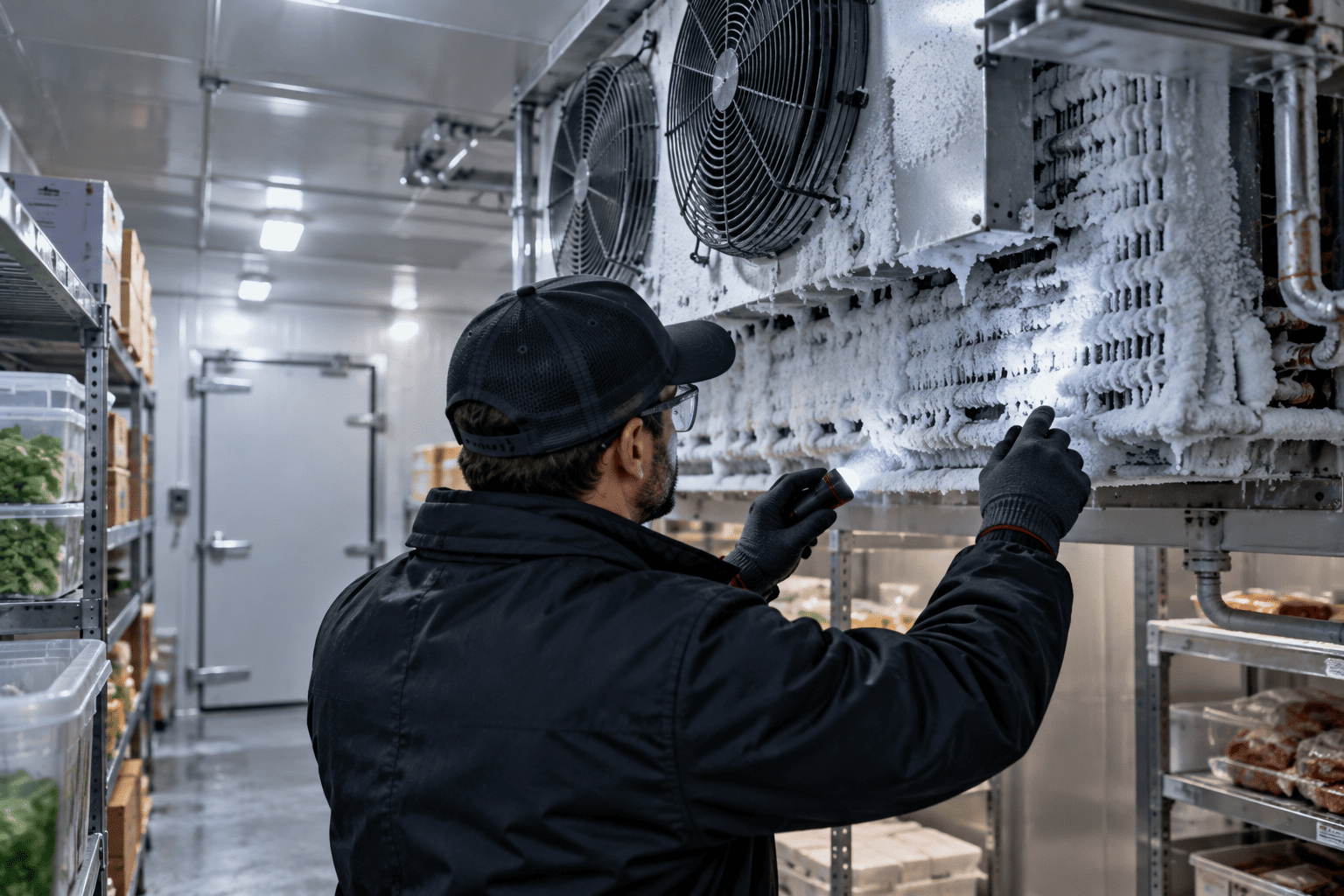
Ice buildup on a commercial refrigeration evaporator is more than a maintenance inconvenience. As frost becomes thicker, airflow through the coil can decrease, refrigeration performance can deteriorate, and walk-in cooler or freezer temperatures may begin to rise. For Houston businesses, professional Commercial HVAC & Industrial Refrigeration Services in Houston TX can determine whether evaporator icing is being caused by a failed defrost component, control problem, air infiltration, drainage issue, fan problem, or another refrigeration condition. ACF Mechanical provides commercial and industrial refrigeration diagnostics, repair, and preventive maintenance throughout Houston, TX.
Why Commercial Refrigeration Systems Need Defrost
When refrigeration equipment operates, the evaporator coil is maintained at a low temperature so it can absorb heat from the refrigerated space.
Moisture in the air can condense and freeze on cold evaporator surfaces. Some frost formation is therefore expected in many low-temperature refrigeration applications.
The purpose of a defrost system is to periodically remove accumulated frost so that air can continue moving efficiently through the evaporator.
Depending on equipment design, commercial refrigeration may use different defrost methods and control strategies. These can include off-cycle defrost, electric defrost, hot-gas defrost, or other manufacturer-specific arrangements.
Because system designs vary, technicians should understand the specific equipment before diagnosing a commercial refrigeration defrost failure Houston businesses are experiencing.
What Happens When a Refrigeration System Does Not Defrost?
If frost is not removed properly, it can gradually build across the evaporator.
As the ice layer becomes thicker, several problems may develop:
- Airflow through the evaporator decreases
- Refrigeration performance declines
- Evaporator fans may become obstructed
- Compressor runtime may increase
- Box temperature may rise
- Temperature recovery may become slower
- Energy consumption may increase
- Refrigeration alarms may occur
- Ice may spread beyond the coil
- Stored products may be exposed to unacceptable temperatures
A commercial refrigeration not defrosting Houston problem should therefore be investigated before the evaporator becomes heavily blocked.
Warning Signs of Commercial Refrigeration Defrost Problems
Facility managers, restaurant operators, and warehouse personnel should watch for signs such as:
- Heavy frost covering the evaporator
- Thick ice around the coil
- Ice around evaporator fan guards
- Fan blades contacting ice
- Reduced airflow from the evaporator
- Walk-in temperature increasing
- Temperature fluctuations
- Refrigeration running for unusually long periods
- Repeated temperature alarms
- Water or ice appearing below the evaporator
- Ice returning soon after manual removal
One symptom alone does not confirm a defrost-system failure.
Professional diagnosis should determine why the ice is developing.
Why Ice Builds Up on Commercial Refrigeration Evaporators
A failed defrost system is an important possible cause of evaporator icing, but it is not the only cause.
Potential causes include:
- Defrost heater failure
- Defrost timer or controller problem
- Defrost sensor failure
- Defrost thermostat problem
- Incorrect defrost termination
- Evaporator fan problems
- Excessive door openings
- Damaged door gaskets
- Warm-air infiltration
- Drainage problems
- Control problems
- Refrigeration system problems
- Incorrect operating conditions
This distinction is critical.
Removing the ice without identifying the underlying cause may provide only temporary improvement.
Commercial Refrigeration Defrost Heater Problems
Electric defrost systems use heaters to warm the evaporator sufficiently to remove accumulated frost.
If a heater fails or does not receive power when required, part or all of the evaporator may remain frozen.
Possible commercial refrigeration defrost heater problems Houston TX include:
- Failed heating element
- Electrical connection problems
- Contactor or relay issues
- Control failure
- Incorrect defrost sequence
- Safety or termination control problems
Symptoms may include incomplete defrost, progressive ice buildup, reduced airflow, and rising refrigerated-space temperature.
Professional commercial refrigeration defrost heater repair Houston should verify both the heater and the circuit controlling it.
Replacing a heater without confirming why it failed to operate may not correct the problem.
Defrost Timer and Controller Problems
Older or simpler refrigeration equipment may use timers, while other systems use electronic controllers or more advanced refrigeration controls.
A timer or controller determines when defrost should occur and may coordinate other parts of the sequence.
Possible commercial refrigeration defrost timer problems Houston TX include:
- Defrost does not initiate
- Defrost occurs at incorrect intervals
- Refrigeration remains in defrost too long
- Equipment exits defrost too early
- Refrigeration does not restart correctly
- Fans do not resume operation as expected
Electronic controls can produce similar symptoms if a sensor, relay, configuration, wiring, or controller problem disrupts the sequence.
Professional diagnosis should verify the complete defrost sequence rather than assuming the timer or controller is defective.
Defrost Thermostat and Sensor Problems
Many refrigeration systems use temperature information to control or terminate defrost.
Depending on the design, a thermostat or sensor may determine when the evaporator has warmed enough for defrost to end.
A commercial refrigeration defrost sensor problem Houston TX can potentially cause:
- Premature defrost termination
- Excessive defrost duration
- Incomplete frost removal
- Incorrect fan operation
- Temperature recovery problems
- Repeated evaporator icing
Sensor readings should be compared with actual conditions.
A sensor that appears to be causing a problem may instead have damaged wiring, poor placement, a control issue, or another circuit problem.
Defrost Termination Problems
Defrost must remove enough frost without unnecessarily heating the refrigerated space.
This makes termination an important part of the process.
If defrost ends too early, ice may remain on the evaporator. The remaining frost can become the foundation for progressively heavier buildup during subsequent refrigeration cycles.
If defrost continues longer than required, box temperature may be affected and refrigeration will have more heat to remove afterward.
Professional commercial refrigeration defrost termination problems Houston TX diagnostics should evaluate the control sequence, sensors, heaters, and actual evaporator condition.
Walk-In Freezer Defrost Problems
Walk-in freezers are particularly vulnerable to frost accumulation because their evaporators operate below freezing.
A walk-in freezer not defrosting Houston businesses depend on may initially continue maintaining temperature, even while ice is building.
As the evaporator becomes more restricted, however, performance can deteriorate.
Common symptoms include:
- Heavy evaporator ice
- Reduced airflow
- Fans surrounded by frost
- Increasing freezer temperature
- Longer compressor runtime
- Slow temperature recovery
- Repeated alarms
- Ice forming around the evaporator housing
Professional walk-in freezer defrost repair Houston TX should determine why frost is not being removed rather than simply melting the visible ice.
Walk-In Freezer Evaporator Fan Blocked by Ice
One serious consequence of heavy evaporator icing is interference with fan operation.
Ice can restrict airflow through the coil and may eventually reach fan guards or blades.
A walk-in freezer evaporator fan blocked by ice Houston TX can cause:
- Very low airflow
- Abnormal fan noise
- Fan blade contact with ice
- Motor stress
- Uneven freezer temperature
- Poor heat transfer
- Additional ice accumulation
The fan motor itself may still be functional.
Replacing the motor would not solve the problem if ice caused by a defrost failure is physically preventing it from operating.
Technicians should inspect both the fan system and the reason for the ice buildup.
Walk-In Cooler Defrost Problems
Walk-in coolers can also experience evaporator icing, although their operating conditions and defrost requirements may differ from low-temperature freezers.
Possible walk-in cooler defrost problems Houston TX can involve:
- Incorrect control settings
- Air infiltration
- Evaporator fan problems
- Drainage problems
- Defrost controls
- Temperature sensors
- Refrigeration conditions
A walk-in cooler frozen evaporator coil Houston TX service call should include evaluation of the complete system.
If the evaporator is freezing unexpectedly, the problem may not be a traditional defrost-system failure.
Defrost Problem or Another Refrigeration Problem?
Several refrigeration faults can produce similar symptoms.
| Symptom | Possible Defrost Issue | Other Possible Cause |
|---|---|---|
| Heavy evaporator ice | Defrost failure | Air infiltration |
| Reduced airflow | Iced evaporator | Fan motor problem |
| Freezer temperature rising | Coil blocked by ice | Compressor/refrigerant issue |
| Fan hitting ice | Excessive frost buildup | Drainage or control problem |
| Ice repeatedly returns | Defrost control problem | Door or gasket issue |
| Frost remains after defrost | Incomplete defrost | Heater or sensor problem |
| Water or ice below evaporator | Defrost drainage problem | Clogged drain |
| Long compressor runtime | Poor heat transfer from icing | Other refrigeration problem |
Accurate diagnosis is essential because replacing a defrost heater will not solve a door-infiltration problem, and repairing a door gasket will not correct a failed defrost controller.
How Houston Humidity Can Increase Frost Load
Houston’s climate adds another factor to commercial refrigeration operation: warm, humid outdoor air.
Humidity itself does not mean a refrigeration system has a defrost failure.
However, when warm, moisture-laden air enters a walk-in cooler or freezer, that moisture can freeze on cold evaporator surfaces.
Moisture infiltration may increase because of:
- Frequent door openings
- Doors being held open during loading
- Damaged door gaskets
- Poor door alignment
- Failed door closers
- Gaps around penetrations
- High traffic in restaurant or warehouse operations
For Houston businesses, controlling air infiltration can be an important part of reducing excessive frost load.
Restaurant Walk-In Freezer Defrost Problems
Restaurants can place particularly heavy demands on walk-in refrigeration.
Doors may open frequently throughout the day, kitchen areas can be warm and humid, and refrigeration equipment often operates continuously.
Restaurant refrigeration defrost problems Houston businesses experience may lead to:
- Ice buildup
- Reduced evaporator airflow
- Temperature instability
- Longer compressor runtime
- Unexpected alarms
- Product-temperature concerns
- Emergency service calls
Restaurant personnel should monitor actual refrigeration temperatures and follow applicable food-safety requirements if equipment cannot maintain appropriate conditions.
Cold Storage Defrost System Problems
Cold-storage facilities may use larger evaporators and more complex refrigeration controls.
Depending on facility design, multiple evaporators may serve separate areas or zones.
Cold storage defrost system problems Houston TX can affect:
- Evaporator airflow
- Temperature consistency
- Refrigeration capacity
- Product conditions
- Equipment runtime
- Operational schedules
A large evaporator becoming progressively blocked with ice can create significant performance problems even if compressors and other major components remain operational.
Warehouse Refrigeration and Door Traffic
Refrigerated warehouses can experience substantial moisture infiltration during loading and unloading.
Repeated door opening can introduce warm Houston air into cold spaces.
For warehouse refrigeration defrost problems Houston, technicians should consider both the refrigeration equipment and facility operating conditions.
Potential contributing factors include:
- Dock activity
- High door traffic
- Damaged strip curtains
- Door seal problems
- Extended loading periods
- Air infiltration
- Defrost scheduling
- Evaporator condition
Addressing only the defrost controls may not fully solve the problem when facility conditions are adding excessive moisture to the space.
Defrost Drainage Problems
During defrost, melted frost must leave the evaporator area through the drainage system.
If the drain is restricted, frozen, incorrectly heated where required, or otherwise unable to remove water, moisture can refreeze.
Possible symptoms include:
- Ice below the evaporator
- Ice around the drain pan
- Water dripping into the refrigerated space
- Repeated ice formation
- Frozen drain lines
- Ice developing near fan components
A drainage problem can therefore resemble a defrost failure or make an existing defrost problem worse.
Professional diagnosis should evaluate both frost removal and meltwater drainage.
Why Simply Removing the Ice Does Not Fix the Problem
When an evaporator becomes heavily iced, removing the ice may be necessary before the equipment can be properly inspected or returned to operation.
But ice removal is not the repair.
If the underlying cause remains, frost will likely return.
Technicians should determine whether the root problem involves:
- Defrost heater
- Timer or controller
- Sensor
- Thermostat
- Relay or contactor
- Fan operation
- Door infiltration
- Gaskets
- Drainage
- Refrigeration performance
- System configuration
This root-cause approach is especially important for businesses experiencing repeated evaporator icing.
Can Defrost Problems Damage Other Refrigeration Components?
Persistent icing can create additional stress throughout the refrigeration system.
Restricted evaporator airflow can reduce heat transfer and cause equipment to operate under abnormal conditions.
Possible consequences include:
- Longer compressor runtime
- Fan motor stress
- Reduced refrigeration capacity
- Temperature instability
- Increased operating costs
- Repeated alarms
- Additional mechanical wear
- Unexpected downtime
Ice that physically interferes with evaporator fans may also damage fan blades, guards, or motors.
Addressing the problem early can help reduce the chance of a localized defrost issue becoming a larger refrigeration repair.
How Technicians Diagnose Defrost Problems
Professional commercial refrigeration diagnostics Houston TX should follow the equipment’s actual sequence of operation.
Depending on system design, diagnosis may include:
- Inspecting evaporator frost patterns
- Reviewing temperature conditions
- Checking defrost schedule
- Testing heaters where applicable
- Evaluating sensors and thermostats
- Checking relays and contactors
- Inspecting electrical connections
- Verifying evaporator fan operation
- Checking drainage
- Inspecting doors and gaskets
- Reviewing controller alarms or history
- Evaluating refrigeration performance
The objective is not simply to identify which component is currently inactive. It is to determine why the defrost sequence is not producing the expected result.
Repairing vs. Replacing Defrost Components
A defrost problem rarely means the entire refrigeration system needs replacement.
Depending on diagnosis, repair may involve:
- Replacing a failed heater
- Repairing wiring
- Replacing a failed sensor
- Correcting controller settings
- Replacing a timer or relay
- Repairing a drain
- Correcting fan problems
- Replacing damaged door gaskets
- Addressing air infiltration
The appropriate repair depends on equipment design, component condition, system age, and the root cause.
A professional commercial refrigeration defrost system repair Houston TX should restore the intended sequence rather than relying on repeated manual defrosting.
Preventive Maintenance for Commercial Refrigeration Defrost Systems
Professional commercial refrigeration maintenance Houston TX can help identify developing defrost problems before an evaporator becomes completely blocked.
Maintenance may include checking:
- Evaporator condition
- Frost pattern
- Defrost schedule
- Heater operation
- Sensors and thermostats
- Relays and controls
- Fan operation
- Drainage
- Door gaskets
- Refrigeration temperatures
- Controller alarms
- Electrical connections
For larger systems, industrial refrigeration maintenance Houston may also include evaluating multiple evaporators and defrost sequences throughout a facility.
Preventive inspection is particularly important when refrigeration equipment protects valuable temperature-sensitive products.
When Defrost Problems Require Emergency Refrigeration Repair
Not every frost problem is an emergency.
However, immediate service may be appropriate when:
- Walk-in freezer temperature is rising rapidly
- Refrigeration airflow has nearly stopped
- Evaporator fans are blocked by ice
- Critical refrigeration equipment shuts down
- Stored products may be at risk
- Temperature alarms continue
- Heavy ice creates a safety or equipment concern
Professional emergency refrigeration repair Houston TX can help identify whether the immediate problem is defrost-related or caused by another refrigeration failure.
Businesses should continue monitoring actual product and space temperatures while following applicable operational and food-safety procedures.
Commercial Refrigeration Defrost Warning Sign Checklist
Houston facility managers and business owners should watch for:
Evaporator Signs
- Heavy frost on the coil
- Thick ice around the evaporator
- Ice returning repeatedly
- Frozen drain pan
- Ice around fan guards
Airflow and Fan Signs
- Weak evaporator airflow
- Fan noise changes
- Fan blades contact ice
- Uneven temperatures throughout the box
Temperature Signs
- Walk-in temperature rising
- Slow temperature recovery
- Temperature fluctuations
- Repeated alarms
- Compressor running longer than normal
Defrost Signs
- Defrost does not appear to occur
- Ice remains after a defrost cycle
- Defrost occurs too frequently
- Refrigeration does not restart normally
- Water repeatedly refreezes after defrost
These symptoms are reasons for professional inspection rather than proof that a specific component has failed.
Why Houston Businesses Choose ACF Mechanical
Commercial refrigeration defrost problems can involve much more than a timer or heater.
Correct diagnosis may require understanding refrigeration controls, evaporator airflow, electrical components, sensors, fans, drainage, compressors, and facility operating conditions.
Houston businesses choose ACF Mechanical for:
- Experienced technicians
- Commercial HVAC expertise
- Industrial refrigeration knowledge
- Walk-in cooler and freezer diagnostics
- Defrost-system troubleshooting
- Preventive maintenance
- Fast response
- Reliable service
- Experience with commercial and industrial refrigeration equipment
ACF Mechanical works with restaurants, warehouses, industrial companies, commercial property owners, facility managers, and other businesses throughout Houston, TX.
Stop Evaporator Ice Buildup Before It Causes a Refrigeration Shutdown
A heavily iced evaporator is a symptom, not a complete diagnosis.
The underlying problem may involve a defrost heater, timer, controller, sensor, fan, drain, door gasket, air infiltration, or another refrigeration condition.
Professional Commercial HVAC & Industrial Refrigeration Services in Houston TX from ACF Mechanical can help identify the cause of repeated ice buildup and restore reliable refrigeration performance.
For Houston businesses, addressing defrost problems early can help maintain airflow, stabilize refrigeration temperatures, reduce unnecessary equipment stress, and lower the risk of unexpected downtime.
If your walk-in cooler, walk-in freezer, cold-storage system, or industrial refrigeration equipment is developing heavy evaporator ice, losing airflow, or failing to maintain temperature, contact ACF Mechanical for professional refrigeration diagnostics and repair in Houston, TX.