
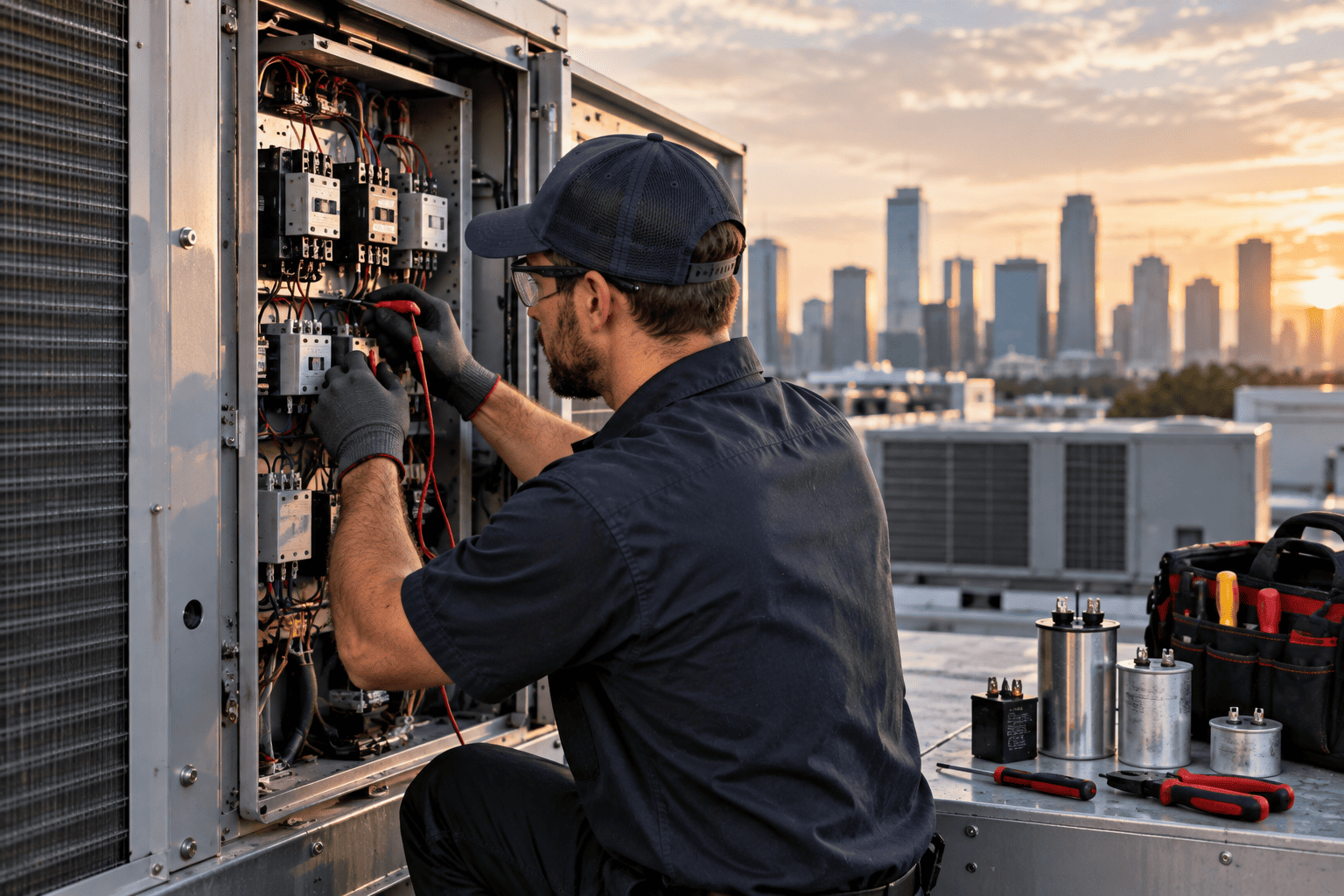
Commercial HVAC and refrigeration equipment depends on electrical switching and motor-support components to start, stop, and operate correctly. When a contactor, relay, or capacitor deteriorates, a rooftop unit may refuse to start, a condenser fan may stop operating, a compressor may struggle to run, or refrigeration equipment may shut down unexpectedly. For Houston businesses, professional Commercial HVAC & Industrial Refrigeration Services in Houston TX can identify whether the problem originates in a contactor, relay, capacitor, motor, compressor, control circuit, or another component. ACF Mechanical provides professional diagnostics, repair, and preventive maintenance for commercial HVAC and refrigeration systems throughout Houston, TX.
Why Contactors, Relays, and Capacitors Matter
Commercial HVAC and refrigeration equipment contains many electrical and electronic components. Contactors, relays, and capacitors perform different functions, but a failure in any of them can interrupt normal equipment operation.
What Does a Contactor Do?
A contactor is an electrically controlled switching device commonly used to control higher-current electrical loads.
Depending on equipment design, contactors may switch power to components such as:
- Compressors
- Condenser fan motors
- Blower motors
- Pumps
- Electric heaters
- Other equipment loads
When the control circuit calls for operation, the contactor should respond and allow the appropriate electrical load to operate.
Worn contacts, a failed coil, damaged wiring, overheating, or another electrical problem can prevent proper operation.
What Does a Relay Do?
Relays are switching devices commonly used within control circuits.
Depending on the system, a relay may participate in:
- Fan control
- Compressor control
- Equipment staging
- Safety circuits
- Alarm circuits
- Defrost sequences
- Control interlocks
A failed relay can interrupt the sequence of operation even when the major mechanical components are still functional.
What Does a Capacitor Do?
Capacitors are used with certain electric motors and compressors, particularly in single-phase applications.
Depending on equipment design, start and run capacitors can help provide the electrical characteristics needed for a motor to start or operate correctly.
Not every commercial HVAC or refrigeration system uses the same capacitor arrangement. Large three-phase equipment, for example, may use very different motor-control configurations.
This is why capacitor diagnosis must always be based on the specific equipment.
Warning Signs of Commercial HVAC Contactor Problems
A failing contactor can produce symptoms ranging from intermittent operation to a complete shutdown.
Common warning signs may include:
- HVAC unit does not start
- Compressor does not energize
- Condenser fan does not operate
- Equipment starts intermittently
- Contactor chatters
- Contacts appear burned or severely pitted
- Electrical components overheat
- Equipment stops unexpectedly
- Control signal is present but the expected load does not operate
These symptoms do not automatically prove the contactor is defective.
A technician must determine whether the contactor itself has failed or whether another electrical or control problem is preventing it from operating.
Why Commercial HVAC Contactors Fail
Commercial HVAC contactors perform repeated switching cycles over their service life.
Potential causes of commercial HVAC contactor failure Houston businesses may encounter include:
- Normal contact wear
- Electrical arcing
- Excessive heat
- Loose electrical connections
- Coil failure
- Contamination
- Abnormal voltage
- Excessive cycling
- Problems with the connected electrical load
- Control-circuit problems
Contacts can become worn or pitted over time. Excessive resistance at a poor connection may also create heat.
Simply replacing a damaged contactor without determining why it failed can allow the same problem to return.
What Happens When a Contactor Will Not Engage?
A commercial HVAC contactor not engaging Houston TX service call requires more than visually inspecting the contactor.
Possible causes include:
- Failed contactor coil
- No control voltage
- Open safety circuit
- Thermostat or controller problem
- Loose or damaged wiring
- Control transformer problem
- Safety switch activation
- Equipment protection logic
- Failed control board
- Another upstream electrical problem
The correct diagnosis follows the control circuit and verifies why the contactor is not being energized.
Burned and Pitted HVAC Contactors
Electrical contacts naturally experience wear as they open and close.
However, severe burning, pitting, discoloration, or overheating can indicate that a component is deteriorating or that another electrical condition is present.
A commercial HVAC burned contactor Houston TX businesses discover should be professionally evaluated.
Technicians may need to consider:
- Contact condition
- Connection tightness
- Voltage
- Current
- Load condition
- Coil operation
- Wiring condition
- Signs of overheating
Replacing only the visibly damaged part without checking the electrical load may leave the root cause unresolved.
Commercial HVAC Relay Problems
Relays can create confusing symptoms because they are often part of a larger control sequence.
A commercial HVAC control relay failure Houston TX may cause:
- A fan not to start
- A compressor not to receive the correct command
- Intermittent equipment operation
- Incorrect staging
- Control sequences to stop
- Equipment to behave unpredictably
The relay itself may be defective, but the technician must also verify whether it is receiving the correct control signal.
A relay that does not energize may simply be responding to another control problem.
Air Handler Relay Problems
Commercial air handlers may contain multiple control components associated with fan operation, cooling calls, heating, dampers, safety circuits, and other functions.
Symptoms of air handler relay problems Houston TX can include:
- Supply fan not operating
- Fan operating intermittently
- Cooling sequence not starting correctly
- Equipment failing to respond to controls
- Unexpected shutdowns
Because air handlers can be integrated with building automation systems and other equipment, troubleshooting often requires evaluating the entire control sequence.
Commercial HVAC Capacitor Problems
Capacitor failures are another possible reason a motor or compressor does not start or operate properly.
Possible commercial HVAC bad capacitor symptoms Houston TX include:
- Motor hums but does not start
- Condenser fan fails to start
- Compressor has difficulty starting
- Motor starts inconsistently
- Equipment trips a protective device
- Component overheats
- Capacitor shows visible physical deterioration
Visual condition alone is not enough to confirm capacitor performance.
Professional testing is necessary.
Start Capacitor vs. Run Capacitor
Start and run capacitors serve different purposes.
Start Capacitors
A start capacitor may provide additional starting torque for certain single-phase motors or compressors.
It is generally designed to remain in the circuit only during startup.
Run Capacitors
A run capacitor is designed to remain in the circuit while the motor operates and helps support proper motor performance.
Some equipment uses dual-run capacitors that serve more than one component.
However, commercial HVAC equipment varies considerably. Technicians should always follow the electrical design and manufacturer specifications for the specific unit.
Commercial HVAC Capacitor Testing
Professional commercial HVAC capacitor testing Houston TX involves more than looking for swelling or leakage.
Depending on the equipment and safe service procedures, technicians may verify:
- Rated capacitance
- Actual measured capacitance
- Component condition
- Wiring
- Connections
- Motor or compressor operation
- Voltage
- Current draw
- Signs of overheating
Capacitors can retain an electrical charge even when equipment is turned off. Commercial electrical compartments may also contain hazardous voltage.
Business owners and facility employees should not open energized equipment or attempt electrical testing without appropriate qualifications and safety procedures.
Compressor Not Starting: Capacitor, Contactor, or Compressor?
When a commercial HVAC compressor does not start, several different problems can produce similar symptoms.
Possible causes include:
- Failed contactor
- Failed capacitor on applicable equipment
- Low or missing control voltage
- Electrical connection problem
- Open safety device
- Compressor internal failure
- Motor winding problem
- Incorrect voltage
- Control-board issue
- Refrigeration protection condition
A commercial HVAC compressor not starting Houston service call should therefore begin with systematic diagnostics.
Replacing a capacitor because a compressor will not start can waste time and money if the actual problem is a contactor, compressor, control circuit, or electrical supply issue.
Condenser Fan Not Starting
A condenser fan that does not operate can quickly affect cooling performance.
Possible causes include:
- Failed fan motor
- Capacitor failure where applicable
- Contactor or relay problem
- Damaged wiring
- Control failure
- Electrical supply problem
- Mechanical obstruction
If the condenser fan stops while other equipment continues operating, heat rejection can deteriorate.
In Houston’s hot climate, proper condenser performance is particularly important during high cooling loads.
Professional commercial HVAC condenser fan not starting Houston TX diagnostics should identify the electrical or mechanical cause before replacing components.
Contactor, Relay, Capacitor, or Another Problem?
Many electrical problems create overlapping symptoms.
| Symptom | Possible Electrical Cause | Other Possible Cause |
|---|---|---|
| Compressor will not start | Contactor or capacitor | Compressor failure |
| Condenser fan will not start | Capacitor, relay, contactor | Fan motor failure |
| HVAC unit will not turn on | Contactor/control circuit | Thermostat or sensor |
| Intermittent operation | Relay or contactor | Wiring/control problem |
| Contactor chatters | Control-voltage problem | Control signal/safety issue |
| Motor hums | Capacitor on applicable equipment | Motor problem |
| Breaker trips | Electrical fault | Compressor or motor problem |
| Unit stops unexpectedly | Relay/control problem | Safety or mechanical issue |
Accurate diagnosis prevents unnecessary parts replacement.
Rooftop Unit Contactor Problems
Rooftop units are widely used in commercial buildings in Houston and often operate for extended periods during Texas cooling seasons.
Depending on design, rooftop equipment may use contactors to control:
- Compressors
- Condenser fans
- Blowers
- Electric heat
- Other loads
Rooftop unit contactor problems Houston businesses experience can result in complete or partial loss of cooling.
A unit with multiple compressors or stages may even continue operating at reduced capacity when one electrical circuit fails, making the problem less obvious.
Rooftop HVAC Capacitor Problems
Some rooftop equipment uses capacitors with condenser fan motors, compressors, or other single-phase components.
Potential symptoms include:
- Fan not starting
- Compressor startup difficulty
- Motor humming
- Intermittent cooling
- Abnormal motor operation
Professional rooftop HVAC capacitor replacement Houston TX should include confirmation that the capacitor is actually defective and evaluation of the connected component.
A failed capacitor can sometimes be the result of broader motor, heat, voltage, or equipment problems.
Commercial Chiller Relays and Electrical Controls
Commercial chillers may use sophisticated electrical controls, starters, contactors, relays, sensors, drives, and safety circuits.
Because configurations vary substantially by chiller type and manufacturer, technicians should avoid assuming that a symptom has the same cause across every system.
Potential commercial chiller relay problems Houston can affect:
- Equipment staging
- Pumps
- Fans
- Compressor control
- Safety sequences
- Alarm circuits
Chiller electrical diagnostics require understanding both the control logic and the mechanical refrigeration system.
Industrial Refrigeration Contactor Problems
Industrial refrigeration equipment also depends on reliable electrical switching.
Depending on system design, contactors may control:
- Compressors
- Condenser fans
- Evaporator fans
- Pumps
- Defrost heaters
- Other refrigeration loads
Industrial refrigeration contactor problems Houston can therefore affect much more than one component.
If a contactor does not close, a critical refrigeration load may not operate.
If contacts become damaged or overheated, unreliable operation may develop.
Professional industrial refrigeration contactor repair Houston TX should include evaluation of both the contactor and the circuit it controls.
Industrial Refrigeration Relay Problems
Relays are frequently involved in refrigeration control sequences.
Depending on the equipment, they may participate in:
- Compressor staging
- Fan control
- Pump control
- Defrost
- Alarms
- Safety circuits
- Control interlocks
An industrial refrigeration relay repair Houston TX diagnosis should determine whether the relay has physically failed or whether another control condition is preventing normal operation.
This distinction is important because refrigeration systems can contain multiple safeties and control devices designed to stop equipment under abnormal conditions.
Walk-In Cooler Contactor and Relay Problems
Walk-in coolers are essential for many restaurants, grocery operations, food-service facilities, and other Houston businesses.
Electrical component failures may cause:
- Condensing unit not starting
- Compressor not operating
- Evaporator fans stopping
- Intermittent refrigeration
- Defrost problems
- Temperature increase
- Unexpected shutdowns
A walk-in cooler compressor not starting Houston TX problem should be investigated promptly.
The cause could involve the contactor, relay, capacitor where applicable, compressor, controls, refrigerant system, or electrical supply.
Walk-In Freezer Electrical Component Problems
Walk-in freezers can experience similar electrical failures, but temperature loss can become particularly disruptive when stored products depend on stable frozen conditions.
Potential symptoms include:
- Compressor fails to start
- Fans stop
- Defrost sequence does not operate correctly
- Refrigeration cycles unexpectedly
- Temperature begins rising
- Electrical components overheat
A walk-in freezer compressor not starting Houston TX service call requires a complete electrical and refrigeration diagnosis rather than automatically replacing a capacitor or relay.
Restaurant Refrigeration Electrical Problems
Restaurant refrigeration equipment often operates continuously under demanding conditions.
Commercial kitchens can add heat, grease, airborne contaminants, and frequent door openings to the operating environment.
Reliable electrical controls are essential for:
- Walk-in coolers
- Walk-in freezers
- Prep refrigeration
- Reach-in refrigeration
- Other commercial cooling equipment
Professional restaurant refrigeration electrical repair Houston can help identify failing switching components before intermittent operation becomes a complete refrigeration shutdown.
Cold Storage and Warehouse Refrigeration
Large cold-storage and warehouse refrigeration systems may contain multiple compressors, fans, control panels, relays, contactors, starters, drives, and safety circuits.
A single failed electrical component may affect one circuit, one refrigeration zone, or a larger part of the system depending on design.
For cold storage refrigeration electrical problems Houston TX, technicians should evaluate the control sequence and affected load instead of replacing components based solely on appearance.
Why Houston Heat Can Increase Electrical Stress
Houston’s long cooling season places substantial operating demand on commercial HVAC and refrigeration equipment.
High outdoor temperatures can lead to:
- Longer cooling cycles
- Increased condenser workload
- More motor operating hours
- More compressor runtime
- Frequent electrical switching
- Higher thermal stress inside equipment
Houston heat does not automatically cause a contactor, relay, or capacitor to fail.
However, sustained operating demand can expose already weakened components and make developing problems more noticeable.
Texas businesses can reduce risk by addressing abnormal operation before peak cooling demand turns a minor electrical problem into a shutdown.
Humidity and Commercial HVAC Electrical Systems
Houston humidity also creates challenging operating conditions.
HVAC equipment often runs for extended periods to maintain both temperature and indoor comfort.
Electrical compartments and components should remain properly protected from water intrusion and abnormal moisture conditions.
Condensate leaks, damaged enclosures, poor drainage, or other moisture sources can create additional concerns around electrical equipment.
If moisture is discovered near electrical components, professional inspection is recommended.
Why Repeated Electrical Component Failure Needs Investigation
Replacing a failed contactor or capacitor may restore operation, but repeated failure is a warning sign.
Technicians may need to investigate:
- Excessive current draw
- Voltage problems
- Loose connections
- Motor problems
- Compressor problems
- Excessive cycling
- Control issues
- Overheating
- Incorrect replacement components
- Environmental contamination
For example, repeatedly replacing a contactor without checking a compressor drawing abnormal current may fail to solve the underlying issue.
Professional commercial HVAC electrical diagnostics Houston TX should focus on why the component failed, not only on which component failed.
Does a Failed Contactor or Capacitor Mean the HVAC System Needs Replacement?
Usually not.
A contactor, relay, or capacitor is an individual electrical component. If the rest of the equipment is in good condition, professional replacement of a failed component may restore reliable operation.
Equipment replacement becomes a broader consideration when the system also has:
- Repeated compressor failures
- Severe coil deterioration
- Frequent electrical failures
- Obsolete controls
- Poor efficiency
- Expensive recurring repairs
- Major refrigerant problems
- Increasing downtime
- Limited parts availability
The decision should be based on overall equipment condition, reliability, operating cost, and business requirements—not one failed electrical component.
How Preventive Maintenance Helps Reduce Electrical Failures
Professional commercial HVAC maintenance Houston TX can help identify developing electrical problems before they result in unexpected shutdowns.
Depending on equipment and service scope, technicians may inspect:
- Contactors
- Relays
- Capacitors where applicable
- Electrical connections
- Wiring
- Voltage
- Current draw
- Signs of overheating
- Compressor operation
- Fan motors
- Control sequences
- Safety devices
For refrigeration systems, industrial refrigeration maintenance Houston can also help identify electrical wear in equipment that may operate continuously or under demanding loads.
Preventive maintenance cannot eliminate every unexpected failure, but it can reveal many conditions before they become more serious.
When Electrical Problems Require Emergency Service
Some electrical problems can wait for scheduled service. Others require prompt attention.
Emergency commercial HVAC repair Houston TX may be necessary when:
- Critical commercial cooling is lost
- A rooftop unit shuts down during extreme heat
- Electrical components are visibly overheating
- Burning odors are present
- Equipment repeatedly trips electrical protection
- Critical operations cannot maintain acceptable conditions
Emergency refrigeration repair Houston may be appropriate when:
- Walk-in cooler temperature is rising
- Walk-in freezer refrigeration stops
- Cold-storage products may be at risk
- A compressor will not start
- Critical refrigeration equipment repeatedly shuts down
If there is evidence of electrical burning, smoke, or an immediate electrical hazard, personnel should follow appropriate facility safety procedures and avoid attempting internal equipment repairs.
Commercial HVAC Electrical Warning Sign Checklist
Facility managers should watch for:
Starting Problems
- Unit will not start
- Compressor will not start
- Condenser fan will not start
- Motor hums
- Equipment starts intermittently
Electrical Symptoms
- Contactor chattering
- Repeated clicking
- Burning odor
- Visible overheating
- Electrical discoloration
- Repeated breaker or protection trips
Performance Problems
- Intermittent cooling
- Unexpected shutdowns
- Reduced refrigeration performance
- Temperature increases
- Fan operation becomes inconsistent
- Equipment stages incorrectly
These symptoms should be investigated before repeated cycling or electrical stress causes additional damage.
Why Houston Businesses Choose ACF Mechanical
Electrical troubleshooting in commercial HVAC and refrigeration equipment requires more than replacing the first component that appears damaged.
Contactors, relays, capacitors, motors, compressors, sensors, safeties, and control circuits work together. Correct diagnosis requires understanding both the electrical system and the mechanical equipment it controls.
Houston businesses choose ACF Mechanical for:
- Experienced technicians
- Commercial HVAC expertise
- Industrial refrigeration knowledge
- Professional electrical diagnostics
- Preventive maintenance
- Fast response
- Reliable service
- Experience with rooftop units, chillers, air handlers, commercial AC systems, walk-in coolers, walk-in freezers, and industrial refrigeration systems
ACF Mechanical serves business owners, facility managers, restaurant owners, warehouses, industrial companies, and commercial property owners throughout Houston, TX.
Get Commercial HVAC and Refrigeration Electrical Problems Diagnosed Early
A failed contactor, relay, or capacitor may look like a simple component problem, but the underlying cause can involve wiring, controls, motors, compressors, voltage, safety devices, or other electrical conditions.
Professional Commercial HVAC & Industrial Refrigeration Services in Houston TX from ACF Mechanical can help identify why equipment is not starting, why a compressor or fan is failing to operate, and whether an electrical component requires repair or replacement.
Early diagnosis can help Houston businesses reduce unexpected downtime, avoid unnecessary parts replacement, and protect critical HVAC and refrigeration equipment from additional stress.
If your rooftop unit, air handler, commercial AC system, chiller, walk-in cooler, walk-in freezer, or industrial refrigeration system will not start or is experiencing intermittent electrical problems, contact ACF Mechanical for professional diagnostics and service in Houston, TX.