
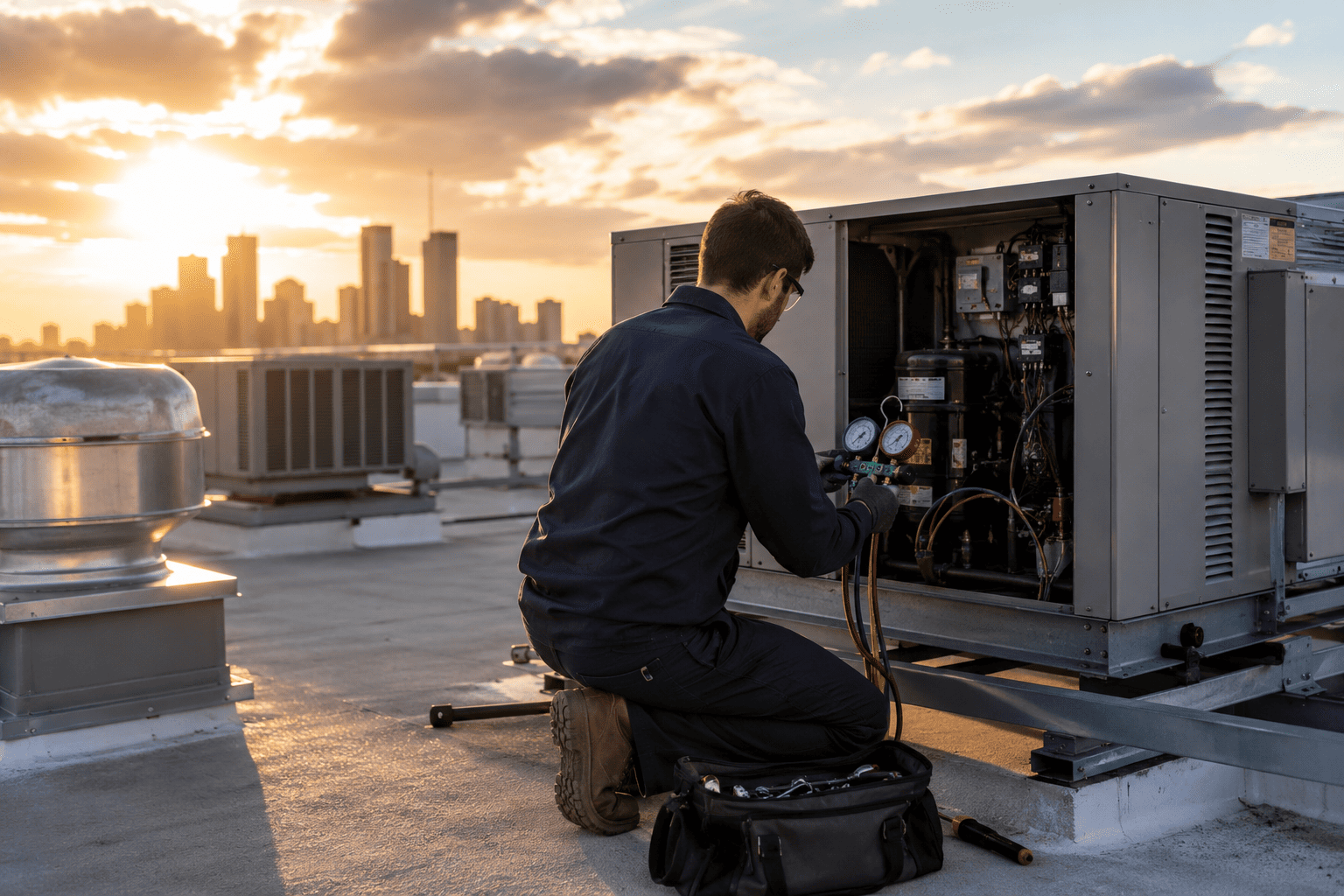
Commercial HVAC and refrigeration problems rarely become expensive overnight. In many cases, equipment shows early warning signs—temperature changes, abnormal pressures, unusual sounds, deteriorating electrical connections, restricted airflow, excessive runtime, or declining refrigeration performance—before a major failure occurs. Professional Commercial HVAC & Industrial Refrigeration Services in Houston TX can help businesses identify these developing problems through detailed inspections and diagnostics. ACF Mechanical works with Houston businesses to evaluate commercial cooling equipment, identify conditions that may affect reliability, and determine when maintenance or repair should be considered before a minor issue becomes a larger operational problem.
Why Regular Equipment Inspections Matter for Houston Businesses
Commercial cooling equipment often operates for long periods, especially during Houston’s extended cooling season.
Texas heat, high humidity, changing building loads, restaurant operations, warehouse activity, and demanding refrigeration requirements can place substantial stress on HVAC and refrigeration equipment.
A system may continue operating while performance gradually declines.
For example:
- A rooftop unit may still cool but require increasingly long cycles.
- An air handler may operate with reduced airflow.
- A chiller may begin showing abnormal operating conditions.
- A walk-in cooler may experience small temperature fluctuations.
- A freezer may accumulate more frost than normal.
- Electrical components may show signs of overheating or wear.
- Refrigeration pressures may begin moving outside expected operating conditions.
These conditions may not immediately stop operations.
However, identifying them during a commercial HVAC inspection Houston TX businesses schedule can provide an opportunity to investigate the cause before equipment reaches the point of failure.
Inspection, Maintenance, and Repair Are Not the Same
Inspection, maintenance, and repair are related, but they serve different purposes.
An inspection evaluates the condition and performance of equipment.
Maintenance includes planned tasks intended to keep equipment operating correctly.
Repair addresses a known malfunction or failed component.
A professional commercial HVAC system inspection Houston may identify conditions that should be corrected through maintenance or repair.
For example, an inspection may reveal:
- Dirty heat-transfer surfaces
- Loose electrical connections
- Worn components
- Drainage problems
- Abnormal temperatures
- Unusual pressure readings
- Airflow restrictions
- Control problems
- Refrigeration concerns
Finding an issue does not automatically mean a major repair is required.
The purpose of an inspection is to understand equipment condition and determine the appropriate next step.
What a Commercial HVAC Inspection May Include
The exact inspection process depends on the equipment, facility, system design, operating conditions, and reason for the service call.
A commercial cooling system inspection Houston may include evaluation of several system areas.
Electrical Components
Commercial HVAC equipment depends on contactors, relays, wiring, motors, capacitors, disconnects, and other electrical components.
Technicians may look for:
- Loose electrical connections
- Damaged wiring
- Signs of overheating
- Worn contactors
- Motor concerns
- Electrical components showing deterioration
Electrical problems can create intermittent operation before causing complete equipment failure.
Airflow
Airflow affects both comfort and equipment performance.
An inspection may include checking:
- Filters
- Blower operation
- Belts
- Coils
- Supply and return conditions
- Dampers
- Airflow restrictions
Poor airflow can make equipment appear to have insufficient cooling capacity even when the refrigeration circuit itself is functioning.
Controls and Sensors
Thermostats, sensors, safety controls, and building automation components influence when and how HVAC equipment operates.
Control-related issues may cause:
- Incorrect temperatures
- Short cycling
- Excessive runtime
- Improper scheduling
- Equipment communication problems
Controls should therefore be considered during commercial HVAC diagnostics Houston rather than focusing only on mechanical components.
Drainage and Moisture
Cooling systems remove moisture from indoor air.
Drain pans, condensate lines, and related components should be checked for conditions that may lead to drainage problems or unwanted water around equipment.
This is particularly relevant in Houston’s humid climate.
Rooftop Unit Inspection in Houston, TX
Rooftop units are common on offices, restaurants, retail spaces, warehouses, and other commercial buildings in Houston.
Because these units are installed outdoors, they are exposed to:
- Texas heat
- Direct sunlight
- Rain
- Dust
- Debris
- Changing weather conditions
A rooftop unit inspection Houston TX may include evaluating:
- Filters
- Coils
- Blower assemblies
- Belts
- Motors
- Electrical connections
- Contactors
- Controls
- Condensate drainage
- Refrigeration operation
- Overall equipment condition
Technicians can also look for signs that the unit is operating differently from expected.
An RTU that runs significantly longer than similar equipment, produces unusual noises, or struggles to maintain the required temperature may need additional troubleshooting.
Commercial Chiller Inspections
Chillers are often central to larger commercial cooling systems.
A problem with a chiller can affect significant portions of a facility, making early detection particularly valuable.
A commercial chiller inspection Houston may consider:
- Operating temperatures
- Pressure conditions
- Electrical components
- Pumps and water flow where applicable
- Controls
- Alarms
- Heat-transfer performance
- Signs of leakage
- Overall operating behavior
Because chiller configurations vary considerably, inspection procedures should match the specific equipment and application.
Trend information can also be valuable.
A gradual change in temperatures, pressures, or runtime may reveal deterioration before the system experiences a major failure.
Air Handler Inspection
Air handlers move conditioned air through commercial buildings and play an important role in indoor temperature, humidity, and airflow.
An air handler inspection Houston TX may evaluate:
- Filters
- Blower wheels
- Motors
- Belts
- Bearings
- Coils
- Drain pans
- Dampers
- Controls
- Cabinet condition
Air handler problems can create symptoms throughout a building.
Facility managers may notice:
- Weak airflow
- Uneven temperatures
- Excessive humidity
- Unusual sounds
- Reduced comfort
These symptoms should be investigated rather than addressed only by repeatedly changing thermostat settings.
Commercial HVAC Performance Testing
Visual inspection provides useful information, but equipment performance may also need to be evaluated through operating measurements.
Commercial HVAC performance testing Houston can help determine how equipment behaves while running.
Depending on the system, technicians may evaluate:
- Temperature differences
- Electrical readings
- Airflow-related conditions
- Refrigeration pressures
- Equipment cycling
- Control operation
- Operating temperatures
Measurements provide objective information that can help distinguish between normal operation and developing problems.
This is particularly important when a system still operates but no longer performs as expected.
Industrial Refrigeration Inspections Require a Different Approach
Industrial and commercial refrigeration systems have different responsibilities from comfort cooling equipment.
A refrigeration problem can affect:
- Food
- Ingredients
- Inventory
- Production processes
- Cold storage
- Restaurant operations
An industrial refrigeration inspection Houston should therefore focus on both equipment operation and temperature reliability.
Depending on the system, an inspection may involve:
- Compressors
- Condensers
- Evaporators
- Fans
- Refrigeration piping
- Controls
- Sensors
- Defrost systems
- Electrical components
- Temperature conditions
- Pressure conditions
Professional industrial refrigeration diagnostics Houston can help determine whether abnormal performance is related to controls, airflow, refrigeration components, electrical systems, or another cause.
Walk-In Cooler Inspections
A walk-in cooler may continue operating while gradually becoming less reliable.
Early symptoms may include:
- Longer compressor runtime
- Temperature fluctuations
- Unusual frost
- Condensation
- Fan problems
- Unusual sounds
- Controller alarms
A walk-in cooler inspection Houston may evaluate the evaporator, condenser, fans, controls, sensors, defrost components, electrical systems, and refrigeration operation.
Door condition may also matter.
Damaged gaskets or doors that do not close correctly can allow warm, humid air into the cooler, increasing the refrigeration load.
For Houston restaurants and food-service facilities, these small problems can become significant if ignored.
Walk-In Freezer Inspections
Freezers present additional challenges because frost and defrost operation can directly affect performance.
A walk-in freezer inspection Houston TX may include checking:
- Temperature
- Frost patterns
- Evaporator condition
- Fan operation
- Defrost operation
- Door seals
- Controls
- Sensors
- Refrigeration performance
Excessive ice should not simply be removed without investigating why it developed.
Possible causes may include:
- Defrost problems
- Air infiltration
- Sensor problems
- Fan issues
- Drainage concerns
- Refrigeration problems
Finding the cause helps prevent the same condition from repeatedly returning.
Restaurant Refrigeration Inspection
Restaurants rely on multiple refrigeration systems operating simultaneously.
Equipment failure can disrupt food storage, preparation, and normal business operations.
A restaurant refrigeration inspection Houston can help identify issues affecting:
- Walk-in coolers
- Walk-in freezers
- Reach-in refrigeration
- Ice-making equipment
- Prep refrigeration
- Other commercial cooling equipment
Restaurant owners and managers should pay attention to changes such as temperature instability, excessive compressor runtime, unusual frost, water around equipment, alarms, or unusual sounds.
Waiting until equipment completely stops cooling can turn a manageable service issue into an urgent operational problem.
Cold Storage Refrigeration Inspections
Cold-storage facilities can have more complex refrigeration requirements than individual walk-in systems.
A cold storage refrigeration inspection Houston may need to consider:
- Multiple evaporators
- Temperature zones
- Compressor systems
- Condensers
- Controls
- Defrost systems
- Alarm systems
- Door activity
- Product load
Temperature history can provide useful diagnostic information.
For example, repeated temperature increases during particular operating periods may indicate a pattern associated with loading activity, defrost operation, airflow, controls, or equipment capacity.
Warehouse HVAC Inspection
Warehouses present unique HVAC challenges.
Large spaces, high ceilings, loading doors, varying occupancy, internal equipment, and changing product loads can all influence cooling demand.
A warehouse HVAC inspection Houston TX may evaluate:
- Rooftop units
- Air handlers
- Controls
- Thermostats
- Air distribution
- Filters
- Fans
- Electrical components
- Cooling performance
Facility managers should also consider whether the building’s use has changed.
A system originally designed for one warehouse operation may perform differently after occupancy, equipment, layout, or operational requirements change.
Early Warning Signs an Inspection Should Not Be Delayed
Commercial HVAC and refrigeration equipment often provides warning signs before a complete breakdown.
Houston businesses should consider professional evaluation when they notice:
- Equipment running longer than normal
- Frequent cycling
- Unusual noises
- Weak airflow
- Uneven building temperatures
- Increasing indoor humidity
- Unexpected thermostat behavior
- Water around HVAC equipment
- Refrigeration temperature fluctuations
- Excessive frost or ice
- Controller alarms
- Electrical odors
- Repeated equipment resets
- Unexplained increases in energy consumption
These symptoms do not identify the cause by themselves.
They indicate that additional inspection or troubleshooting may be appropriate.
How Inspections Can Help Prevent Expensive Repairs
The purpose of an inspection is not to guarantee that equipment will never fail.
Mechanical systems contain components that wear and can sometimes fail unexpectedly.
However, inspections can help identify observable conditions before they become more serious.
| Inspection Finding | Possible Result if Ignored |
|---|---|
| Loose electrical connection | Overheating or component failure |
| Restricted airflow | Reduced cooling and equipment stress |
| Dirty heat-transfer surface | Longer runtime and reduced performance |
| Drainage problem | Water damage or equipment shutdown |
| Worn belt | Airflow loss |
| Abnormal refrigeration condition | Cooling failure |
| Faulty temperature sensor | Incorrect equipment operation |
| Defrost problem | Ice buildup and temperature instability |
| Damaged door gasket | Increased refrigeration load |
This is how inspections can help prevent HVAC failures Houston businesses want to avoid.
The same principle applies when businesses want to prevent refrigeration breakdowns Houston TX facilities cannot afford during normal operations.
Equipment Assessments Can Help With Repair-or-Replace Decisions
Inspections are also valuable when equipment is aging.
A commercial HVAC equipment assessment Houston can help business owners understand the condition of existing equipment before deciding whether continued repair or replacement makes more sense.
Important factors include:
- Equipment age
- Current condition
- Repair history
- Availability of parts
- Current performance
- Reliability
- Facility requirements
- Future business needs
A refrigeration equipment assessment Houston can provide similar information for walk-ins, cold storage, restaurant refrigeration, and industrial systems.
Replacement decisions should not be based on age alone.
Equipment condition and business requirements should also be considered.
Inspection and Preventive Maintenance Work Best Together
Inspections are most useful when they are part of a broader equipment-management strategy.
Regular commercial HVAC maintenance Houston TX can combine condition checks with appropriate maintenance tasks.
Similarly, industrial refrigeration maintenance Houston can help businesses identify and address developing issues while maintaining critical cooling equipment.
A preventive approach may include:
- Equipment inspections
- Cleaning
- Filter service
- Electrical checks
- Control evaluation
- Refrigeration checks
- Drainage inspection
- Performance measurements
- Documentation of developing concerns
Maintenance history can make future diagnostics more effective because technicians can compare current equipment behavior with previous conditions.
Inspections Cannot Eliminate Every Emergency
Even well-maintained equipment can experience unexpected failures.
A motor can fail, an electrical component can stop working, or another component may malfunction without extensive warning.
However, inspections can reduce uncertainty by identifying visible deterioration and abnormal operating conditions.
When emergency HVAC repair Houston TX businesses need becomes necessary, documented equipment history can also help technicians understand previous conditions.
The same applies to emergency refrigeration repair Houston facilities may require.
Preventive inspection and responsive repair should therefore be viewed as complementary parts of equipment management.
How Often Should Commercial Equipment Be Inspected?
There is no single inspection interval appropriate for every commercial facility.
Frequency depends on factors such as:
- Equipment type
- Equipment age
- Runtime
- Facility requirements
- Environmental conditions
- Manufacturer recommendations
- Maintenance history
- Importance of the equipment to operations
A small office rooftop unit and a restaurant walk-in freezer do not have identical operational risks.
Likewise, refrigeration supporting critical inventory may justify closer attention than non-critical comfort equipment.
ACF Mechanical can help businesses determine an appropriate maintenance and inspection approach based on their equipment and operating requirements.
Commercial HVAC and Refrigeration Inspection Checklist
Houston business owners and facility managers can use this general checklist when evaluating whether equipment needs professional attention.
HVAC
- Is the system maintaining temperature?
- Has runtime increased?
- Is airflow weaker than normal?
- Are some zones consistently warmer or colder?
- Are unusual noises present?
- Is humidity becoming difficult to control?
- Are there signs of water around equipment?
- Are thermostats or controls behaving unexpectedly?
Refrigeration
- Are temperatures stable?
- Has compressor runtime changed?
- Is frost accumulating unusually?
- Are evaporator fans operating correctly?
- Are doors and gaskets in good condition?
- Are alarms appearing?
- Are unusual sounds present?
- Is condensation appearing where it did not before?
Any significant change from normal operating behavior deserves attention.
Why Houston Businesses Choose ACF Mechanical
Commercial HVAC and industrial refrigeration inspections require more than a quick visual check.
Technicians need to understand how individual components work together and how equipment should perform under actual operating conditions.
Houston businesses choose ACF Mechanical for:
- Experienced technicians
- Commercial HVAC expertise
- Industrial refrigeration knowledge
- Preventive maintenance
- Professional diagnostics
- Fast response
- Reliable service
- Experience with rooftop units, chillers, air handlers, commercial AC systems, walk-in coolers, and freezers
ACF Mechanical works with business owners, facility managers, restaurants, warehouses, industrial companies, and commercial property owners throughout Houston, TX.
The objective is to identify actual equipment conditions, explain findings clearly, and recommend appropriate next steps based on the system’s needs.
Identify Problems Before They Become Expensive Repairs
Commercial HVAC and refrigeration equipment does not always stop working immediately when a problem develops.
Many systems continue operating while airflow declines, electrical components deteriorate, refrigeration performance changes, sensors become inaccurate, or mechanical components begin showing signs of wear.
A professional inspection can help identify these conditions before they develop into more disruptive failures.
For commercial buildings in Houston, this proactive approach is particularly important because HVAC and refrigeration systems often operate under demanding Texas heat and humidity conditions.
Professional Commercial HVAC & Industrial Refrigeration Services in Houston TX from ACF Mechanical can help evaluate equipment condition, investigate performance concerns, and determine whether maintenance or repair is needed.
If your rooftop units, chillers, air handlers, commercial AC systems, walk-in coolers, freezers, or industrial refrigeration equipment are showing changes in performance, contact ACF Mechanical to schedule a professional system inspection.