
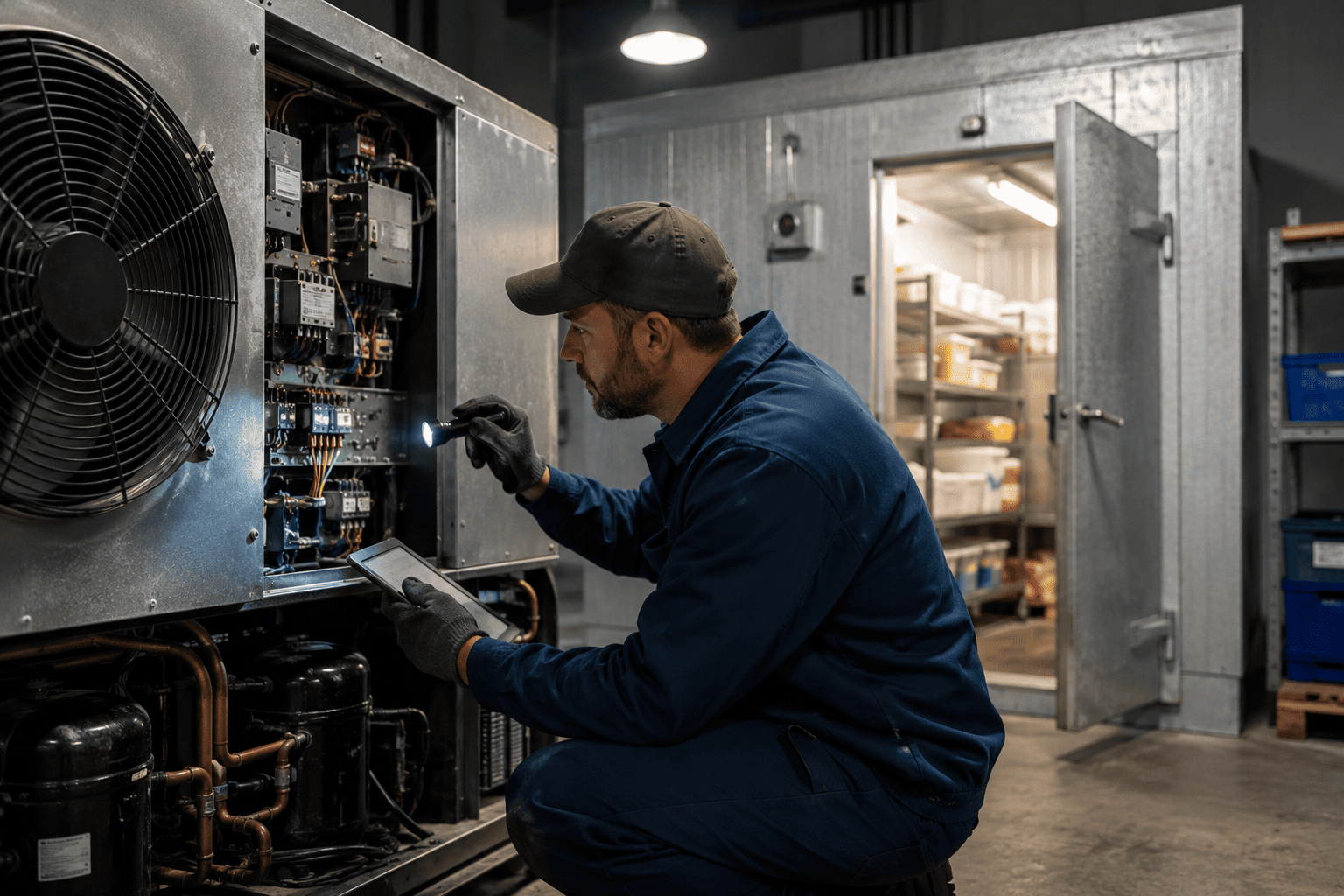
Commercial HVAC and refrigeration equipment cannot perform correctly if the controls telling it when and how to operate are inaccurate, poorly configured, or failing. A rooftop unit may be mechanically sound but run at the wrong times because of scheduling problems. A walk-in cooler may have sufficient refrigeration capacity but experience temperature fluctuations because of a faulty sensor or controller. For Houston businesses, professional Commercial HVAC & Industrial Refrigeration Services in Houston TX should include attention to the controls, sensors, thermostats, and monitoring systems that coordinate critical cooling equipment. ACF Mechanical helps commercial and industrial facilities identify control-related problems and maintain dependable HVAC and refrigeration performance.
Why HVAC and Refrigeration Controls Matter
Controls act as the decision-making layer of commercial cooling equipment.
They use information from thermostats, temperature sensors, pressure switches, humidity sensors, timers, and other devices to determine when equipment should operate.
Depending on the system, controls may manage:
- Equipment startup and shutdown
- Space temperature
- Refrigeration temperature
- Compressor operation
- Fan operation
- Heating and cooling stages
- Defrost cycles
- Humidity
- Ventilation
- Building zones
- Equipment schedules
- Alarms and safety functions
Problems with commercial HVAC controls Houston TX businesses depend on can therefore create symptoms that appear to be mechanical failures.
Before replacing major equipment, technicians should determine whether the system is receiving accurate information and responding correctly to control commands.
How Commercial HVAC Control Systems Work
A commercial HVAC control system Houston TX may range from relatively simple thermostatic controls to sophisticated building automation.
A basic commercial system might use thermostats and equipment-specific controllers.
Larger commercial buildings may use centralized systems that coordinate rooftop units, chillers, air handlers, pumps, ventilation equipment, and multiple zones.
The control process generally involves three steps:
- A sensor measures a condition.
- The controller compares the measurement with the desired setpoint.
- Equipment responds according to the control logic.
If any part of this process is inaccurate, system performance can suffer.
For example, a sensor that incorrectly reports room temperature may cause cooling equipment to operate longer than necessary or shut down too early.
Thermostat Problems Can Affect Commercial HVAC Performance
Thermostats may seem like simple devices, but they play a critical role in commercial HVAC operation.
Problems with commercial HVAC thermostat controls Houston businesses use may include:
- Incorrect temperature readings
- Poor thermostat placement
- Improper scheduling
- Incorrect setpoints
- Wiring problems
- Communication failures
- Configuration errors
Thermostat placement is especially important.
A thermostat located near a heat-producing appliance, exterior door, direct sunlight, or another unusual heat source may not accurately represent conditions throughout the occupied space.
That can cause the HVAC system to respond to a localized condition instead of the actual building load.
Temperature Sensors Need Accurate Readings
Modern commercial HVAC and refrigeration systems often depend on multiple sensors.
These can monitor:
- Supply-air temperature
- Return-air temperature
- Outdoor temperature
- Refrigerated space temperature
- Coil temperature
- Discharge temperature
- Humidity
- Pressure
Commercial HVAC sensor problems Houston TX facilities experience can produce confusing symptoms.
A faulty sensor might cause equipment to:
- Run continuously
- Stop prematurely
- Cycle unnecessarily
- Trigger alarms
- Maintain the wrong temperature
- Activate the wrong operating stage
Because the mechanical equipment may still be functional, sensor problems require accurate troubleshooting rather than assumptions.
Commercial HVAC Temperature Control in Houston
Temperature control becomes particularly important in Houston because cooling demand can change substantially throughout the day.
A commercial building may experience different loads based on:
- Outdoor temperature
- Solar exposure
- Occupancy
- Business hours
- Equipment operation
- Door activity
- Ventilation requirements
Professional commercial HVAC temperature control Houston should account for these changing conditions.
A system configured for an empty building should not necessarily operate the same way during peak occupancy.
Proper controls can help equipment respond more appropriately as loads change.
HVAC Zoning for Commercial Buildings
Large commercial properties rarely experience identical conditions throughout every space.
A conference room full of people may require more cooling than an unoccupied storage area.
West-facing offices may receive greater afternoon solar heat than interior rooms.
This is where HVAC zoning commercial buildings Houston can provide better control.
Zoning may use:
- Multiple thermostats
- Zone sensors
- Dampers
- Variable-air-volume equipment
- Separate rooftop units
- Building automation
Proper zoning can help reduce hot and cold spots while preventing unnecessary cooling of areas that do not require the same load.
However, poorly configured zoning can create airflow and pressure problems.
Controls and air distribution therefore need to work together.
Building Automation Can Coordinate Multiple HVAC Systems
Larger facilities may benefit from building automation HVAC Houston TX solutions that coordinate multiple pieces of equipment.
A building automation system may provide centralized control of:
- Rooftop units
- Air handlers
- Chillers
- Pumps
- Exhaust fans
- Ventilation
- Temperature zones
- Operating schedules
An HVAC building management system Houston facilities use can also provide operators with information about equipment status and alarms.
This can make it easier for facility managers to identify unusual operating conditions.
For example, a building automation system may reveal that a rooftop unit is operating outside normal business hours or that one zone consistently fails to reach its setpoint.
These patterns can help guide troubleshooting.
Scheduling Can Reduce Unnecessary Equipment Operation
One of the simplest control problems is incorrect scheduling.
Commercial HVAC equipment may continue operating after employees and customers leave the building.
This can happen because:
- Schedules were never configured correctly
- Business hours changed
- Temporary overrides were never removed
- Controllers lost programming
- Different systems use conflicting schedules
Professional HVAC control system optimization Houston should include a review of operating schedules.
The objective is not simply to reduce runtime. Equipment still needs to support appropriate temperature, humidity, ventilation, and facility requirements.
Instead, schedules should reflect how the building is actually used.
Humidity Controls Are Important in Houston
Houston’s climate makes humidity management a major part of commercial HVAC operation.
Temperature alone does not describe indoor comfort.
A building may reach its temperature setpoint while still experiencing excessive humidity.
Commercial HVAC humidity controls Houston may use humidity sensors and control strategies to coordinate cooling and dehumidification.
Potential control-related humidity problems include:
- Incorrect humidity readings
- Improper setpoints
- Short HVAC cycles
- Incorrect ventilation control
- Sensor placement problems
- Poor coordination between system components
Humidity problems should therefore be evaluated as part of the complete HVAC system rather than addressed by thermostat temperature alone.
Industrial Refrigeration Controls Have a Different Responsibility
Industrial refrigeration controls are responsible for maintaining conditions that may directly affect inventory, food safety, processes, or production.
Professional industrial refrigeration controls Houston may manage:
- Refrigerated space temperature
- Compressor operation
- Condenser operation
- Evaporator fans
- Defrost
- Pressure controls
- Safety functions
- Alarms
For commercial and industrial facilities, a control failure can sometimes create problems even when major refrigeration components remain operational.
Accurate controls are therefore essential to system reliability.
Refrigeration Temperature Sensors Can Create Hidden Problems
A refrigeration temperature sensor Houston facility relies on must accurately represent the actual refrigerated space or equipment condition.
If a sensor reads incorrectly, the controller may receive false information.
For example, a sensor that reads warmer than the actual temperature could cause excessive refrigeration runtime.
A sensor that reads colder than reality could cause the system to stop cooling before the space reaches the required temperature.
Possible signs of sensor problems include:
- Temperature displayed incorrectly
- Difference between controller reading and independent measurement
- Unexplained compressor operation
- Unexpected alarms
- Product temperature concerns
- Irregular cycling
Technicians can compare sensor readings with verified measurements and inspect associated wiring and control logic.
Walk-In Cooler Temperature Controls
Restaurants, food-service businesses, grocery operations, and commercial kitchens depend on stable walk-in temperatures.
Walk-in cooler temperature controls Houston TX may coordinate:
- Compressor operation
- Evaporator fans
- Temperature setpoints
- Defrost functions
- Alarms
A temperature problem should not automatically be blamed on the compressor.
Potential causes can include:
- Faulty sensors
- Controller problems
- Incorrect settings
- Wiring issues
- Defrost problems
- Mechanical refrigeration issues
A complete diagnosis helps identify whether the problem originates in the control system or refrigeration equipment.
Walk-In Freezer Controls and Defrost
Freezer control systems have an additional challenge: frost management.
Evaporators operating below freezing can accumulate frost.
Defrost systems are designed to remove that frost at controlled intervals.
Walk-in freezer temperature controls Houston may work alongside:
- Defrost timers
- Electronic controllers
- Coil sensors
- Termination controls
- Fan-delay controls
Incorrect defrost operation can lead to excessive frost, reduced airflow, temperature problems, or unnecessary heat entering the freezer.
The issue may involve control settings, sensors, heaters, wiring, or another component.
Professional troubleshooting should identify the actual cause rather than repeatedly removing ice without correcting the underlying problem.
Restaurant Refrigeration Controls
Restaurants typically operate multiple pieces of refrigeration equipment simultaneously.
These may include:
- Walk-in coolers
- Walk-in freezers
- Reach-in refrigerators
- Prep equipment
- Ice machines
- Other refrigerated storage
Reliable restaurant refrigeration controls Houston TX help maintain stable operation across these systems.
Restaurant managers should pay attention to:
- Temperature alarms
- Unexpected temperature changes
- Frequent cycling
- Frost accumulation
- Controller error codes
- Differences between displayed and measured temperature
Early investigation can help prevent control problems from developing into larger operational disruptions.
Cold Storage Temperature Control
Temperature consistency can be especially important in cold-storage environments.
Cold storage temperature control Houston may require multiple sensors, alarms, refrigeration stages, and monitoring systems.
Facilities may need to account for:
- Product requirements
- Door activity
- Loading operations
- Different temperature zones
- Defrost cycles
- Refrigeration capacity
- Alarm thresholds
A single temperature reading may not provide enough information for a large refrigerated space.
Multiple monitoring points can provide a clearer picture of conditions throughout the facility.
System Monitoring Helps Identify Developing Problems
Controls do more than start and stop equipment.
Modern systems can also provide valuable operational information.
Commercial HVAC system monitoring Houston may track:
- Temperatures
- Equipment status
- Runtime
- Alarms
- Setpoints
- Zone conditions
Industrial refrigeration system monitoring Houston may track:
- Refrigerated space temperatures
- Compressor status
- Alarm conditions
- Defrost activity
- Critical operating conditions
Monitoring can help facility managers recognize changes before they become major failures.
For example, gradually increasing runtime may indicate that equipment performance is deteriorating even if temperatures remain acceptable.
Controls Can Support Better Energy Management
HVAC and refrigeration equipment can represent a significant portion of a commercial facility’s energy consumption.
Commercial HVAC energy management Houston TX can involve using controls to better match operation with actual building demand.
Potential strategies include:
- Appropriate operating schedules
- Temperature setbacks where suitable
- Coordinated zoning
- Staged equipment operation
- Improved sensor accuracy
- Eliminating unnecessary overrides
Similarly, refrigeration energy management Houston can involve optimizing control sequences while maintaining required product temperatures.
The goal should always be reliable system operation first, with efficiency improvements achieved without compromising facility requirements.
Warning Signs of HVAC or Refrigeration Control Problems
Houston business owners and facility managers should consider professional evaluation when they notice:
- Temperature readings that do not match actual conditions
- Equipment operating outside scheduled hours
- Frequent HVAC cycling
- Inconsistent temperatures between zones
- Repeated thermostat adjustments
- Unexpected controller alarms
- Walk-in temperatures fluctuating
- Excessive refrigeration runtime
- Defrost problems
- Humidity remaining high despite cooling
- Building automation communication errors
- Controls repeatedly requiring manual overrides
These symptoms can also have mechanical causes.
Proper troubleshooting should evaluate both equipment and controls.
Control Repair vs. Mechanical Repair
Correct diagnosis is particularly important because control problems can resemble mechanical problems.
For example:
| Symptom | Possible Control Cause | Possible Mechanical Cause |
|---|---|---|
| HVAC runs continuously | Faulty thermostat or sensor | Cooling capacity or equipment issue |
| Room too warm | Incorrect setpoint or control | Airflow or refrigeration problem |
| Walk-in temperature high | Sensor or controller problem | Compressor or refrigeration issue |
| Frequent cycling | Control configuration | Mechanical or sizing problem |
| High humidity | Control or sensor issue | Airflow or equipment problem |
| Freezer icing | Defrost control issue | Airflow or refrigeration issue |
Professional commercial HVAC control repair Houston TX should therefore begin with system diagnosis.
The same principle applies to refrigeration control repair Houston.
Replacing expensive mechanical components without identifying a faulty control can leave the original problem unresolved.
Controls Should Be Included in Preventive Maintenance
Controls, sensors, and thermostats should be inspected as part of regular commercial HVAC maintenance Houston TX and industrial refrigeration maintenance Houston.
Maintenance may include:
- Checking thermostat operation
- Comparing sensor readings
- Reviewing setpoints
- Inspecting control wiring
- Reviewing schedules
- Checking alarms
- Evaluating controller operation
- Testing safety controls
- Reviewing system performance
For facilities using building automation, maintenance may also include reviewing system trends and identifying unusual operating patterns.
This helps businesses address control problems before they affect comfort, refrigeration temperatures, or equipment reliability.
When Controls Should Be Upgraded
Older control systems may still operate but no longer provide the functionality a commercial facility requires.
A control upgrade may be worth evaluating when:
- Existing controllers are unreliable
- Replacement parts are difficult to obtain
- Building use has changed
- Equipment has been replaced
- Scheduling capabilities are limited
- Facility managers need better monitoring
- Multiple systems need better coordination
An upgrade does not necessarily require replacing all HVAC or refrigeration equipment.
In some cases, improving how existing equipment is controlled can provide better visibility and operation.
Compatibility should always be evaluated before modifications are made.
Why Houston Businesses Choose ACF Mechanical
Control systems require an understanding of both the electrical and control side of equipment and the mechanical systems they manage.
ACF Mechanical provides commercial HVAC and industrial refrigeration support for businesses throughout Houston, TX.
Houston businesses choose ACF Mechanical for:
- Experienced technicians
- Commercial HVAC expertise
- Industrial refrigeration knowledge
- Control-system troubleshooting
- Preventive maintenance
- HVAC and refrigeration repair
- Fast response
- Reliable commercial service
- Experience with rooftop units, chillers, air handlers, walk-in coolers, and freezers
Rather than assuming every performance problem requires major equipment replacement, technicians can evaluate the complete system to identify whether controls, sensors, settings, airflow, refrigeration components, or mechanical equipment are contributing to the issue.
Improve Control of Your Houston HVAC and Refrigeration Systems
Reliable commercial cooling depends on more than compressors, fans, coils, and motors.
The controls that coordinate these components determine when equipment operates and how it responds to changing conditions.
For Houston businesses, properly functioning controls can support better temperature management, humidity control, refrigeration reliability, equipment monitoring, and overall system performance.
Problems with thermostats, sensors, schedules, zoning, defrost controls, or automation can create symptoms that resemble major equipment failures. Accurate troubleshooting can help businesses identify the actual cause before unnecessary repairs or replacements are made.
Professional Commercial HVAC & Industrial Refrigeration Services in Houston TX from ACF Mechanical can help business owners, facility managers, restaurants, warehouses, industrial companies, and commercial property owners evaluate HVAC and refrigeration controls alongside the equipment they manage.
Contact ACF Mechanical to schedule commercial HVAC or industrial refrigeration service and have control-related performance problems professionally evaluated.