Businesses in Houston depend on reliable heating, cooling, ventilation, and refrigeration equipment to keep daily operations moving. When a rooftop unit stops cooling, a walk-in freezer cannot maintain temperature, or an industrial refrigeration system develops a problem, the result can be much more serious than an uncomfortable building. Equipment failures can disrupt operations, affect inventory, reduce employee productivity, and create unexpected repair expenses.
For companies searching for Commercial HVAC & Industrial Refrigeration Services in Houston TX, preventive maintenance is one of the most effective ways to protect critical mechanical equipment before small problems develop into major failures.
Houston’s long cooling season, high temperatures, humidity, and demanding operating conditions place significant stress on commercial HVAC and refrigeration systems. Equipment serving restaurants, warehouses, offices, retail properties, cold storage facilities, and industrial buildings may operate for extended periods under heavy loads.
A structured maintenance program helps identify developing problems, maintain system performance, and reduce the likelihood of unexpected downtime.
ACF Mechanical provides commercial HVAC and refrigeration solutions for Houston businesses that need dependable equipment performance, professional maintenance, repairs, and support for their mechanical systems.
What Is Preventive Commercial HVAC Maintenance?
Preventive HVAC maintenance is scheduled inspection and service performed before equipment experiences a major failure.
Instead of waiting for an air conditioner, rooftop unit, chiller, or air handler to stop operating, technicians evaluate the system periodically and look for conditions that could affect reliability or efficiency.
A typical commercial HVAC maintenance program in Houston, TX may involve checking:
- Filters and airflow
- Evaporator and condenser coils
- Electrical connections and components
- Motors and bearings
- Belts and pulleys
- Refrigerant conditions
- Drainage systems
- Thermostats and controls
- Temperature performance
- System pressures
- Unusual vibration or noise
- Signs of component wear
Maintenance requirements vary depending on equipment type, operating environment, system age, application, and operating hours.
For commercial buildings in Houston, maintenance frequency should reflect how heavily the equipment is used. A rooftop unit serving an office building may have different requirements from equipment supporting a restaurant kitchen, warehouse, manufacturing operation, or temperature-sensitive facility.
Why Houston’s Climate Makes Preventive Maintenance Important
Commercial HVAC equipment in Houston operates under demanding conditions.
During extended periods of Texas heat, cooling systems may run for many hours each day. High outdoor temperatures increase the load on condensers, compressors, motors, and other components.
Humidity creates additional challenges.
Commercial AC systems must manage both temperature and moisture. Poor airflow, dirty coils, drainage problems, or improper system performance can make humidity control more difficult and may cause equipment to work harder than necessary.
Outdoor equipment also accumulates dirt and debris over time. When heat-transfer surfaces become contaminated, the system may lose efficiency and experience greater operating stress.
These conditions make HVAC maintenance for Houston businesses an important part of facility management rather than an optional service performed only when problems appear.
The Cost of Waiting Until Equipment Fails
Reactive maintenance means addressing equipment only after something goes wrong.
Although this approach may appear to reduce maintenance expenses initially, it can expose a business to much larger operational risks.
An unexpected HVAC or refrigeration failure may lead to:
- Unplanned business interruptions
- Emergency service requirements
- Employee or customer discomfort
- Temperature-sensitive inventory problems
- Reduced refrigeration performance
- Increased stress on remaining equipment
- More extensive component damage
- Higher operating costs
- Lost productivity
- Unexpected capital expenses
For restaurants, grocery operations, cold storage facilities, and other businesses that rely on refrigeration, equipment performance can be directly connected to inventory protection.
For offices and commercial properties, HVAC failures can affect occupants throughout the building.
For warehouses and industrial facilities, cooling problems can interfere with processes, working conditions, equipment rooms, or products that require controlled temperatures.
Preventive maintenance changes the strategy from responding to failures to managing equipment condition.
Preventive Maintenance vs. Emergency Repair
Both preventive service and emergency repair have important roles, but they address different situations.
| Preventive Maintenance | Emergency Repair |
|---|---|
| Scheduled in advance | Required after a failure or urgent problem |
| Identifies developing issues | Addresses an existing malfunction |
| Helps reduce unexpected downtime | Restores operation after disruption |
| Supports system efficiency | Focuses on immediate system recovery |
| Allows maintenance planning | Often requires urgent decisions |
| Helps track equipment condition | May reveal damage after failure occurs |
| Supports equipment longevity | May involve major component replacement |
Even well-maintained equipment can occasionally fail. The objective of preventive maintenance is not to promise that a system will never experience a problem. It is to reduce avoidable failures, identify warning signs earlier, and give facility managers more information about equipment condition.
When an unexpected failure does occur, access to emergency commercial HVAC repair in Houston, TX becomes essential.
Commercial HVAC Equipment That Requires Regular Maintenance
Different commercial HVAC systems have different maintenance needs. Understanding the equipment installed at a property allows maintenance to be tailored to actual operating conditions.
Rooftop Units
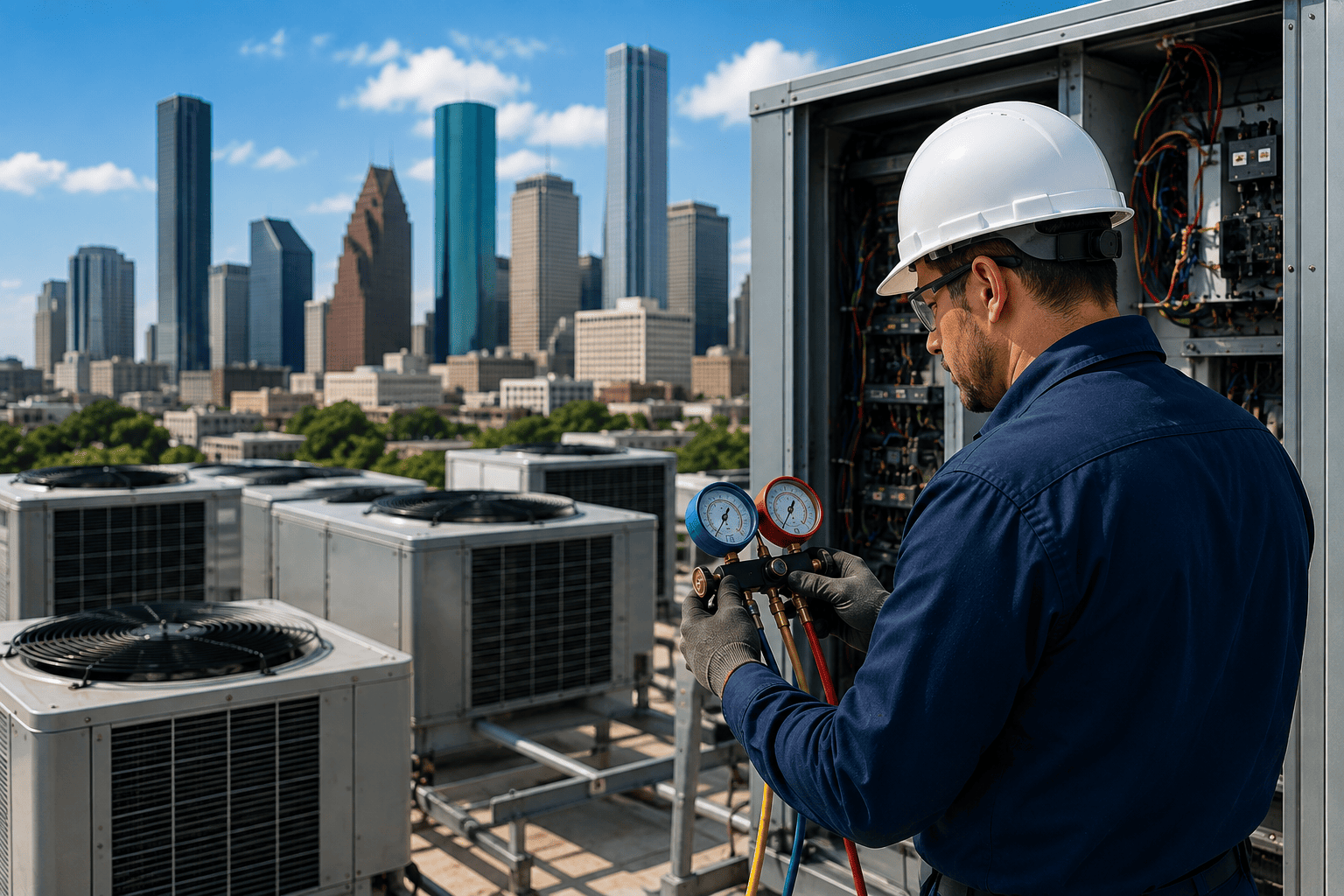
Rooftop units are common throughout commercial properties because they combine major heating and cooling components into packaged systems.
RTUs operate outdoors and are exposed to heat, rain, dirt, airborne debris, and changing weather conditions.
Preventive service may include evaluating:
- Coil condition
- Filters
- Belts
- Motors
- Electrical components
- Refrigerant performance
- Drainage
- Controls
- Airflow
A small airflow or electrical issue can place additional stress on other components if it is not identified early.
Chillers
Chillers can support cooling in larger commercial and industrial facilities.
Because these systems may serve significant portions of a building or process, changes in performance should be investigated before they lead to larger operational problems.
Maintenance should consider operating pressures, temperatures, controls, heat-transfer performance, pumps, electrical components, and other system-specific conditions.
Air Handlers
Air handlers are responsible for moving and conditioning air throughout commercial buildings.
Dirty filters, coil contamination, belt wear, motor problems, or airflow restrictions can reduce system performance.
Regular inspection helps maintain appropriate airflow and allows technicians to identify mechanical wear before it causes a larger interruption.
Commercial AC Systems
Commercial split systems and packaged air-conditioning equipment can experience many of the same problems as larger HVAC equipment, including dirty coils, restricted airflow, electrical deterioration, drainage issues, and refrigerant-related problems.
Commercial AC maintenance in Houston, TX helps businesses address these conditions before peak cooling demand exposes system weaknesses.
Why Industrial Refrigeration Maintenance Is Critical
Refrigeration systems often support operations where temperature control is essential.
Restaurants, food-service operations, warehouses, cold storage facilities, and industrial companies may depend on refrigeration equipment continuously.
That makes industrial refrigeration maintenance in Houston especially important.
Unlike comfort cooling, a refrigeration problem may directly affect products, ingredients, storage conditions, or business processes.
A preventive refrigeration program may include inspection of:
- Compressors
- Condensers
- Evaporators
- Refrigeration controls
- Electrical components
- Fans and motors
- Refrigerant conditions
- Temperature controls
- Defrost systems
- Door seals and hardware
- Drainage
- System pressures and temperatures
Technicians can also look for performance changes that may indicate developing mechanical or control problems.
Walk-In Cooler and Freezer Maintenance
Walk-in coolers and freezers are critical equipment for many Houston restaurants, food-service businesses, grocery operations, and storage facilities.
A unit that appears to be running normally may still have developing problems.
Warning signs can include:
- Temperature fluctuations
- Longer compressor run times
- Ice accumulation
- Unusual noises
- Water around the equipment
- Damaged door gaskets
- Condenser contamination
- Poor airflow
- Frequent cycling
- Difficulty recovering temperature after door openings
Regular walk-in cooler maintenance in Houston, TX helps detect these issues before the equipment experiences a complete failure.
Walk-in freezer maintenance is equally important because low-temperature equipment operates under demanding conditions and may experience problems involving defrost cycles, evaporator icing, controls, compressors, and door seals.
Refrigeration Maintenance for Restaurants
Restaurants depend on multiple mechanical systems at the same time.
Kitchen environments generate heat and moisture, while dining spaces require dependable comfort cooling. Walk-in coolers, freezers, prep refrigeration, and other equipment must maintain proper temperatures while doors may be opened frequently throughout the day.
That makes coordinated restaurant HVAC and refrigeration service in Houston valuable for restaurant operators.
A maintenance strategy can address both sides of the operation:
HVAC Equipment
- Rooftop units
- Commercial AC systems
- Air handlers
- Ventilation-related HVAC components
- Controls
Refrigeration Equipment
- Walk-in coolers
- Walk-in freezers
- Condensing units
- Evaporators
- Refrigeration controls
- Cold storage equipment
Working with a contractor experienced in both commercial HVAC and refrigeration simplifies maintenance planning and gives business owners one resource for multiple critical mechanical systems.
Cold Storage and Warehouse Refrigeration Maintenance
Cold storage operations face a different level of risk because refrigeration is often fundamental to the facility’s purpose.
Unexpected system problems can affect large quantities of temperature-sensitive inventory.
Cold storage refrigeration maintenance in Houston should therefore focus on both equipment condition and operational reliability.
Technicians may evaluate system performance trends, compressors, condensers, evaporators, controls, electrical components, airflow, refrigerant conditions, and other equipment critical to maintaining required temperatures.
The same principle applies to HVAC service for warehouses in Houston.
Large warehouse spaces may use rooftop units, make-up air equipment, split systems, air handlers, or specialized cooling equipment. Maintenance planning should account for building size, occupancy, heat loads, operating schedules, and equipment application.
Warning Signs Your Commercial HVAC System Needs Service
Facility managers should not wait for complete system failure before requesting service.
Common warning signs include:
- Cooling takes longer than usual
- Some areas of the building are warmer than others
- Utility consumption increases without an obvious explanation
- Equipment cycles unusually often
- Airflow becomes weak
- New noises or vibration appear
- Water or condensation appears near equipment
- Thermostats or controls behave inconsistently
- Equipment struggles during the hottest part of the day
- Breakers trip or electrical problems recur
These symptoms can have multiple causes, so professional diagnosis is important.
Timely commercial HVAC repair in Houston can address the immediate problem while a maintenance program can help reduce recurrence.
Warning Signs Refrigeration Equipment Needs Attention
Refrigeration systems also provide early indications that performance is changing.
Watch for:
- Rising or inconsistent temperatures
- Excessive frost or ice
- Compressor short cycling
- Equipment running continuously
- Unusual sounds
- Condenser fans not operating correctly
- Evaporator icing
- Damaged door seals
- Longer temperature recovery times
- Unexpected alarms
- Higher energy consumption
If these conditions appear, scheduling commercial refrigeration service in Houston, TX promptly can help prevent a minor problem from becoming an operational emergency.
How Preventive Maintenance Supports Energy Efficiency
HVAC and refrigeration equipment can represent a significant portion of a commercial property’s energy demand.
Maintenance cannot make inefficient equipment inherently efficient, but it can help equipment operate closer to its intended condition.
For example, dirty coils can interfere with heat transfer. Restricted filters can reduce airflow. Worn belts can affect fan performance. Improper controls can cause unnecessary operating cycles.
Addressing these conditions helps reduce avoidable system stress.
Businesses considering energy-efficient commercial HVAC systems in Houston should also remember that efficiency depends on more than the equipment selected during installation.
Correct sizing, installation, commissioning, controls, airflow, and ongoing maintenance all influence real-world performance.
How Preventive Maintenance Can Extend Equipment Life
Commercial HVAC and refrigeration systems are major business investments.
Premature equipment replacement can create significant capital costs, especially for facilities with multiple rooftop units, refrigeration systems, or industrial cooling equipment.
Preventive maintenance can support equipment longevity by reducing unnecessary operating stress and addressing wear before it contributes to larger component failures.
For example:
- Dirty coils can increase operating pressure and workload.
- Restricted airflow can affect system performance.
- Worn belts can eventually fail and stop airflow.
- Loose electrical connections can cause overheating.
- Drainage problems can create water-related issues.
- Damaged refrigeration components can affect temperature control.
Regular inspections give businesses an opportunity to correct these conditions earlier.
A Practical Preventive Maintenance Checklist for Houston Businesses
A commercial maintenance plan should be customized to the facility and equipment, but facility managers can use the following checklist as a starting point.
HVAC Maintenance Checklist
- Inspect and replace filters as required
- Inspect evaporator and condenser coils
- Check airflow
- Inspect belts and pulleys
- Evaluate motors and bearings
- Inspect electrical connections
- Check controls and thermostats
- Inspect condensate drainage
- Evaluate refrigerant conditions
- Check system temperatures and pressures
- Listen for unusual noises
- Look for excessive vibration
- Review overall system operation
Refrigeration Maintenance Checklist
- Verify operating temperatures
- Inspect evaporator and condenser condition
- Check fans and motors
- Inspect electrical components
- Evaluate refrigeration controls
- Check defrost operation
- Inspect walk-in doors and gaskets
- Look for ice accumulation
- Check drainage
- Review compressor operation
- Evaluate refrigerant system performance
- Inspect for unusual noises or vibration
Maintenance frequency should be determined by equipment type, manufacturer requirements, operating environment, system age, usage, and facility needs.
How Often Should Commercial HVAC and Refrigeration Equipment Be Serviced?
There is no single maintenance schedule appropriate for every commercial facility.
Equipment operating continuously or under heavy loads may require more frequent attention than systems used under lighter conditions.
Factors that influence maintenance frequency include:
- Equipment type
- Equipment age
- Operating hours
- Houston weather conditions
- Indoor and outdoor environment
- Occupancy
- Building use
- Refrigeration temperature requirements
- Manufacturer recommendations
- Previous service history
Restaurants, cold storage facilities, industrial operations, and other businesses with mission-critical refrigeration may require more frequent inspection than standard office properties.
A professional contractor can evaluate the equipment and develop a schedule based on actual operational requirements.
Repair, Maintain, or Replace?
Preventive maintenance also helps businesses make better capital planning decisions.
When technicians regularly inspect equipment, facility managers gain more information about system condition and recurring problems.
Replacement may deserve consideration when:
- Major components repeatedly fail
- Repair frequency continues increasing
- Equipment can no longer meet building loads
- Critical parts become difficult to obtain
- Energy performance has deteriorated substantially
- The system no longer supports operational requirements
- Repair costs are becoming difficult to justify
Replacement should not automatically be recommended simply because equipment is older.
A reliable commercial HVAC contractor should consider equipment condition, repair history, performance, operating requirements, and the economics of repair versus replacement.
Building a Preventive Maintenance Strategy
An effective maintenance program should be organized around business risk rather than treating every piece of equipment identically.
Start by identifying critical assets.
For example, a restaurant’s walk-in freezer may present greater operational risk than a small HVAC unit serving a storage room. A warehouse’s primary cooling equipment may be more critical than a secondary system.
Businesses can classify equipment according to:
- Operational importance
- Consequences of failure
- Equipment age
- Repair history
- Replacement lead time
- Operating hours
- Seasonal demand
From there, maintenance can be prioritized around the equipment most likely to affect business continuity.
This approach is especially useful for facilities with multiple rooftop units, commercial refrigeration systems, walk-in coolers, freezers, and industrial cooling equipment.
Why Houston Businesses Choose ACF Mechanical
Commercial HVAC and refrigeration systems require contractors who understand how mechanical equipment affects business operations.
ACF Mechanical supports Houston businesses with commercial HVAC, refrigeration, repair, installation, and preventive maintenance solutions designed around equipment reliability and facility needs.
Businesses can turn to ACF Mechanical for:
- Experienced technicians
- Commercial HVAC expertise
- Refrigeration knowledge
- Preventive maintenance
- Fast response
- Reliable service
From rooftop units and commercial AC systems to walk-in coolers, freezers, and industrial refrigeration equipment, ACF Mechanical provides professional support for a wide range of commercial mechanical systems.
For business owners, facility managers, restaurant operators, warehouse managers, industrial companies, and commercial property owners, working with one provider for HVAC and refrigeration can simplify mechanical system management.
Protect Your Business Before the Next Equipment Failure
Preventive maintenance is not simply another facility expense. It is a strategy for managing operational risk.
Houston businesses depend heavily on cooling and refrigeration equipment, particularly during periods of extreme Texas heat. Waiting until a rooftop unit, commercial AC system, walk-in cooler, freezer, or refrigeration system stops operating can turn a manageable maintenance issue into an urgent business problem.
Professional preventive HVAC maintenance for commercial buildings in Houston can help identify developing issues, support equipment efficiency, and reduce the risk of avoidable downtime.
The same principle applies to preventive refrigeration maintenance for restaurants, warehouses, cold storage operations, and industrial facilities.
If your business needs Commercial HVAC & Industrial Refrigeration Services in Houston TX, ACF Mechanical can evaluate your equipment, identify maintenance priorities, address existing problems, and help develop a service approach based on your facility’s operational needs.
Contact ACF Mechanical to request commercial HVAC or refrigeration service and start building a more proactive maintenance strategy.